
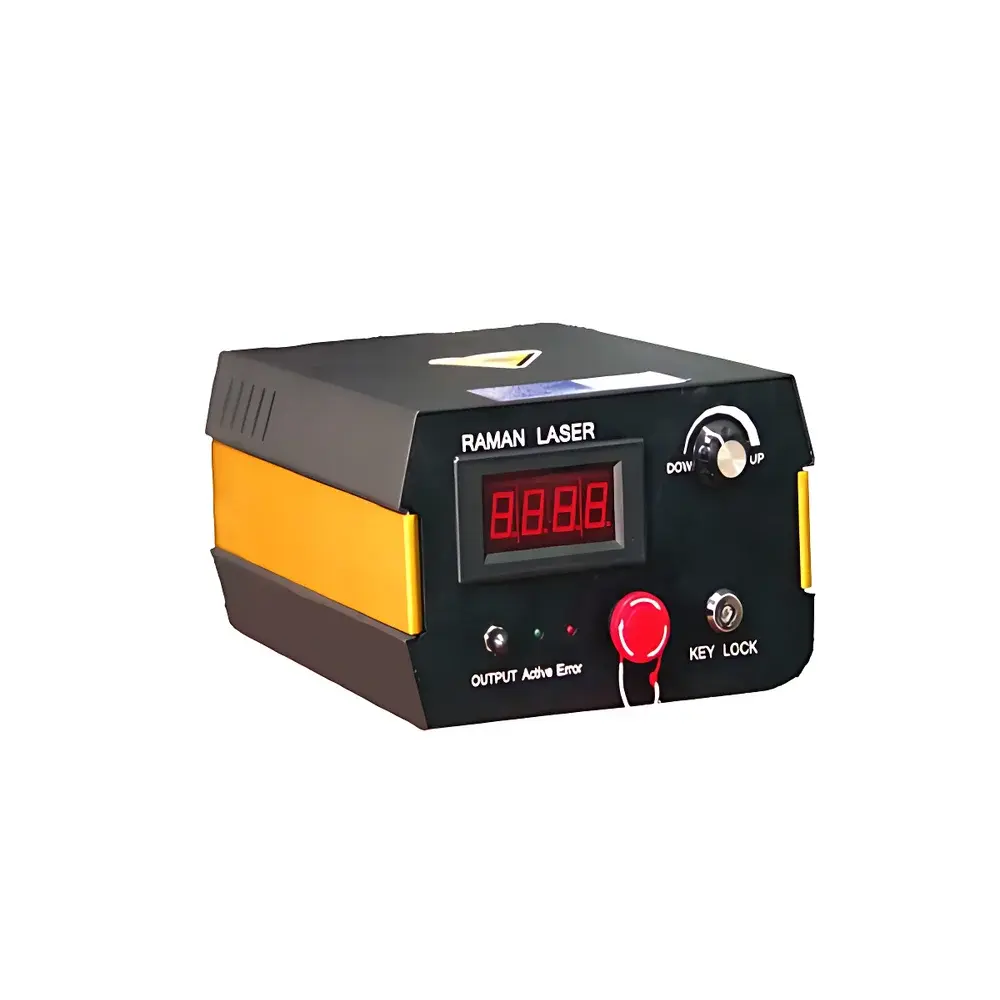
SPL SPL-Laser-785nm 785 nm Semiconductor Laser System for Raman Spectroscopy
| Brand | SPL |
|---|---|
| Model | SPL-Laser-785nm, 500 mW |
| Wavelength | 785 nm |
| Output Power | 500 mW (CW) |
| Spectral Linewidth | < 0.2 nm |
| Operating Temperature Control | Integrated TEC |
| Power Stability | < ±1% over 8 h |
| Output Configuration | Free-space and fiber-coupled options available |
| Compliance | RoHS-compliant, CE-marked |
| Cooling | Active thermoelectric cooling (TEC) with PID feedback |
| Modulation | Analog/TTL modulation input optional |
| Beam Quality | TEM₀₀, M² < 1.1 |
| Polarization Extinction Ratio | > 100:1 |
| Warm-up Time | < 15 min to operational stability |
Overview
The SPL SPL-Laser-785nm is a purpose-engineered 785 nm semiconductor laser system optimized for demanding Raman spectroscopy applications. It operates on the principle of stimulated emission in an AlGaAs-based diode gain medium, delivering high-brightness, narrow-linewidth continuous-wave (CW) output at 785 nm — a wavelength strategically selected to minimize fluorescence interference while maintaining strong Raman scattering cross-sections in organic and biological samples. Unlike broadband or multimode sources, this system employs monolithic cavity design with integrated wavelength-stabilizing elements to achieve spectral purity below 0.2 nm full width at half maximum (FWHM), enabling high-resolution vibrational mode discrimination. Its 500 mW nominal output power exceeds typical industry requirements for benchtop and portable Raman spectrometers, supporting signal-to-noise ratio (SNR) enhancement without inducing thermal degradation in sensitive samples. The system integrates a precision thermoelectric cooler (TEC) with digital PID temperature control and automatic power control (APC) circuitry, ensuring long-term output stability (< ±1% over 8 hours) under variable ambient conditions — a critical requirement for quantitative and time-resolved Raman measurements.
Key Features
- Stable 785 nm CW output at up to 500 mW, calibrated and guaranteed at point of shipment
- Narrow spectral linewidth (< 0.2 nm FWHM) achieved via internal grating stabilization and temperature-locking
- Integrated dual-loop control: TEC-based temperature regulation + APC-driven current feedback for power consistency
- TEM₀₀ spatial mode with M² 100:1 for optimal coupling into spectrograph slit or optical fiber
- Two standard output configurations: collimated free-space beam (with adjustable focus) and SMA905-compatible fiber-coupled version (FC/PC or FC/APC connector options)
- Low-noise analog and TTL modulation inputs (0–5 V, 0–1 kHz bandwidth) for synchronization with gated detectors or lock-in amplifiers
- Ruggedized OEM-ready housing with standardized 19 mm × 45 mm × 85 mm footprint and conductive-anodized aluminum chassis for EMI shielding and thermal dissipation
Sample Compatibility & Compliance
The SPL-Laser-785nm is compatible with standard Raman sampling interfaces including reflective microscope objectives (e.g., 20×, 50×, 100×), quartz cuvettes, fiber-optic probes (e.g., 200 µm core diameter), and solid-sample stages. Its low temporal coherence and suppressed side modes reduce speckle noise in imaging Raman modalities. From a regulatory standpoint, the system complies with IEC 60825-1:2014 (Class 3B laser safety), RoHS Directive 2011/65/EU, and CE marking requirements for electromagnetic compatibility (EMC) per EN 61326-1. While not certified for clinical diagnostics, its performance characteristics align with ISO/IEC 17025-accredited laboratory practices when used within validated Raman measurement protocols. The embedded firmware supports audit-trail-capable logging (via RS232/USB interface) for GLP/GMP-aligned environments requiring traceability of laser operating parameters.
Software & Data Management
The laser system communicates via ASCII-based serial protocol over USB virtual COM port or RS232 interface. A platform-independent configuration utility (Windows/macOS/Linux) enables real-time monitoring of diode current, TEC voltage, case temperature, and output power (via internal photodiode calibration). All settings — including setpoint temperatures, APC target power, modulation thresholds, and warm-up delay timers — are stored in non-volatile memory. For integration into automated workflows, SDKs are provided in C/C++, Python (PySerial), and LabVIEW (NI-VISA compatible), supporting remote triggering, parameter sweeps, and synchronized acquisition with spectrometers from Ocean Insight, Hamamatsu, or Princeton Instruments. Data logs include timestamped metadata (UTC), firmware revision, and hardware ID — essential for instrument qualification (IQ/OQ/PQ) documentation.
Applications
- Portable and benchtop Raman spectrometers for pharmaceutical raw material identification (per USP and EP 2.2.48)
- In-line process monitoring in chemical synthesis and polymer manufacturing
- Non-destructive analysis of cultural heritage artifacts and forensic trace evidence
- Fiber Bragg grating (FBG) interrogation and distributed Raman sensing in oil & gas pipeline integrity systems
- Biomedical tissue characterization (e.g., cancer margin detection, lipid/protein ratio mapping)
- Calibration source for wavelength accuracy verification in dispersive spectrometers
FAQ
What is the recommended warm-up time before achieving spectral and power stability?
Typical stabilization time is ≤15 minutes under ambient conditions (20–25 °C); full thermal equilibrium and sub-0.1% power drift are achieved within 30 minutes.
Can the laser be operated in pulsed mode?
It supports external TTL or analog modulation up to 1 kHz; however, it is not designed for nanosecond pulsing or Q-switching — use only within specified modulation bandwidth limits.
Is fiber coupling included by default?
No — free-space output is standard; fiber coupling (with SMA905 connector and 200 µm core fiber) is an optional configuration selected at time of order.
Does the system support compliance with FDA 21 CFR Part 11 for electronic records?
While the laser itself does not implement Part 11 controls, its data logging interface provides immutable timestamps and user-accessible parameter history — enabling integration into Part 11-compliant LIMS or ELN platforms via third-party middleware.
What maintenance is required during routine operation?
No scheduled maintenance is required; periodic verification of output power (using NIST-traceable power meter) and beam alignment is recommended every 6 months for GLP-conforming labs.



