
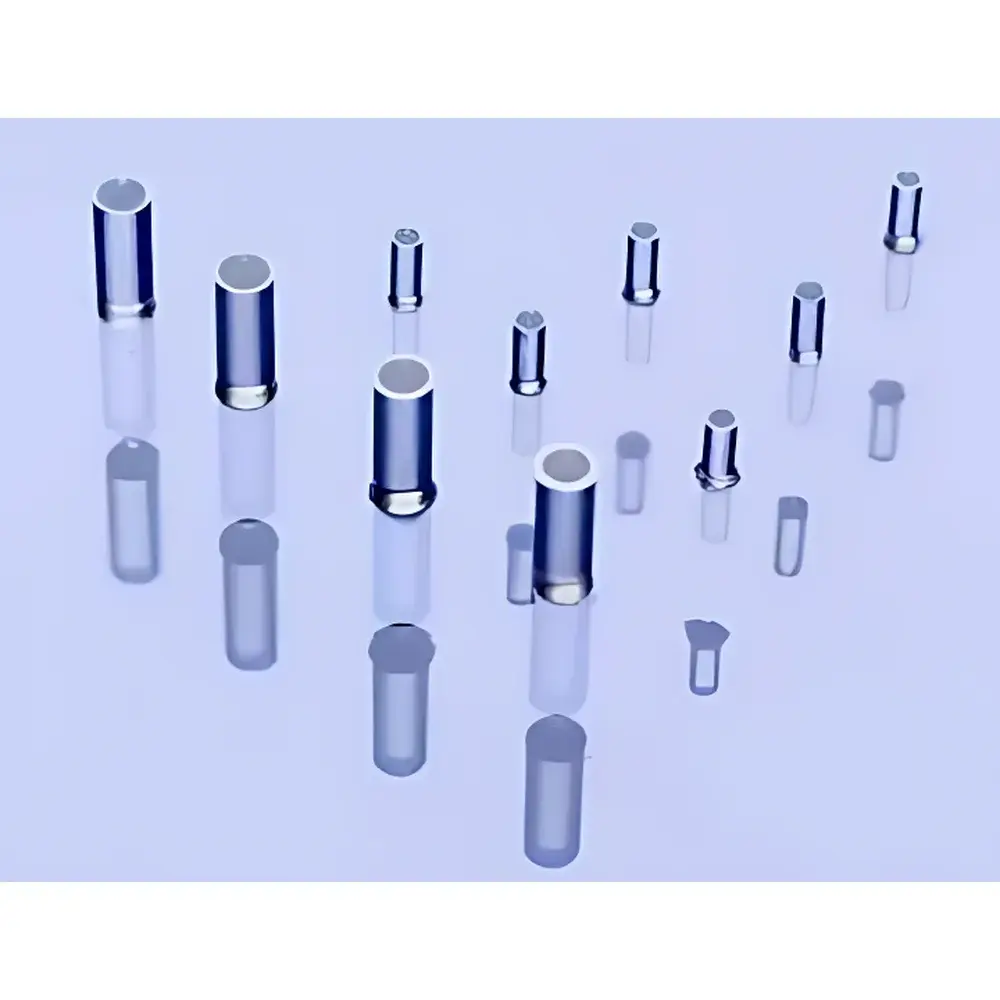
GRINTECH GRIN Lens for Endoscopic Objectives – Gradient-Index Cylindrical Objective Lens
| Brand | GRINTECH |
|---|---|
| Origin | Canada |
| Type | Imported Optical Component |
| Model | GRIN Cylindrical Objective Lens |
| Design Wavelength | 570 nm |
| Numerical Aperture (NA) | 0.5 |
| Material | Biocompatible Silver-Based Glass |
| Surface | Planar, Low Chromatic Aberration |
| Coating Options | NC (Uncoated), C1 (Dual-Side Visible-Antireflection, R < 0.5% @ 0–30° incidence, specified wavelength range) |
| Compliance | EN ISO 10993-1 (Biological Safety — Toxicology Evaluation) |
| Integration | Compatible with GRIN relay lenses via optical-contact bonding |
| Customization | Available for non-standard working distance, lens length, and design wavelength |
Overview
The GRINTECH GRIN Lens for Endoscopic Objectives is a high-precision gradient-index (GRIN) cylindrical objective lens engineered specifically for minimally invasive optical imaging systems. Unlike conventional refractive optics, this lens leverages radially varying refractive index distribution within a homogeneous glass medium to achieve focusing without curved surfaces—enabling ultra-compact, alignment-insensitive, and aberration-controlled imaging in constrained geometries typical of endoscopic and catheter-based platforms. Its planar input/output interfaces eliminate air-glass surface reflections at normal incidence and support direct optical bonding with relay GRIN lenses or prism assemblies, forming monolithic, robust imaging trains suitable for sterile, single-use, or reusable medical devices. Designed for operation at 570 nm—a key wavelength in fluorescence-guided endoscopy and narrow-band imaging—the lens delivers a numerical aperture of 0.5, balancing resolution, depth of field, and light throughput in biologically relevant spectral windows.
Key Features
- Biocompatible silver-based glass substrate certified per EN ISO 10993-1 for cytotoxicity, sensitization, and intracutaneous reactivity—validated for short- and long-term tissue contact.
- Planar entrance and exit surfaces minimize wavefront distortion and simplify integration into sealed, fluid-immersed, or hermetically packaged endoscope distal tips.
- Low chromatic aberration architecture optimized for monochromatic or quasi-monochromatic illumination sources including laser diodes and filtered LED systems.
- Customizable working distance, total lens length, and design wavelength (standard: 570 nm); available with integrated aperture stops for controlled field definition and stray-light suppression.
- Antireflection coating options: NC (uncoated, ~12% Fresnel reflection per surface) or C1 (dual-side visible-band AR coating, average reflectance < 0.5% across 450–700 nm at 0–30° angle of incidence).
- Direct optical-contact bonding capability with GRINTECH relay lenses (e.g., GRIN-Relay-1.0mm series) enables modular, scalable endoscope optical path design without alignment-sensitive air gaps.
Sample Compatibility & Compliance
This GRIN objective is qualified for use in Class IIa/IIb medical imaging devices under EU MDR 2017/745 when integrated into validated system-level designs. Its material composition and surface finish comply with ISO 10993-1 biological evaluation requirements for non-implantable, mucosal-contacting components. The lens is compatible with standard sterilization methods including ethylene oxide (EtO) gas and low-temperature hydrogen peroxide plasma—no degradation of GRIN profile or coating integrity observed after accelerated aging (500 h at 60°C, 95% RH). It supports integration with 8° angled front-face prisms and non-polarizing cube beamsplitters for oblique-view or dual-channel (e.g., reflectance + fluorescence) endoscopic configurations.
Software & Data Management
As a passive optical component, the GRIN objective does not incorporate embedded firmware or digital interfaces. However, its performance parameters—including measured MTF, point-spread function (PSF), and axial chromatic shift—are traceably documented in GRINTECH’s optical test reports (ISO 10110-5 compliant), provided with each shipment. These datasets are structured in standardized ASCII format for import into Zemax OpticStudio, CODE V, or FRED optical design environments. For regulatory submissions (e.g., FDA 510(k), CE technical file), GRINTECH supplies full material declarations (RoHS, REACH), coating spectral reflectance curves (250–1100 nm), and batch-specific interferometric surface flatness maps (λ/20 PV over Ø1.0 mm clear aperture).
Applications
- High-resolution distal-tip imaging in flexible and rigid endoscopes, including urological, gastrointestinal, and neuroendoscopic systems.
- Miniaturized OCT probe optics where dispersion control and polarization preservation are critical.
- Laser scanning confocal micro-endoscopy requiring diffraction-limited spot formation at sub-millimeter working distances.
- Fluorescence lifetime imaging (FLIM) and time-resolved spectroscopy probes operating at 570 nm excitation/emission bands.
- Embedded vision modules for surgical robotics and intraoperative guidance platforms subject to stringent size, weight, and EMI constraints.
FAQ
Can this GRIN lens be used with broadband illumination sources beyond 570 nm?
Yes—while optimized for peak performance at 570 nm, the lens maintains usable transmission and acceptable wavefront error across 480–650 nm. Chromatic focal shift is characterized and supplied in test reports for multi-wavelength system modeling.
Is optical bonding to relay lenses supported with standard adhesives?
GRINTECH recommends UV-curable optical adhesives with refractive index matched to the GRIN glass (n ≈ 1.62 at 570 nm) and low outgassing (e.g., Norland NOA81, MasterBond EP30-2). Full bonding protocols—including surface cleaning, cure intensity, and post-bond stress relief—are detailed in Application Note GRIN-AN-012.
What is the maximum tolerable temperature during sterilization cycles?
The lens retains structural and optical integrity up to 121°C for ≤20 min (autoclave-compatible housing required). Prolonged exposure above 140°C may induce irreversible GRIN profile diffusion.
Are custom coatings available for NIR or UV spectral bands?
Yes—custom MgF₂-based or multilayer dielectric coatings can be applied for 350–400 nm (UV) or 780–950 nm (NIR), with reflectance < 0.8% over ±15° angular acceptance. Lead time increases by 6–8 weeks.
Does GRINTECH provide ray-traced system models for integration validation?
Upon request and NDA execution, GRINTECH supplies non-proprietary sequential raytrace files (.zmx or .seq) for common relay + objective combinations, including thermal expansion coefficients and mechanical tolerance stacks per ISO 2768-mK.



