
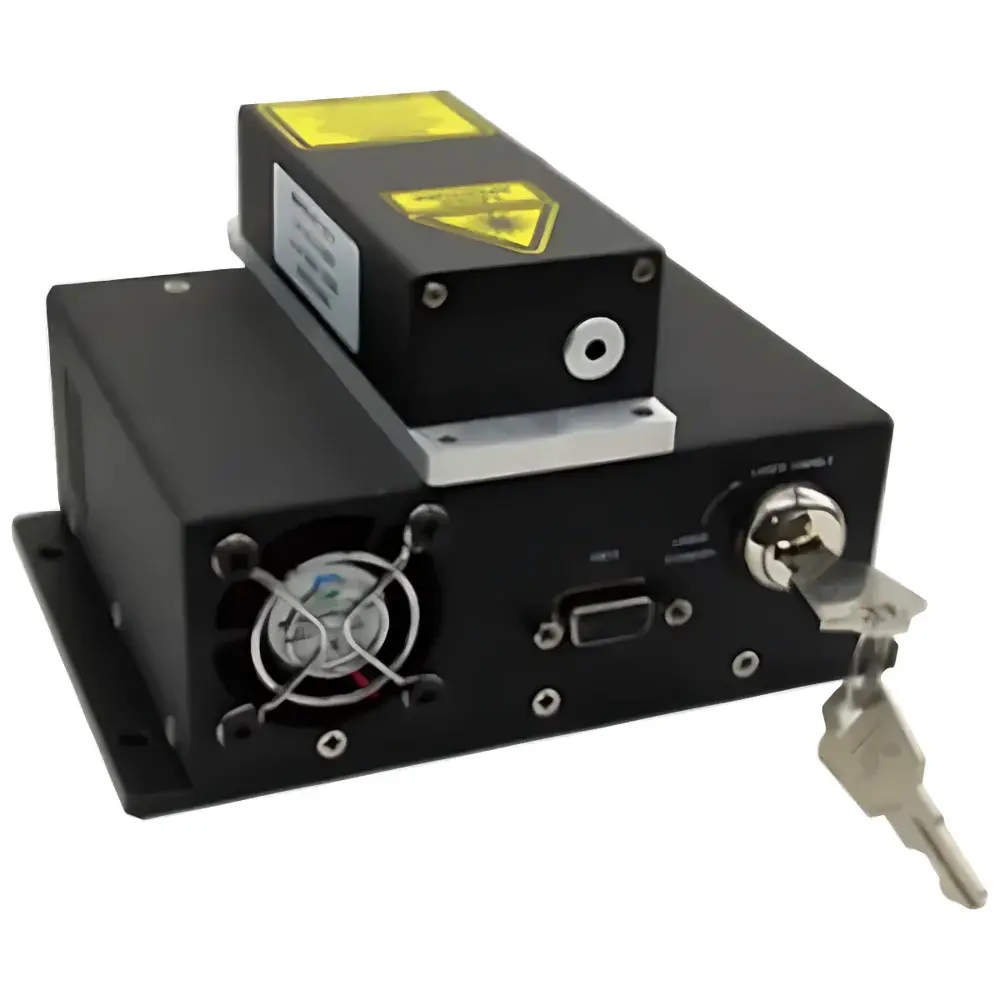
RealLight MCH Series 300-ps Single-Longitudinal-Mode Microchip Laser
| Brand | RealLight |
|---|---|
| Origin | Beijing, China |
| Model | MCH Series |
| Wavelength Options | 1064 nm / 532 nm (customizable to 355 nm / 266 nm) |
| Pulse Width | 300 ps (typ.) |
| Repetition Rate | up to 100 kHz |
| Output Energy | up to 3 µJ @ 1064 nm |
| Average Power | up to 100 mW |
| Beam Mode | TEM₀₀ |
| Polarization Ratio | >100:1 |
| Power Stability (8 h) | ±3% |
| Divergence (full angle, 1/e²) | ≤30 mrad (horizontal/vertical) |
| Laser Head Dimensions | 45 × 33 × 120 mm |
| Power Supply Dimensions | 168 × 88 × 140 mm |
| Input Power | 100–240 VAC, 50/60 Hz |
| Control Interface | RS232, USB |
| Max System Power Consumption | ≤40 W |
| Operating Temperature | 15–35 °C |
| Storage Temperature | 0–60 °C |
| Triggering | Internal & External TTL-compatible |
Overview
The RealLight MCH Series is a family of passively Q-switched, diode-pumped solid-state (DPSS) microchip lasers engineered for high-repetition-rate, single-longitudinal-mode (SLM) operation with sub-nanosecond pulse duration. Based on monolithic Nd:YAG or Nd:YVO₄ gain media with semiconductor saturable absorber mirror (SESAM) technology, the MCH platform delivers exceptional temporal coherence, narrow spectral linewidth (<100 MHz), and diffraction-limited beam quality (M² 10 kW) while maintaining excellent pulse-to-pulse energy stability.
Key Features
- Sub-350-ps pulse width at fundamental wavelength (1064 nm), with optional harmonic generation to 532 nm, 355 nm, and 266 nm
- True single-longitudinal-mode output with longitudinal mode spacing (FSR) >10 GHz, ensuring high temporal coherence for interferometric and heterodyne applications
- Repetition rate programmable from single-shot to 100 kHz via internal oscillator or external TTL trigger (rising-edge synchronized)
- TEM₀₀ Gaussian beam profile with M² < 1.1 and polarization extinction ratio exceeding 100:1, enabling efficient coupling into single-mode fibers and nonlinear crystals
- Hermetically sealed, monolithic microchip resonator—no moving parts, no realignment required over lifetime
- Low-noise power supply with active temperature stabilization (±0.1 °C) for long-term amplitude stability (±3% over 8 hours)
- OEM-ready mechanical and electrical interfaces: RS232 and USB 2.0 for remote parameter control, status monitoring, and firmware updates
Sample Compatibility & Compliance
The MCH Series is designed for laboratory and industrial environments requiring reliable, maintenance-free pulsed laser operation under ISO/IEC 17025-aligned metrology conditions. While not certified as medical or aerospace-grade hardware, its construction adheres to IEC 60825-1:2014 Class 4 laser safety requirements (with integrated interlock circuitry and emission indicator LED). All units undergo factory calibration traceable to NIST-traceable photodiode standards for pulse energy and average power. The system complies with CE marking directives (EMC Directive 2014/30/EU and Low Voltage Directive 2014/35/EU) and RoHS 2011/65/EU restrictions on hazardous substances. For regulated industries—including analytical instrumentation used in pharmaceutical QC labs—the laser’s stable pulse parameters support method validation per USP and ICH Q2(R2) guidelines when integrated into validated optical measurement platforms.
Software & Data Management
RealLight provides the MCH Control Suite—a Windows-based application supporting full parameter configuration (repetition rate, trigger mode, warm-up delay), real-time power/energy logging, and automated stability reporting. Data export is available in CSV and HDF5 formats for compatibility with MATLAB, Python (NumPy/Pandas), and LabVIEW environments. The embedded firmware implements non-volatile memory storage for user-defined presets and maintains an audit trail of operational events (e.g., power-on cycles, temperature excursions, fault logs), satisfying basic GLP/GMP data integrity expectations. Remote operation via ASCII command protocol over RS232 or USB CDC allows seamless integration into custom DAQ architectures without proprietary drivers.
Applications
- Laser seeding: High-coherence, low-jitter pulses serve as master oscillators for amplifier chains (e.g., regenerative amplifiers, fiber MOPA systems) in ultrafast spectroscopy and attosecond science
- LIDAR & time-of-flight ranging: Sub-300-ps pulses enable centimeter-level spatial resolution in coherent detection LIDAR and short-range industrial distance sensors
- Nonlinear optics: Efficient second-harmonic (532 nm), third-harmonic (355 nm), and fourth-harmonic (266 nm) generation in BBO, LBO, or CLBO crystals for UV-Raman and deep-UV lithography alignment
- Time-resolved fluorescence & phosphorescence decay analysis: Precise timing synchronization supports TCSPC (time-correlated single-photon counting) with picosecond timing resolution
- Micromachining & surface texturing: High peak intensity enables cold ablation of polymers, thin-film removal, and selective material processing with minimal thermal damage zone
- Optical coherence tomography (OCT) light sources: SLM operation reduces speckle noise and improves axial resolution in swept-source OCT configurations
FAQ
What is the typical spectral linewidth of the MCH Series in SLM operation?
The free-running SLM linewidth is <100 MHz (FWHM), measured via scanning Fabry–Pérot interferometry. Linewidth may broaden slightly under high-repetition-rate operation due to thermal transient effects; active cavity temperature control mitigates this drift.
Can the MCH laser be synchronized to an external clock source with jitter below 100 ps?
Yes. The external trigger input accepts TTL-compatible signals with <50 ps RMS jitter contribution to pulse timing. For sub-20 ps jitter, optional low-jitter RF synchronization modules are available upon request.
Is harmonic generation included in the standard delivery, or is it an add-on option?
Harmonic modules (SHG, THG, FHG) are optional accessories. Standard units emit at 1064 nm or 532 nm only. Custom-configured lasers with integrated harmonic generation are offered under OEM agreements with full optical characterization reports.
Does the system support analog modulation of pulse energy or repetition rate?
No analog modulation is implemented in the base model. Pulse energy is stabilized via closed-loop pump diode current control; repetition rate is digitally set via internal PLL or external trigger edge. Analog modulation capability requires custom firmware and hardware revision (contact engineering support).
What is the expected lifetime of the SESAM and laser crystal under continuous operation?
Accelerated life testing indicates >20,000 hours MTBF for the monolithic gain chip and >15,000 hours for the SESAM under nominal operating conditions (25 °C ambient, 70% max duty cycle). Lifetime is strongly dependent on thermal management and drive current derating.




