
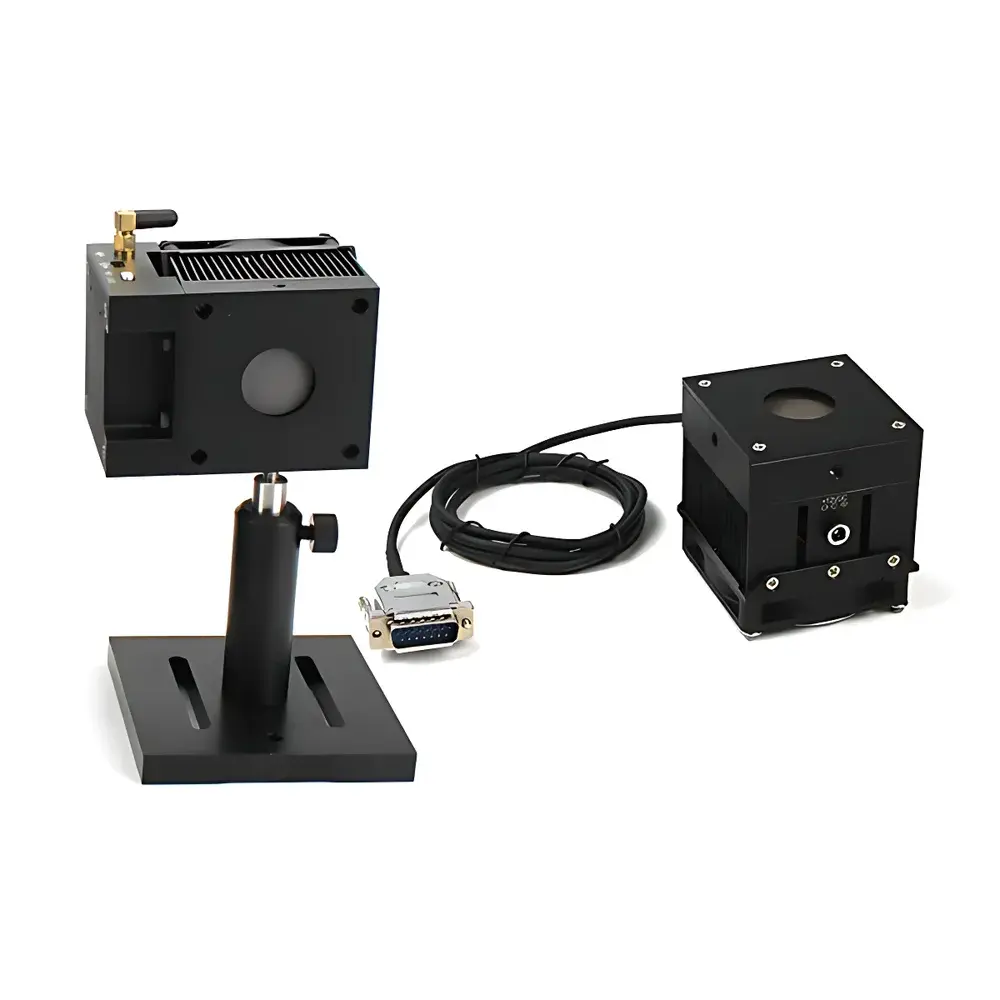
SPL SPL-8203 Series Thermopile Laser Power Sensors
| Brand | SPL |
|---|---|
| Model | SPL-8203-01 / SPL-8203-02 / SPL-8203-03 |
| Power Ranges | 0.01–2 W, 0.05–70 W, 0.2–250 W |
| Wavelength Range | 0.19–20 µm |
| Response Time | 3 s (SPL-8203-01/02), 8 s (SPL-8203-03) |
| Active Aperture | 10 mm (SPL-8203-01), 19 mm (SPL-8203-02), 25 mm (SPL-8203-03) |
| Cooling | Forced-air |
| Interface Options | DB15 (for SPL-8201 meter), Bluetooth/USB (direct PC/mobile) |
| Calibration Data Storage | Onboard EEPROM |
| Compliance | Traceable to NIST-equivalent standards per ISO/IEC 17025-accredited calibration lab |
Overview
The SPL SPL-8203 Series Thermopile Laser Power Sensors are precision-calibrated, broadband thermal detectors engineered for absolute optical power measurement across continuous-wave (CW) and quasi-CW laser sources. Based on the thermoelectric principle—where incident radiation is absorbed by a blackened thermopile junction and converted into a proportional voltage via the Seebeck effect—these sensors deliver high linearity, low drift, and wavelength-independent responsivity from the deep ultraviolet (190 nm) through the far-infrared (20 µm). Unlike photodiode-based instruments, thermopiles exhibit minimal spectral dependence and saturation resistance, making them ideal for high-power industrial and scientific lasers including Nd:YAG (1064 nm), CO₂ (10.6 µm), Ho:YAG (2.1 µm), high-brightness laser diodes, and excimer sources (193 nm, 248 nm). Each SPL-8203 variant is factory-calibrated against reference standards traceable to national metrology institutes; calibration coefficients—including wavelength-corrected sensitivity factors—are permanently stored in onboard EEPROM, ensuring measurement integrity without external recalibration or manual coefficient entry.
Key Features
- Three scalable models optimized for distinct power regimes: SPL-8203-01 (0.01–2 W), SPL-8203-02 (0.05–70 W), and SPL-8203-03 (0.2–250 W), with peak short-term ratings up to 250 W for <60 s exposure
- Dual interface architecture: DB15 analog output compatible with SPL-8201 optical power meter for standalone operation, and Bluetooth/USB digital interface enabling direct connection to PCs, laptops, or mobile devices without auxiliary hardware
- Integrated digital functionality in USB/Bluetooth variants—including TTL-compatible external trigger input, PWM-controlled analog output, and real-time data streaming—enabling closed-loop laser power stabilization and automated process control
- Forced-air cooling system ensures thermal equilibrium during extended measurements; validated stability of ±0.5% over 8-hour continuous operation at rated power
- Robust mechanical design with anodized aluminum housing (70 × 70 × 70 mm for DB15 versions; 97 × 70 × 70 mm for USB/Bluetooth variants) and IP54-rated front aperture protection against dust ingress
- Compliance-ready firmware supporting audit trails, user-access levels, and timestamped measurement logs—aligned with GLP and ISO/IEC 17025 documentation requirements
Sample Compatibility & Compliance
The SPL-8203 series supports direct measurement of collimated or focused beams within its specified active aperture—10 mm (SPL-8203-01), 19 mm (SPL-8203-02), and 25 mm (SPL-8203-03)—without beam attenuation or spatial filtering. It is compatible with free-space CW and modulated laser systems operating at repetition rates up to 10 kHz (limited by thermal time constant). The sensor’s absorber coating exhibits uniform absorption >96% across 0.19–20 µm, eliminating correction errors associated with spectral roll-off. All units ship with individual calibration certificates documenting uncertainty budgets per ISO/IEC 17025, referencing traceability to primary standards maintained by accredited laboratories. While not FDA 21 CFR Part 11 certified out-of-the-box, the OPM software platform supports configurable electronic signatures, audit logs, and data export in CSV/PDF formats suitable for regulated environments under internal SOP governance.
Software & Data Management
The SPL OPM (Optical Power Measurement) software provides full instrument control, real-time plotting, statistical analysis (min/max/avg/std dev), and batch export capabilities. USB-connected sensors support multi-channel acquisition via standard USB hubs—up to 16 sensors simultaneously—enabling parallel monitoring of multi-laser setups or beam-split configurations. Bluetooth variants maintain stable bidirectional communication up to 10 m (line-of-sight) with automatic reconnection and packet-loss recovery. All digital interfaces transmit raw voltage, calibrated power, timestamp, and status flags using a deterministic serial protocol compliant with RS-232 framing conventions (emulated over USB/Bluetooth). Firmware updates are delivered via signed binary packages with SHA-256 verification, ensuring integrity and version control across laboratory deployments.
Applications
- Industrial laser manufacturing: real-time power monitoring of fiber, CO₂, and disk lasers during cutting, welding, and cladding processes
- R&D labs: characterization of ultrafast amplifier chains, OPO outputs, and tunable IR sources where spectral neutrality is critical
- Medical device validation: verification of therapeutic laser output (e.g., dermatology, ophthalmology, lithotripsy systems) per IEC 60601-2-22 compliance protocols
- Calibration laboratories: transfer standards for secondary power meters and irradiance reference sources
- Defense & aerospace: qualification testing of directed-energy systems and LIDAR transmitters under MIL-STD-810 environmental profiles
FAQ
What is the maximum permissible power density for SPL-8203 sensors?
For continuous exposure, the maximum power density is limited by aperture size and cooling capacity: ≤2 kW/cm² for SPL-8203-01, ≤1.9 kW/cm² for SPL-8203-02, and ≤1.3 kW/cm² for SPL-8203-03. Exceeding these values may cause localized heating and measurement drift.
Can SPL-8203 sensors measure pulsed lasers?
Yes—provided pulse energy remains below 100 mJ per pulse and average power stays within the model’s rated range. Thermal time constants (3 s or 8 s) limit minimum measurable pulse repetition frequency to ~0.05 Hz for accurate averaging.
Is NIST-traceable calibration included with purchase?
Each unit ships with a certificate of calibration documenting measurement uncertainty (k=2), reference standard ID, and environmental conditions during calibration. Traceability is established to national standards via an ILAC-MRA signatory laboratory.
How is data synchronization handled in multi-sensor USB configurations?
OPM software implements hardware-timed sampling using host PC clock synchronization; inter-sensor timing skew is <1 ms across 16 channels when using a powered USB 3.0 hub.
Does the Bluetooth interface support BLE 5.0 and encrypted pairing?
Yes—the embedded module complies with Bluetooth SIG Core Specification v5.0, supports LE Secure Connections pairing (FIPS 140-2 validated), and uses AES-128 encryption for all transmitted measurement payloads.





