
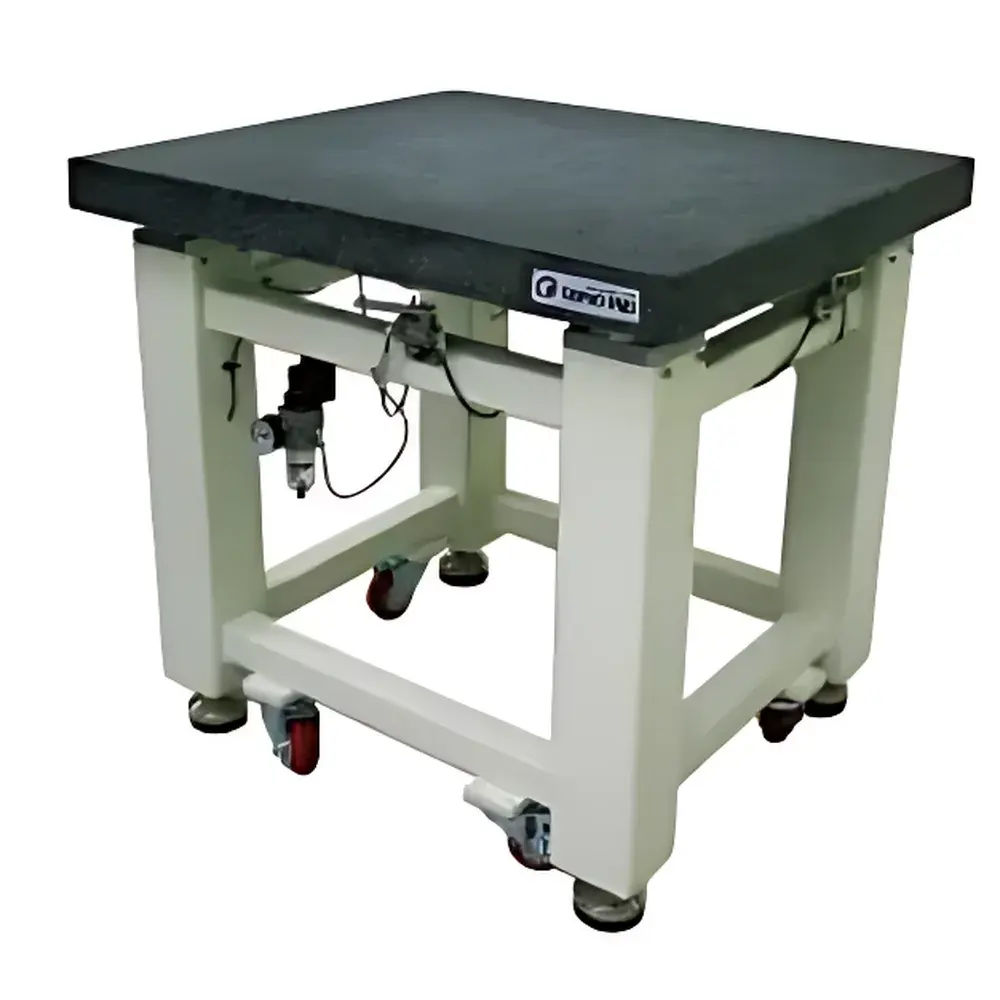
GIVA Series Passive Vibration Isolation Optical Table
| Origin | South Korea |
|---|---|
| Manufacturer Type | Authorized Distributor |
| Origin Category | Imported |
| Model | GIVA Series Passive Vibration Isolation Platform |
| Pricing | Available Upon Request |
Overview
The GIVA Series Passive Vibration Isolation Optical Table is an engineered precision platform designed for ultra-stable optical and metrological applications where sub-micron positional stability and low-frequency vibration attenuation are critical. Based on passive isolation principles—leveraging optimized pneumatic or elastomeric isolator stacks combined with high-damping structural design—the platform suppresses ground-borne vibrations in the 1–10 Hz range, a key frequency band for atomic force microscopy (AFM), scanning probe microscopy (SPM), laser interferometry, and high-resolution optical alignment. Unlike active systems requiring power and feedback control, the GIVA series delivers robust, maintenance-free isolation performance through mechanical resonance tuning and inertial mass decoupling—making it ideal for cleanroom-integrated labs, university research facilities, and ISO 14644-compliant environments where electromagnetic interference (EMI) sensitivity prohibits active electronics.
Key Features
- Integrated auto-leveling system with direct-drive electro-mechanical actuators enabling rapid stabilization (<30 s typical leveling time) without manual shimming or external tools.
- Lightweight yet rigid honeycomb-core breadboard structure fabricated from aerospace-grade aluminum alloy, offering exceptional stiffness-to-weight ratio (≥1.2 × 10⁶ N·m²/kg) and minimized thermal drift.
- Optional granite top plate (grade G603 or equivalent) available for enhanced dimensional stability, surface flatness (≤±0.005 mm/m), and long-term creep resistance—certified per ISO 8543-2 for metrological applications.
- Standard M6 threaded mounting holes on 25 × 25 mm grid; optional 50 × 50 mm grid configuration supports larger optical components and modular optomechanical integration.
- Isolator stack compliance tuned to target transmissibility <0.1 below 5 Hz and <0.05 at 2 Hz—validated per ASTM E1876 for dynamic modulus and damping characterization.
Sample Compatibility & Compliance
The GIVA platform accommodates instruments ranging from compact AFM heads (<15 kg) to full-frame optical microscopes and multi-axis laser alignment stations (up to 200 kg static load, center-loaded). Its vibration transmission function meets ISO 20486:2017 requirements for laboratory vibration-sensitive equipment support structures. Surface flatness, thermal expansion coefficient (α = 23.6 × 10⁻⁶ /°C for aluminum core), and acoustic emission profiles are documented in factory calibration reports traceable to KRISS (Korea Research Institute of Standards and Science). For GLP/GMP-regulated environments, platform installation protocols align with ISO/IEC 17025:2017 Annex A.3 on environmental condition control.
Software & Data Management
While the GIVA series operates passively and requires no embedded firmware, its auto-leveling subsystem includes RS-232 and USB-C interfaces for integration into centralized lab management systems. Optional OEM SDK enables programmable leveling sequences via Python or LabVIEW APIs—supporting audit trails compliant with FDA 21 CFR Part 11 when deployed alongside validated data acquisition software. Calibration certificates include uncertainty budgets per GUM (JCGM 100:2008) and are archived with unique serial-numbered digital signatures.
Applications
- Atomic Force Microscopy (AFM) and Scanning Tunneling Microscopy (STM) setups requiring <1 nm vertical stability over 1-hour acquisitions.
- Laser cavity alignment and mode-matching in ultrafast optics laboratories, including Ti:sapphire oscillator and OPCPA beamlines.
- Interferometric surface metrology (e.g., Zygo Verifire, 4D Technology AccuFiz) where floor vibration induces fringe instability.
- Quantum optics experiments involving trapped-ion or cold-atom platforms sensitive to broadband mechanical noise.
- In-line optical inspection stations for semiconductor wafer metrology and photomask qualification under Class 100 cleanroom conditions.
FAQ
What is the recommended payload capacity for optimal isolation performance?
For maximum transmissibility reduction, static payloads should be distributed within 70–90% of the rated capacity (150 kg standard, 200 kg heavy-duty option), with center-of-gravity deviation ≤±25 mm from platform centroid.
Can the granite top option be retrofitted post-purchase?
Yes—granite plates are mechanically interchangeable using standardized dowel-pin alignment and vacuum-assisted clamping; retrofit kits include recalibration documentation and surface flatness verification report.
Does the auto-leveling system require periodic recalibration?
No—actuator position encoders are factory-trimmed and thermally compensated; annual verification against a NIST-traceable inclinometer is recommended per ISO/IEC 17025 Clause 6.6.
Is seismic anchoring hardware included?
Seismic restraint brackets (ANSI/AISC 360-compliant) are optional accessories; installation must comply with local building codes and is performed by certified structural technicians.
How does the GIVA series compare to air-spring platforms in low-frequency isolation?
GIVA’s tuned-mass elastomer isolators achieve comparable 2–5 Hz attenuation to pneumatic systems but with zero compressed-air infrastructure, eliminating moisture contamination risk and pressure regulation drift—critical for vacuum chamber-adjacent installations.




