
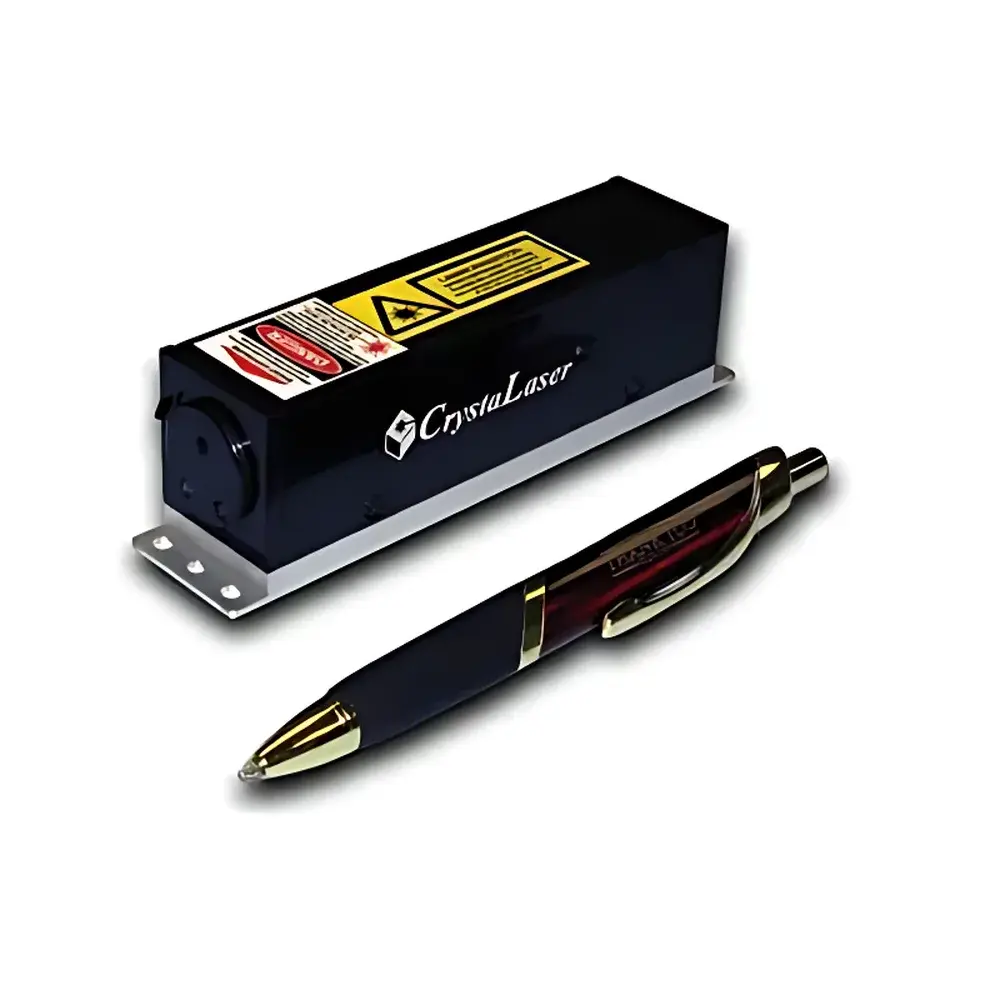
CrystaLaser CL657/CL660/CL671 Continuous-Wave Diode-Pumped Solid-State Red Lasers
| Brand | CrystaLaser |
|---|---|
| Origin | USA |
| Model Series | CL657, CL660, CL671 |
| Wavelengths | 657 nm, 660 nm, 671 nm |
| Output Power (671 nm) | 25–300 mW |
| Output Power (657/660 nm) | 50–300 mW |
| Longitudinal Mode | Single-Longitudinal-Mode (SLM) or Multimode |
| Spectral Linewidth (SLM) | < 10⁻⁵ nm |
| Spectral Linewidth (Basic) | < 0.15 nm (nominal) |
| RMS Intensity Noise | < 0.5% (10 Hz – 20 MHz, SLM) |
| RMS Intensity Noise | 2% (10 Hz – 10 kHz), >20% (100 kHz – 1 MHz, Basic) |
| Coherence Length (SLM) | > 300 m |
| Transverse Mode | TEM₀₀, M² < 1.1 |
| Beam Diameter (1/e²) | 0.2 mm (standard) |
| Full-Angle Beam Divergence | 4 mrad (reducible with expander) |
| Power Stability (rms) | < 2% over 8 h |
| optional ultra-stable | 0.5% or 0.25% over 24 h |
| Beam Pointing Stability | < 0.02 mrad (at constant temperature) |
| Polarization | Linear |
| extinction ratio 50 | 1 standard, >100:1 optional |
Overview
The CrystaLaser CL657, CL660, and CL671 series are continuous-wave (CW), diode-pumped solid-state (DPSS) red lasers engineered for precision optical instrumentation applications requiring stable, narrow-linewidth visible light sources. These lasers operate at fixed wavelengths—657 nm, 660 nm, and 671 nm—each optimized for distinct spectroscopic, interferometric, and alignment tasks where high spectral purity and spatial coherence are critical. Unlike gas-based red lasers (e.g., He–Ne), DPSS architecture delivers superior power scalability, compact footprint, and enhanced reliability without requiring high-voltage discharge or gas replenishment. The SLM variants employ intra-cavity etalons and temperature-stabilized resonators to achieve sub-10⁻⁵ nm linewidths and coherence lengths exceeding 300 meters—enabling long-path interferometry, holography, and Doppler velocimetry. Basic versions offer broader linewidth (<0.15 nm nominal) suited for fluorescence excitation, flow cytometry, and general-purpose alignment where absolute coherence is secondary to cost-effective stability.
Key Features
- Three discrete wavelength options (657 nm, 660 nm, 671 nm) covering key absorption bands of organic dyes, quantum dots, and biological fluorophores.
- TEM₀₀ output with M² < 1.1 ensures diffraction-limited focusing for high-resolution confocal microscopy and optical trapping.
- Beam diameter (1/e²) of 0.2 mm enables efficient coupling into single-mode fibers or spatial filters; optional beam expanders (2× to 10×) support collimation and field-of-view optimization.
- Ultra-low beam pointing drift (< 0.02 mrad) under thermally stable conditions minimizes realignment needs in vibration-sensitive setups such as atomic physics experiments or gravitational wave detector calibration.
- Linear polarization with standard 50:1 extinction ratio—upgradable to >100:1 for demanding polarization-sensitive measurements including ellipsometry and magneto-optic Kerr effect (MOKE) studies.
- RMS power stability as low as 0.25% over 24 hours (ultra-stable configuration) meets stringent requirements for photometric calibration and radiometric reference standards.
Sample Compatibility & Compliance
These lasers are compatible with standard optomechanical mounts (e.g., SM1-threaded housings), fiber-coupling adapters (FC/PC, FC/APC), and OEM integration platforms. No sample preparation or consumables are required—operation is fully solid-state with no gas handling, liquid cooling, or hazardous materials. All units comply with IEC 60825-1:2014 Class 3B laser safety standards and include integrated interlock connectors, emission indicators, and key-switch enable circuits. Firmware and hardware design adhere to electromagnetic compatibility (EMC) directives per EN 61326-1, ensuring reliable operation in shared laboratory environments alongside sensitive electronics such as lock-in amplifiers and CCD readout systems. While not certified for medical device use, the lasers meet foundational performance criteria referenced in ISO 13485-aligned QA documentation for instrument-grade optical subsystems.
Software & Data Management
The CL-series lasers operate in analog control mode via 0–5 V or 0–10 V input for current modulation, supporting external PID loops for active power stabilization. Optional USB- or RS-232–enabled controllers provide digital setpoint adjustment, real-time monitoring of diode temperature and output power, and logging of operational parameters (e.g., runtime, thermal cycles, fault events). Data export formats include CSV and ASCII-compatible timestamps, enabling traceability for GLP-compliant workflows. Audit trails—where implemented via host PC software—are structured to align with FDA 21 CFR Part 11 principles (electronic signatures, user access logs, immutable records), though full Part 11 validation requires site-specific qualification protocols.
Applications
- High-finesse cavity ring-down spectroscopy (CRDS) using 671 nm for trace gas detection of molecular oxygen isotopologues.
- Stimulated Raman scattering (SRS) microscopy excitation at 660 nm for label-free lipid imaging in live tissue.
- Calibration of spectroradiometers and goniophotometers per CIE S 025/E:2015 guidelines using known-wavelength, low-noise sources.
- Atomic physics experiments involving rubidium D₂-line repumping (657 nm) and cesium magneto-optical trap (MOT) diagnostics.
- Alignment and fiducial referencing in synchrotron beamlines and X-ray free-electron laser (XFEL) end stations.
- Interferometric displacement metrology in semiconductor wafer inspection tools requiring multi-hundred-meter coherence length.
FAQ
Are these lasers air-cooled or water-cooled?
All CL657/CL660/CL671 models are conduction-cooled via integrated aluminum heatsinks and require only ambient airflow—no external chiller or recirculating coolant system is necessary.
Can the output be fiber-coupled?
Yes—standard FC/PC or FC/APC fiber launch options are available with coupling efficiencies ≥65% for single-mode SMF-28 fiber; custom AR-coated collimators support polarization-maintaining (PM) fiber integration.
What is the warm-up time to specified stability?
Thermal equilibrium is achieved within 30 minutes; full rms power stability specifications apply after 60 minutes of continuous operation at nominal load.
Is there a TTL modulation input option?
An optional external TTL blanking input (0–5 V, rise/fall < 100 ns) supports pulsed operation down to 10 kHz repetition rates while preserving CW spectral characteristics.
Do you provide NIST-traceable calibration certificates?
Yes—optional factory calibration includes wavelength verification against a wavemeter traceable to NIST SRM 2034 and power calibration against a thermopile sensor calibrated per ISO/IEC 17025-accredited procedures.




