
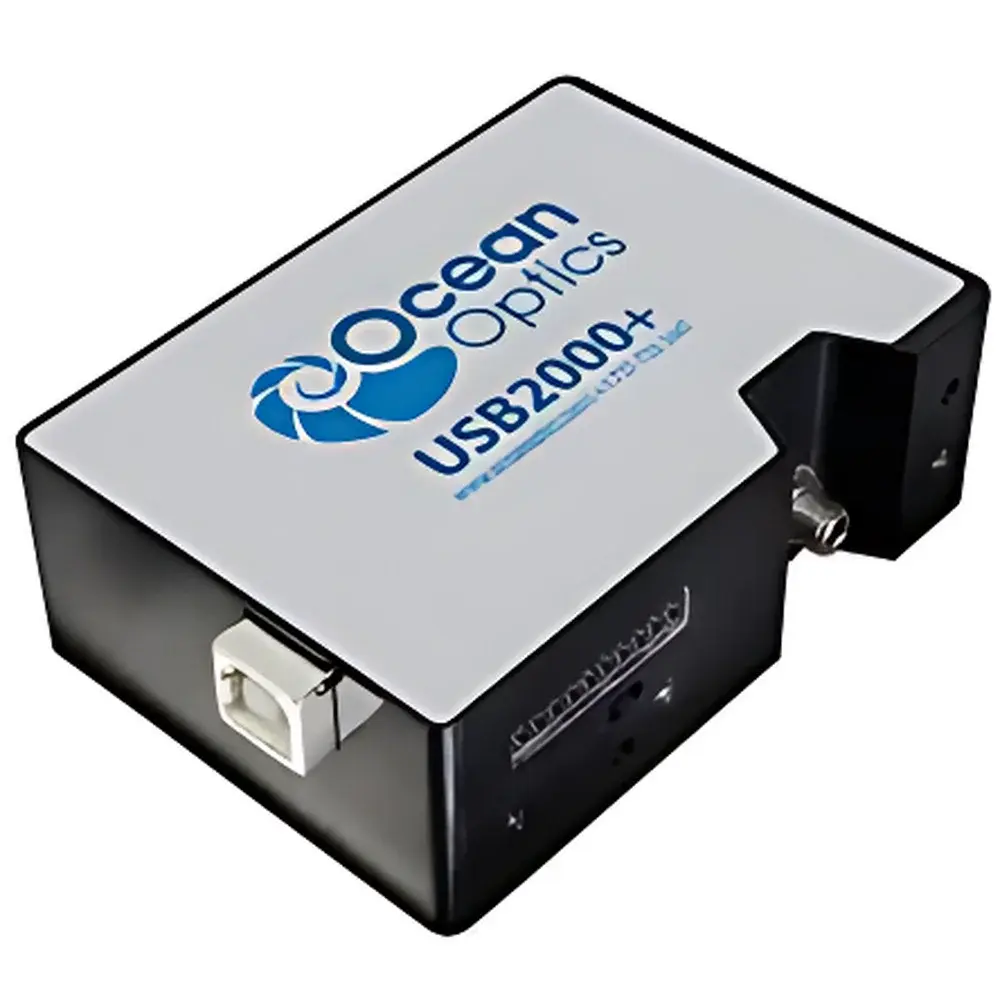
Ocean Optics USB2000+ Fiber Optic Spectrometer
| Brand | Ocean Optics |
|---|---|
| Origin | USA |
| Model | USB2000+ |
| Detector Type | Linear CCD (Sony ILX511B, 2048 pixels) |
| Spectral Range | 200–1100 nm (configurable) |
| Optical Resolution (FWHM) | 0.03–8.4 nm (dependent on grating & slit) |
| Signal-to-Noise Ratio | 250:1 (full-scale) |
| A/D Resolution | 16-bit |
| Integration Time | 1 ms – 65 s |
| Dark Noise | 50 RMS counts |
| Stray Light | <0.05% @ 600 nm |
| Linearity | >99.8% |
| Interface | USB 2.0 (480 Mbps), RS-232, 22-pin GPIO connector (8 programmable I/O) |
| Dimensions | 89.1 × 63.3 × 34.4 mm |
| Weight | 190 g |
| Compliance | RoHS, CE |
Overview
The Ocean Optics USB2000+ Fiber Optic Spectrometer is a compact, high-performance benchtop spectrometer engineered for precision spectral acquisition in research, industrial QA/QC, and field-deployable analytical systems. Based on the Czerny-Turner optical architecture (f/4, asymmetric design with 42 mm input and 68 mm output focal lengths), it employs a thermally stable, fixed-optics platform with no moving parts—ensuring long-term calibration integrity and mechanical robustness. Its core detection system integrates a Sony ILX511B linear silicon CCD array (2048 pixels, 14 μm × 200 μm pixel size, ~62,500 e⁻ full-well capacity), optimized for sensitivity across the UV-VIS-NIR spectrum (200–1100 nm). The instrument operates on fundamental principles of dispersive spectroscopy: incident light is collimated, diffracted by a user-selectable grating, and focused onto the CCD detector, where photon flux is converted to digital intensity values via a 16-bit analog-to-digital converter. With a minimum integration time of 1 ms and real-time dark current correction based on temperature feedback, the USB2000+ supports dynamic measurements of transient phenomena—including pulsed LED characterization, plasma emission monitoring, and rapid colorimetric assays—while maintaining photometric stability under variable thermal conditions.
Key Features
- Modular optical platform enabling full customization of spectral range, resolution, and throughput via interchangeable slits (5–200 μm), gratings (14 options spanning UV to NIR), order-sorting filters (e.g., OFLV-200-850, OFLV-350-1000), and detector window coatings (UV2, VIS-NIR, etc.)
- High-fidelity electronics including auto-zeroing 16-bit A/D conversion, EEPROM-stored wavelength and intensity calibration coefficients, and hardware-level dark noise compensation
- 8-channel programmable GPIO interface for synchronized peripheral control (e.g., shutter triggering, lamp pulsing, stage actuation) and four configurable trigger modes (external TTL, software, synchronous, and gated)
- USB 2.0 bus-powered operation (no external power supply required); also supports RS-232 communication (5 VDC powered) for embedded or PLC-integrated deployments
- Thermally compensated optical bench with UV-grade fused silica windows and SAG+ coated mirrors; all components factory-aligned and permanently secured to eliminate drift
- Cross-platform compatibility with SpectraSuite software (Windows, macOS, Linux) supporting hot-swap recognition, real-time spectral display, and automated coefficient retrieval from onboard memory
Sample Compatibility & Compliance
The USB2000+ interfaces seamlessly with Ocean Optics’ ecosystem of sampling accessories—including SMA905-coupled fiber probes, cuvette holders, integrating spheres (e.g., ISP-REF), cosine correctors (CC3-DA), flow cells, and calibrated light sources—enabling quantitative absorbance, reflectance, fluorescence, and radiometric measurements per ASTM E308, ISO/CIE 15, and USP . Its optical design complies with GLP/GMP data integrity requirements when used with SpectraSuite’s audit-trail-enabled acquisition protocols (supporting FDA 21 CFR Part 11–compliant metadata logging via third-party extensions). All units are RoHS-compliant and CE-marked for EMC and safety (EN 61326-1, EN 61000-6-3), making them suitable for regulated laboratory environments and OEM instrumentation integration.
Software & Data Management
SpectraSuite provides intuitive cross-platform control, real-time spectral visualization, mathematical operations (baseline correction, peak integration, ratioing), and export to CSV, TXT, or HDF5 formats. Each USB2000+ stores its unique calibration coefficients, serial number, and optical configuration in non-volatile memory—automatically loaded at connection to ensure traceable, reproducible results. For custom automation, the device supports ASCII-based serial command sets over RS-232 or SPI/I²C for microcontroller interfacing. Raw spectral data can be streamed at up to 1,000 full-spectrum acquisitions per second over USB 2.0, with timestamped metadata suitable for time-resolved kinetics analysis. Optional SDKs (C++, Python, LabVIEW) enable integration into larger analytical workflows compliant with LIMS or MES architectures.
Applications
- UV-VIS absorption spectroscopy for concentration determination (e.g., protein quantification via Bradford assay, nucleic acid purity assessment)
- Color measurement and spectral matching in paint, textile, and display manufacturing per CIE 1931 chromaticity standards
- In-line process monitoring of chemical reactions, fermentation, or polymerization using fiber-coupled immersion probes
- LED and laser diode spectral characterization—including centroid wavelength, FWHM, and side-mode suppression ratio (SMSR)
- Environmental sensing (e.g., NO₂, SO₂, O₃ detection via differential optical absorption spectroscopy—DOAS—when paired with broadband deuterium/halogen sources)
- Educational laboratories for teaching optical physics, quantum mechanics (atomic emission spectra), and instrumental analysis fundamentals
FAQ
What spectral ranges are available out-of-the-box?
Standard configurations include USB2000+UV-VIS (200–850 nm), USB2000+VIS-NIR (350–1000 nm), USB2000+XR (200–1050 nm), and USB2000+RAD (200–850 nm with cosine correction and absolute irradiance calibration).
Can I change the grating or slit after purchase?
Yes—the optical bench is fully modular; replacement gratings, slits, and filters are available as field-serviceable components with alignment-free installation.
Is the USB2000+ compatible with Linux-based embedded systems?
Yes—low-level USB HID and serial protocols are documented and supported via open-source drivers; Python bindings are maintained by the Ocean Optics community.
How is wavelength calibration performed and maintained?
Each unit ships with NIST-traceable Hg-Ar lamp calibration data stored in EEPROM; SpectraSuite applies polynomial correction (typically 3rd-order) during acquisition, and users may perform re-calibration using known emission lines.
What is the maximum sustainable acquisition rate for continuous streaming?
At full 2048-pixel resolution and minimum 1 ms integration, sustained throughput reaches 1,000 spectra/second over USB 2.0; performance scales inversely with pixel binning and communication overhead.
Related Products




