
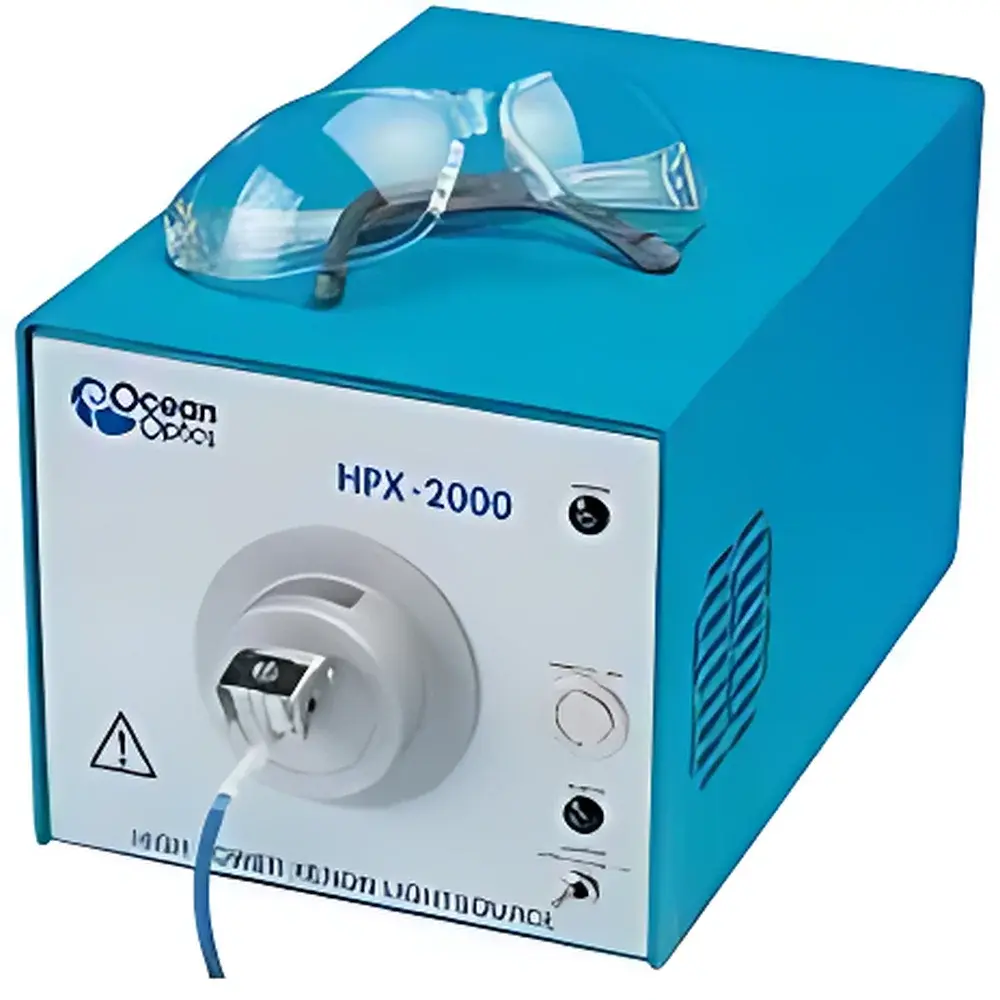
Ocean Optics HPX-2000 High-Power Continuous Xenon Light Source
| Brand | Ocean Optics |
|---|---|
| Origin | USA |
| Model | HPX-2000 |
| Spectral Range | 185–2200 nm |
| Output Power | 35 W |
| Input Power | 60 W AC |
| Lamp Type | Short-Arc Xenon |
| Shutter Control | Manual Switch & TTL-Compatible (Positive Pulse via 15-pin Connector) |
| Filter Holder | Accepts 25 mm round or square filters, 14 mm thick |
| Dimensions | 145 × 165 × 260 mm |
| Weight | 5.0 kg |
| Lamp Lifetime | ≥1000 h (typ. 2000 h) |
| Fiber Interface | SMA 905 |
| UV-Optimized Operation | Requires UV-grade optical fiber |
Overview
The Ocean Optics HPX-2000 is a high-intensity, continuous-output xenon light source engineered for demanding optical applications requiring broad-spectrum irradiance from deep ultraviolet through near-infrared wavelengths. Based on a stabilized short-arc xenon lamp, the HPX-2000 delivers 35 W of radiant power across a spectral range of 185–2200 nm—enabling consistent excitation in fluorescence spectroscopy, reflectance measurements, photostability testing, and calibration of spectrometers and imaging systems. Unlike pulsed xenon sources (e.g., the PX-2), the HPX-2000 provides steady-state illumination ideal for time-resolved intensity monitoring, kinetic assays, and applications where temporal stability outweighs peak pulse brightness. Its thermally managed housing ensures long-term radiometric reproducibility, while the integrated air-cooling system maintains optimal lamp operating temperature without external chillers or compressed-air infrastructure.
Key Features
- Broadband Spectral Coverage: Continuous emission spanning 185 nm (deep UV) to 2200 nm (NIR), with strong output in the 250–800 nm region critical for organic fluorophore excitation and semiconductor characterization.
- Integrated Mechanical Shutter: Precisely timed light gating via front-panel switch or external TTL-compatible positive-pulse trigger (15-pin D-sub connector), supporting synchronization with detectors, monochromators, or data acquisition systems.
- Modular Lamp Design: Field-replaceable lamp module simplifies maintenance—users may either return the unit for professional lamp replacement or install a pre-aligned spare module (sold separately) with minimal alignment recalibration.
- Dedicated Filter Mounting System: Precision-machined filter holder accommodates standard 25 mm diameter circular or 25 × 25 mm square optical filters up to 14 mm thickness, enabling rapid spectral shaping for bandpass selection, UV blocking, or harmonic suppression.
- UV-Ready Optical Interface: SMA 905 port optimized for coupling with solarization-resistant UV-VIS fibers; recommended use of Ocean Insight’s UV-enhanced or deuterium-grade silica fibers for stable transmission below 300 nm.
- Stable Thermal Architecture: Passive and forced-air hybrid cooling maintains lamp envelope temperature within ±2°C over extended operation, minimizing spectral drift and intensity fluctuation (<1.5% RMS over 1 hour at steady state).
Sample Compatibility & Compliance
The HPX-2000 is compatible with standard cuvette-based, fiber-coupled, and free-space optical configurations. It meets IEC 61000-4-3 (radiated immunity) and IEC 61000-4-6 (conducted immunity) requirements for laboratory electromagnetic environments. While not certified for Class I laser product compliance, its output falls under ANSI Z136.1-2022 guidelines for non-laser optical radiation hazards when used with appropriate beam containment and UV shielding. For GLP/GMP-regulated environments, the device supports audit-ready operation when paired with calibrated reference detectors and traceable NIST-traceable spectral irradiance standards (e.g., NIST SRM 2032). No internal batteries or hazardous substances are present; RoHS 3 and REACH-compliant materials are used throughout construction.
Software & Data Management
The HPX-2000 operates as a standalone hardware component with no embedded firmware or proprietary software dependency. Shutter control integrates natively with third-party DAQ platforms—including National Instruments LabVIEW, MATLAB Data Acquisition Toolbox, and Python-based PyVISA—via standard TTL logic signaling. Timing logs, shutter actuation events, and operational hours can be externally timestamped and archived using host-system logging tools. For traceable calibration workflows, users may pair the HPX-2000 with Ocean Insight’s OceanView or SpectraSuite software to correlate spectral output against reference lamps (e.g., FEL-type tungsten halogen standards) and generate ISO/IEC 17025-compliant calibration reports when operated within an accredited lab environment.
Applications
- Steady-state fluorescence excitation in life science assays (e.g., protein folding studies, enzyme kinetics, DNA intercalation screening)
- Reflectance and transmittance characterization of thin-film coatings, photovoltaic absorbers, and optical filters
- Spectrometer wavelength and radiometric calibration across UV-VIS-NIR ranges
- Accelerated photodegradation testing per ASTM G154 and ISO 4892-3 protocols
- Multi-spectral imaging system illumination for agricultural phenotyping and material sorting
- Photochemical reactor activation where continuous photon flux—not peak intensity—is critical
FAQ
What is the recommended optical fiber for UV applications?
Use UV-grade fused silica fiber with solarization-resistant coating (e.g., Ocean Insight’s UV-VIS or UV-Enhanced series); standard VIS-NIR fibers exhibit significant attenuation below 250 nm.
Can the HPX-2000 be synchronized with a gated detector?
Yes—the TTL input accepts positive-edge-triggered pulses (3.3–5 V logic) with rise time <100 ns, enabling precise shutter-to-detection timing for lock-in or time-gated measurements.
Is lamp alignment required after module replacement?
No—each lamp module is factory-aligned to optical axis tolerances ≤±0.15 mm; mechanical registration ensures repeatable positioning without user adjustment.
Does the HPX-2000 comply with FDA 21 CFR Part 11 for electronic records?
The device itself does not store or process data; however, when integrated into a validated system with audit-trail-capable software (e.g., LabArchives or Thermo Fisher SampleManager), it supports Part 11 compliance through external event logging and electronic signature controls.
What is the expected spectral stability over lamp lifetime?
Radiometric output remains within ±5% of initial value at 365 nm and ±7% at 254 nm over 2000 hours of operation, assuming proper thermal management and clean optical path maintenance.







