
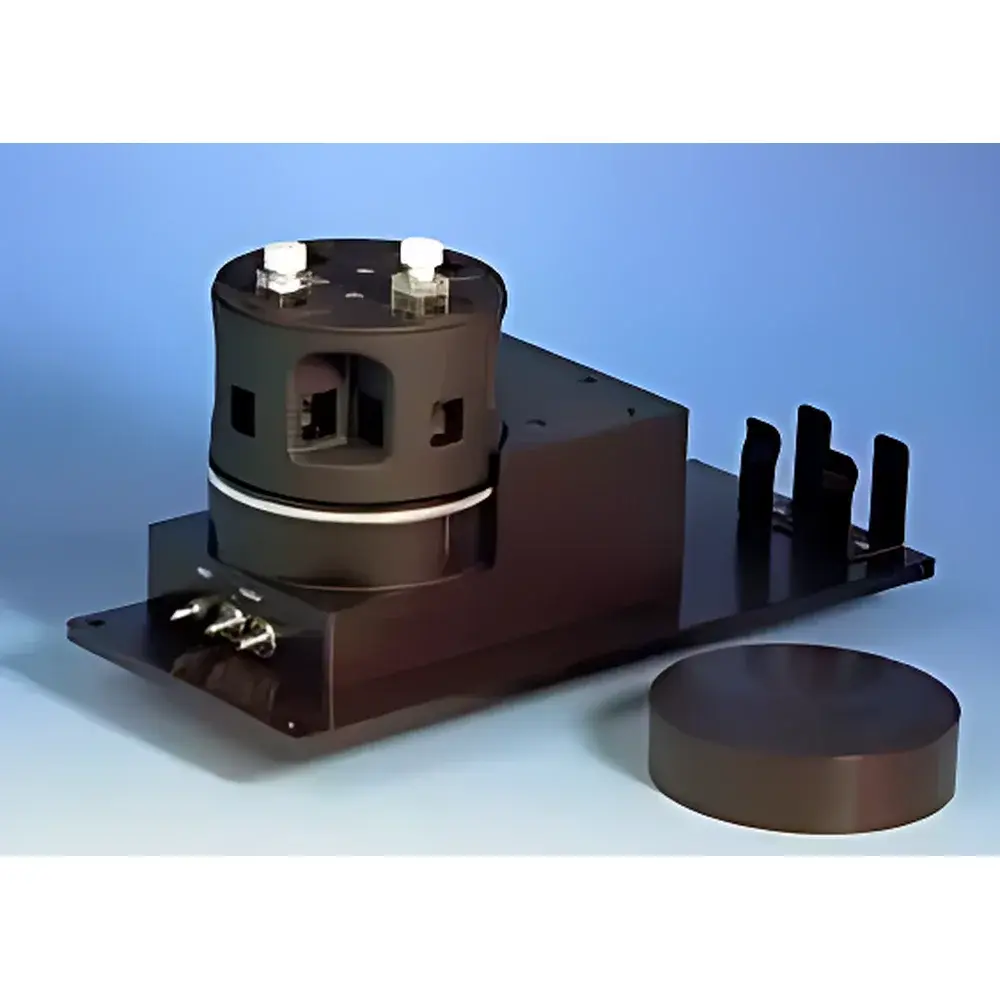
Quantum Northwest TLC400 Quad-Position Tower Sample Holder with Precision Temperature Control
| Brand | Quantum Northwest |
|---|---|
| Origin | South Korea |
| Model | TLC400 Quad-Position Tower Sample Holder |
| Temperature Range | −25.00 to +105.00 °C (standard), extendable to −55.00 to +150.00 °C (custom) |
| Temperature Accuracy | ±0.02 °C |
Overview
The Quantum Northwest TLC400 Quad-Position Tower Sample Holder is a high-precision, thermoelectrically controlled sample mounting platform engineered for demanding optical spectroscopy applications. It operates on the Peltier (thermoelectric) principle to deliver rapid, bidirectional temperature regulation—cooling and heating—with exceptional stability and repeatability across a broad operational range. Designed specifically for integration into UV/VIS absorption, fluorescence, circular dichroism, transient absorption, Raman, and near-infrared spectrometers, the TLC400 supports rigorous experimental protocols requiring precise thermal management of liquid or solid-state samples in standard cuvettes (e.g., 10 mm pathlength quartz or fused silica cells). Its tower architecture enables sequential, automated access to four independently monitored sample positions without manual repositioning—minimizing thermal drift and operator-induced variability. The system’s core thermal performance—±0.02 °C accuracy over −25.00 to +105.00 °C (standard configuration)—is validated using embedded thermistors calibrated traceably to NIST-traceable references. Optional extended-range versions (−55.00 to +150.00 °C) are available under custom engineering specifications.
Key Features
- Quad-position rotating tower design enabling automated, sequential sample interrogation without manual handling or instrument realignment
- Peltier-based active temperature control with dual-mode operation (heating/cooling), achieving ramp rates up to 3.5 °C/min (typical) and stabilization within ±0.02 °C
- Independent magnetic stirring at each position (speed continuously adjustable from 0–1200 rpm) to ensure homogeneous thermal distribution and mitigate concentration gradients
- Integrated thermistor sensors mounted in direct thermal contact with each sample compartment—providing real-time, position-specific temperature feedback
- Optical slit set included to define excitation and emission apertures, reducing stray light and improving signal-to-noise ratio in fluorescence and absorbance measurements
- Modular mechanical interface compatible with standard optical breadboards, kinematic mounts, and OEM spectrometer housings (custom flange and alignment pin configurations available)
Sample Compatibility & Compliance
The TLC400 accommodates standard 10 × 10 mm square or 12.5 × 12.5 mm rectangular cuvettes, as well as custom cell geometries upon request. It supports aqueous, organic, and viscous media—including glycerol-based cryoprotectants and low-vapor-pressure solvents—without condensation or leakage under controlled humidity conditions. All wetted surfaces are constructed from chemically inert, anodized aluminum and PTFE-sealed stainless steel components compliant with ISO 8573-1 Class 3 for particulate and hydrocarbon contamination. While the device itself is not a medical or diagnostic instrument, its thermal control architecture meets the functional requirements for GLP-compliant spectroscopic method validation per ICH Q2(R2), and its digital temperature logging capability supports audit-ready data capture aligned with FDA 21 CFR Part 11 when integrated with compliant host software environments.
Software & Data Management
The TLC400 communicates via RS-232 or USB virtual COM port, supporting ASCII command protocol for integration with LabVIEW, Python (PySerial), MATLAB, or third-party spectrometer control suites (e.g., OceanInsight OceanView, Horiba FluorEssence, Agilent Cary WinUV). Temperature profiles—including ramp, hold, step, and script-defined sequences—can be programmed and executed autonomously. Internal memory retains up to 16 user-defined thermal protocols. Real-time temperature telemetry from all four positions is timestamped and exportable as CSV for post-acquisition correlation with spectral datasets. Firmware updates are delivered via vendor-provided utilities and maintain backward compatibility with legacy control interfaces.
Applications
- Temperature-dependent UV/VIS absorption studies of protein unfolding, ligand binding, and polymer phase transitions
- Fluorescence quantum yield and lifetime measurements across defined thermal gradients
- Thermal stability screening of quantum dots, perovskite nanocrystals, and organic emissive materials
- In situ monitoring of catalytic reactions in solution-phase photochemistry
- Calibration validation of thermally sensitive photodetectors and reference standards
- Multi-sample comparative kinetics in enzyme assays and photochemical degradation experiments
FAQ
Can the TLC400 be used with fiber-coupled spectrometers?
Yes—the tower geometry and low-profile optical path allow direct coupling to SMA905 or FC/PC fiber inputs when aligned with appropriate collimation optics.
Is external chiller or coolant required for operation?
No—all thermal management is self-contained via Peltier modules and passive/forced-air heat dissipation; no recirculating chillers or liquid cooling loops are needed.
What is the maximum allowable sample volume per position?
Standard configuration supports up to 3.5 mL in 10 mm pathlength cuvettes; custom cell adapters accommodate volumes from 100 µL to 10 mL.
Does the unit support remote triggering synchronized with spectrometer acquisition?
Yes—TTL-compatible trigger input/output ports enable hardware-level synchronization with detector gate signals or laser pulse triggers.
Are calibration certificates provided with shipment?
Each unit ships with a factory-issued temperature uniformity and accuracy report, traceable to ISO/IEC 17025-accredited calibration standards.




