
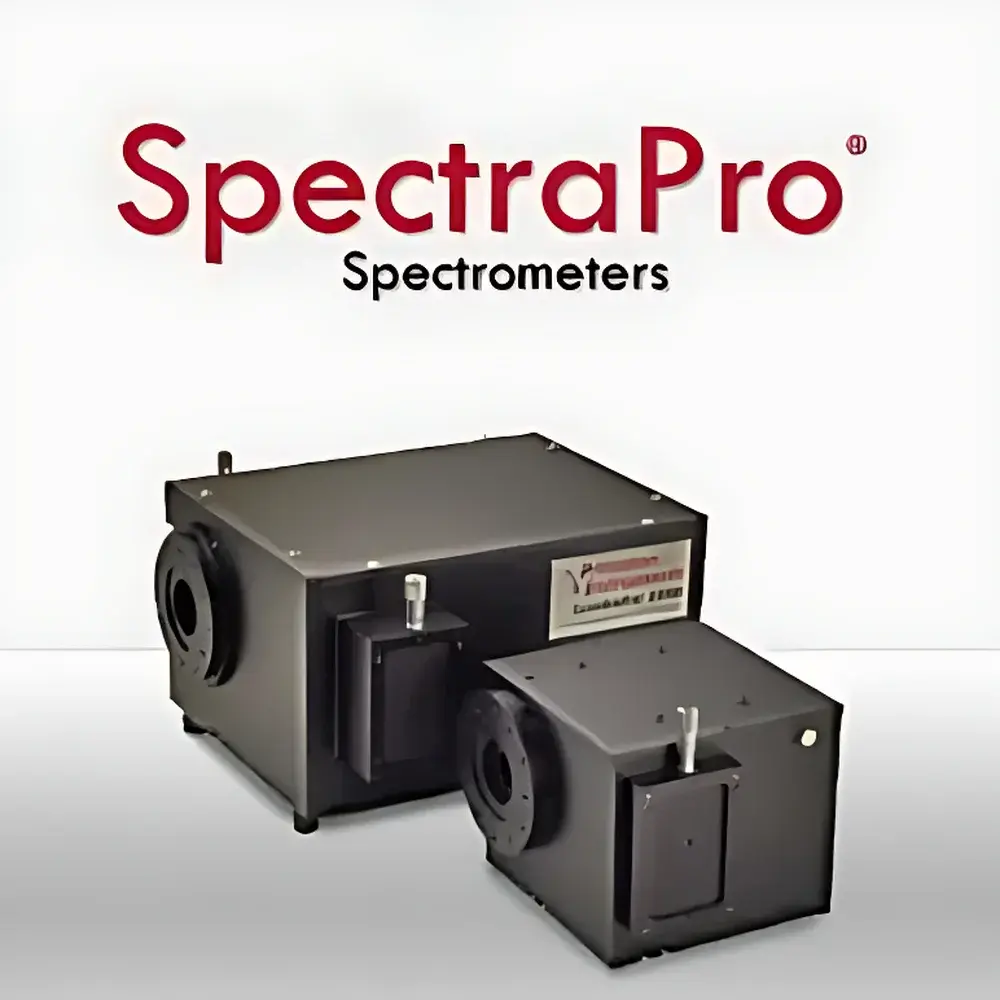
Princeton Instruments SpectraPro C-T Series Imaging Spectrograph and Scanning Monochromator
| Brand | Princeton Instruments / Teledyne Princeton Instruments |
|---|---|
| Origin | USA |
| Manufacturer Type | Authorized Distributor |
| Import Status | Imported |
| Models | SP2150, SP2300, SP2500, SP2750 |
| Pricing | Upon Request |
Overview
The Princeton Instruments SpectraPro C-T Series is a high-performance, Czerny–Turner (C-T) optical design imaging spectrograph and scanning monochromator engineered for precision spectral analysis across ultraviolet (UV), visible (VIS), and near-infrared (NIR) wavelength ranges (193 nm – 1100 nm). Its optimized reflective optics—comprising spherical and toroidal mirrors, a motorized grating turret, and interchangeable entrance/exit ports—deliver high throughput, low stray light, and diffraction-limited spectral resolution. Unlike prism-based or transmissive-grating systems, the SpectraPro’s all-reflective architecture eliminates chromatic aberration and enables broadband operation without refocusing. The system supports both single-point detection (e.g., PMT, photodiode) and array-based detection (CCD, EMCCD, sCMOS, InGaAs), with optional astigmatism-corrected imaging optics enabling simultaneous multi-fiber spectral acquisition. Each model is calibrated to NIST-traceable standards and designed for long-term stability in demanding laboratory environments—including cleanrooms, vacuum chambers, and cryogenic setups.
Key Features
- Czerny–Turner optical layout with precision-aligned toroidal mirrors for minimized coma and astigmatism
- Four focal length options: 150 mm (SP2150), 300 mm (SP2300), 500 mm (SP2500), and 750 mm (SP2750), each optimized for specific resolution-throughput trade-offs
- Motorized triple-grating turret with software-controlled indexing and auto-alignment to optical axis
- Multi-port configuration: up to three independently selectable entrance slits and four exit ports (model-dependent), supporting dual-source excitation, beam splitting, and parallel detection
- High-efficiency optical coatings: Acton #1900 enhanced aluminum (193 nm–mid-IR), protected silver (>98% avg. reflectance), or optional gold (NIR-optimized)
- Integrated IntelliCal Wavelength & Intensity Calibration System: dual-lamp (Hg + Ne-Ar) source with nonlinear optimization algorithm delivering up to 10× improved wavelength accuracy; NIST-traceable LED-based intensity calibration compensates for detector QE, grating efficiency, and etaloning artifacts
- Compatibility with Princeton Instruments’ full detector portfolio: PIXIS, PyLoN, PyLoN-IR, ProEM, PI-MAX4, and NIRvana cameras—including back-illuminated, deep-depletion, and eXcelon®-coated variants for enhanced NIR quantum efficiency
Sample Compatibility & Compliance
The SpectraPro C-T Series accommodates diverse sample interfaces—including free-space beams, fiber-coupled inputs (SMA905, FC/PC), microscope ports, and vacuum flange mounts (CF-40, CF-63). It complies with international spectroscopic measurement standards including ASTM E131 (Standard Terminology Relating to Molecular Spectroscopy), ISO 17025 (General Requirements for the Competence of Testing and Calibration Laboratories), and USP (Spectrophotometric Absorption Measurements). When operated with LightField software and enabled audit trail features, the system supports 21 CFR Part 11-compliant workflows for regulated environments (e.g., pharmaceutical QC, clinical research). All optical components meet RoHS and REACH directives; vacuum-compatible models are available for UHV applications down to 10⁻⁹ Torr.
Software & Data Management
LightField spectroscopy software (Windows 64-bit) serves as the unified control and analysis platform—providing real-time spectral acquisition, hardware time-stamping, automated grating selection, slit width/height control, and IntelliCal integration. It supports multi-dimensional data capture (λ–t, λ–x–y, λ–V), batch processing, spectral deconvolution, peak fitting (Gaussian/Lorentzian), and export to HDF5, CSV, and vendor-neutral JCAMP-DX formats. Optional WinSpec (32-bit, legacy support) maintains backward compatibility with existing instrument control scripts. SpectraHub readout electronics enable synchronized multi-camera triggering and low-noise digitization at up to 5 MHz pixel rates. All software modules include GLP/GMP-ready audit trails, user role management, and electronic signature capability when configured per regulatory requirements.
Applications
- Tip-Enhanced Raman Spectroscopy (TERS): High spatial resolution (<10 nm) vibrational mapping using plasmonically enhanced nano-probes
- Laser-Induced Breakdown Spectroscopy (LIBS): Elemental fingerprinting of solids, liquids, and gases—validated on NASA’s Curiosity rover for Martian surface analysis
- Photoluminescence & Electroluminescence: Time-resolved carrier dynamics in semiconductors, perovskites, and 2D materials
- Microspectroscopy: Coupled to inverted/epifluorescence microscopes for sub-cellular spectral phenotyping
- Absorbance, Reflectance, and Transmission: Quantitative thin-film metrology, optical coating characterization, and solar cell EQE testing
- Plasma Emission Diagnostics: Line-ratio thermometry and species identification in fusion tokamaks and industrial plasma reactors
- Cherenkov Radiation Imaging: Single-electron detection and spectral reconstruction in particle physics experiments
FAQ
What wavelength range does the SpectraPro C-T Series cover?
The base system operates from 193 nm (deep UV) to 1100 nm (NIR); extended range to 2.2 µm is achievable with InGaAs detectors and gold-coated optics.
Can I use multiple detectors simultaneously?
Yes—multi-port configurations allow concurrent connection of up to two array detectors and one PMT via independent exit ports, enabling real-time reference-channel correction or dual-band acquisition.
Is vacuum compatibility available?
Standard models are air-compatible; custom vacuum versions (CF-40/63 flanges, bakeable to 80°C) are offered for synchrotron beamline and UHV surface science applications.
How is grating alignment maintained during automated switching?
Each grating position in the turret includes mechanical detents and optical home-sensing; firmware performs closed-loop verification and fine-tunes mirror alignment via piezo-actuated collimator adjustment.
Does the system support time-resolved measurements?
When paired with PI-MAX4 gated ICCD or ProEM EMCCD cameras and LightField’s hardware-triggered acquisition mode, temporal resolution down to 200 ps is achievable with external laser sync.
Related Products





