
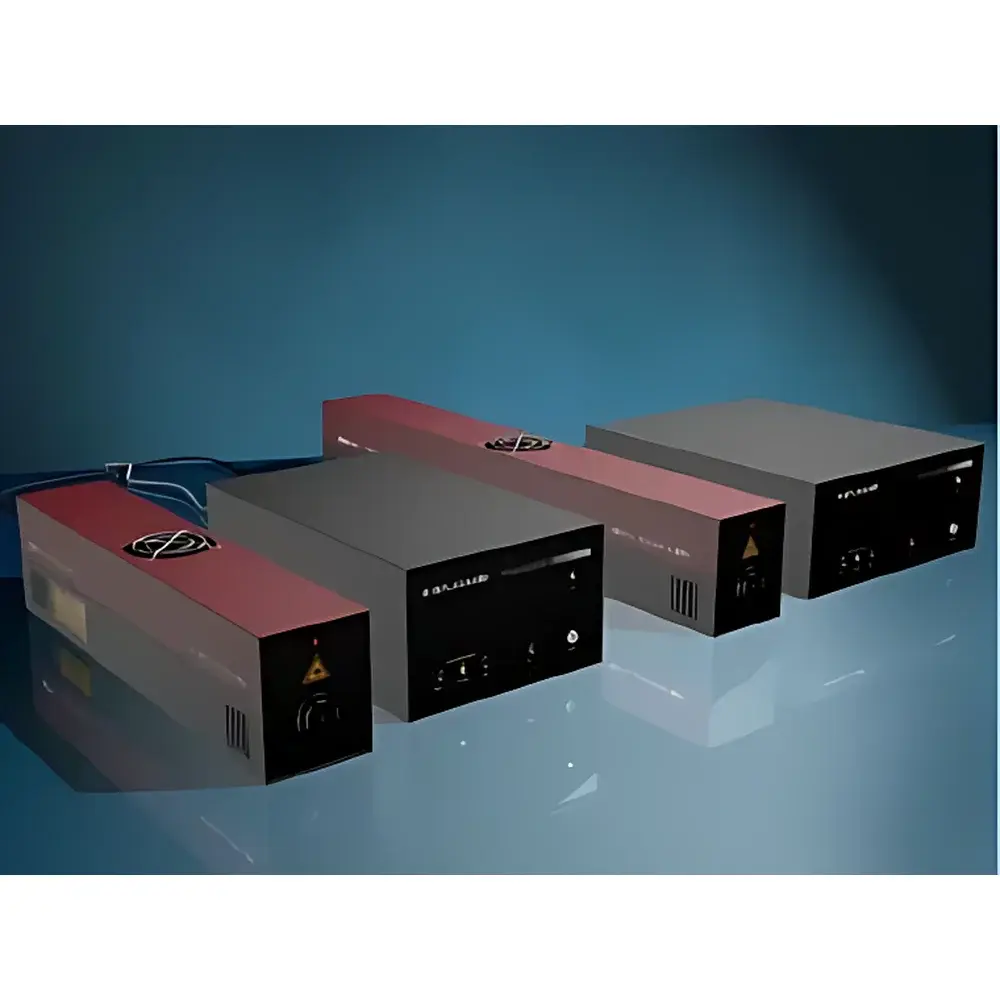
SPL-HeCd Helium-Cadmium Laser
| Brand | SPL |
|---|---|
| Origin | USA |
| Manufacturer Type | Authorized Distributor |
| Import Status | Imported |
| Model | SPL-HeCd |
| Core Technology | Gas Discharge Laser (He–Cd Plasma Tube) |
| Wavelength Options | 325 nm (UV), 441.6 nm (blue), or simultaneous dual-line output |
| Polarization | Linear, high extinction ratio (up to 100:1) |
| Beam Mode | TEM₀₀ or TEMₘₙ |
| Output Power Range | 5–150 mW depending on configuration |
| Cooling | Air-cooled |
| Lifetime | ≥5,000 hours typical tube life |
Overview
The SPL-HeCd Helium-Cadmium Laser is a continuous-wave (CW), gas-discharge-based laser system engineered for stable, narrow-linewidth ultraviolet and visible emission in laboratory and industrial metrology environments. Operating on the principle of electron-impact excitation within a helium–cadmium plasma medium, the laser produces coherent radiation at two primary atomic transitions: 325.0 nm (ultraviolet, from Cd⁺ ion) and 441.6 nm (blue-violet, also from Cd⁺). Unlike solid-state or diode lasers, He–Cd lasers offer intrinsic wavelength stability, low amplitude noise (5,000 h mean time between failures).
Key Features
- Simultaneous dual-wavelength operation: Independent or co-aligned 325 nm and 441.6 nm outputs with configurable power ratios (e.g., 5/35 mW to 30/100 mW)
- High spectral purity: Single longitudinal mode (SLM) and transverse mode (TEM₀₀ or TEMₘₙ) options available; linewidth <3 MHz typical
- Linear polarization: Built-in polarizing plasma tube design; extinction ratio up to 100:1; no external waveplates required for polarization-sensitive applications
- Air-cooled architecture: No external chiller or water loop needed—reducing footprint, maintenance, and infrastructure dependency
- Modular beam delivery: Integrated kinematic mounting platform compatible with standard Ø1″ or Ø25 mm optical posts; optional fiber coupling adapters (UV-grade fused silica)
- Compliance-ready control interface: RS-232 and analog 0–5 V modulation inputs support integration into automated test systems and GLP-compliant workflows
Sample Compatibility & Compliance
The SPL-HeCd laser is routinely deployed in applications requiring traceable UV–vis excitation sources, including photomask inspection, Raman spectroscopy calibration, and semiconductor wafer alignment. Its 325 nm output meets ASTM E2098 (standard practice for UV laser calibration) and supports ISO/IEC 17025-accredited measurement procedures when paired with NIST-traceable power meters. All models comply with IEC 60825-1:2014 Class 3B laser safety requirements; integrated key-switch interlock, emission indicator LED, and shutter control satisfy FDA 21 CFR Part 1040.10 mandates. The plasma tube assembly conforms to RoHS Directive 2011/65/EU and REACH Annex XIV restrictions on cadmium handling—tube replacement and disposal protocols are documented per EPA 40 CFR Part 261.
Software & Data Management
SPL provides the HeCd Control Suite—a Windows-based application supporting real-time power monitoring, temperature logging, runtime hour tracking, and fault-code diagnostics. The software generates audit-trail logs compliant with 21 CFR Part 11 (electronic records & signatures) when configured with user authentication and event timestamping. Data export is supported in CSV and HDF5 formats for integration with MATLAB, Python (via PyVISA), or LabVIEW environments. Remote operation via TCP/IP is available as an optional firmware upgrade, enabling centralized fleet management across multi-instrument laboratories operating under ISO 9001 or GMP quality systems.
Applications
- Fluorescence microscopy: Selective excitation of DAPI, Hoechst, and quantum dot probes with minimal photobleaching due to low-noise CW output
- Holographic data storage research: High-coherence 325 nm source enabling sub-200 nm fringe spacing in volume holograms
- Ellipsometry calibration: Stable 441.6 nm reference for phase-sensitive thin-film thickness measurement systems
- Lithography tool alignment: UV beam used for mask-to-wafer registration in maskless direct-write systems
- Raman spectrometer excitation: 441.6 nm line reduces fluorescence background in carbon nanotube and graphene characterization
- Interferometric displacement metrology: Sub-nanometer resolution achievable using heterodyne detection with stabilized He–Cd reference beams
FAQ
What is the typical warm-up time to achieve power stability?
Full thermal equilibrium and <±1% power stability are achieved within 30 minutes after cold start.
Can the 325 nm and 441.6 nm beams be spatially separated and independently directed?
Yes—dichroic mirrors (e.g., Semrock FF409-Di01) or prism-based beam combiners allow clean separation; all dual-line models include collimated, co-aligned outputs optimized for post-source splitting.
Is the laser compatible with vacuum environments?
The base unit is not vacuum-rated; however, custom flange-mounted variants with CF-40 feedthroughs and differential pumping ports are available upon request.
How often does the plasma tube require replacement?
Under normal operation (8 h/day, 25°C ambient), tube lifetime exceeds 5,000 hours; end-of-life is indicated by >20% power drop or inability to sustain discharge at nominal current.
Does SPL provide NIST-traceable calibration certificates?
Yes—factory calibration includes spectral center wavelength verification (±0.05 nm) and output power certification (±3% uncertainty, k=2) traceable to NIST SRM 2211.





