
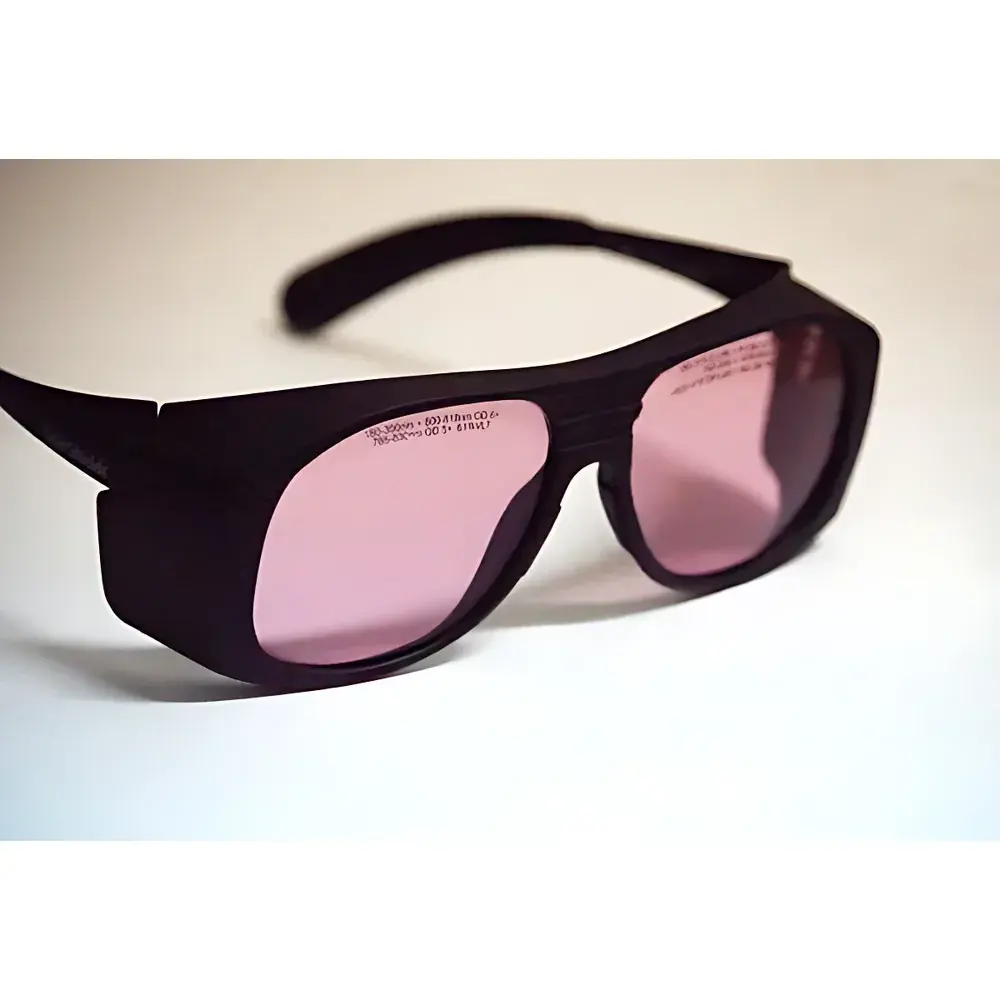
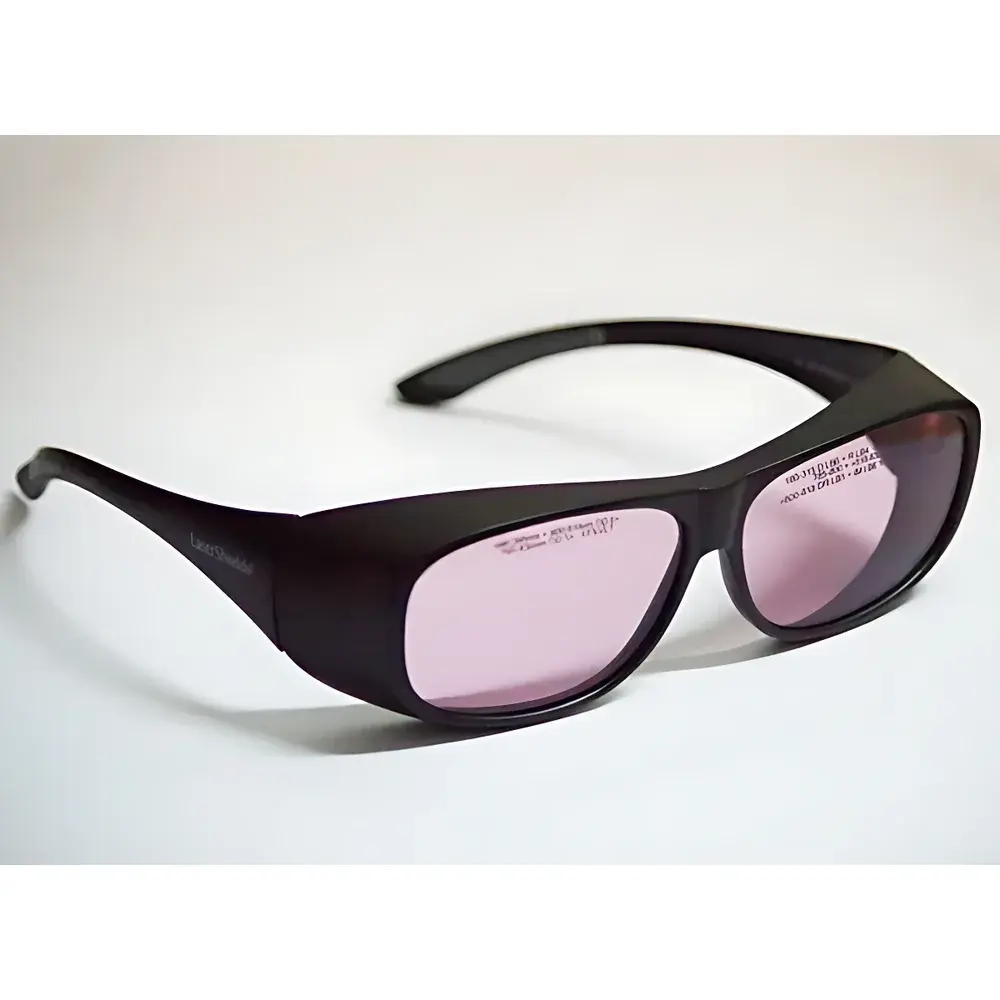
NoIR Laser DI2 Professional Laser Safety Goggles
| Brand | NoIR Laser |
|---|---|
| Origin | USA |
| Model | DI2 |
| Optical Density (OD) Range | OD 4+ across 190–11,000 nm |
| Lens Material | Hard-Coated Polycarbonate |
| Frame Design | Over-Glasses Compatible |
| Compliance | ANSI Z136.1, EN 207, EN 208 |
| Accessories Included | Protective Case, Neck Strap, Microfiber Cleaning Cloth |
Overview
The NoIR Laser DI2 Professional Laser Safety Goggles are engineered for reliable, high-fidelity optical radiation protection in demanding laboratory, clinical, industrial, and defense environments. Designed and manufactured in the United States, the DI2 model employs a proprietary dye-impregnated polycarbonate substrate combined with a durable hard-coat surface treatment to deliver consistent attenuation across an exceptionally broad spectral range—from deep ultraviolet (190 nm) through visible light and into the far-infrared (11,000 nm). Unlike absorptive gel or laminated filter designs, the DI2’s homogeneous dye dispersion within the lens matrix ensures uniform optical density (OD) without wavelength-dependent hotspots or edge effects. Its performance is grounded in fundamental photonic absorption physics, where molecular-level chromophores selectively dissipate incident photon energy as heat—preserving beam collimation integrity while eliminating reflection hazards common in dielectric-coated alternatives. The goggle conforms to the core safety principles defined in ANSI Z136.1 (American National Standard for Safe Use of Lasers) and meets the stringent material and testing requirements of European standards EN 207 (for direct laser exposure) and EN 208 (for alignment applications).
Key Features
- Ultra-broadband protection: Certified OD ≥4 across 190–11,000 nm, covering excimer lasers (193 nm), Nd:YAG (1064 nm), CO₂ (10.6 µm), and quantum cascade laser (QCL) emission bands.
- Impact-resistant lens substrate: Optically clear, shatterproof polycarbonate engineered to ASTM F803-22 specifications for high-velocity impact resistance.
- Hard-coated surface: Scratch-resistant coating maintains nominal OD even after repeated cleaning or incidental abrasion—surface micro-scratches do not compromise attenuation performance.
- Ergonomic over-glasses frame: Adjustable temple arms and contoured nose bridge enable secure, pressure-distributed wear over prescription eyewear without compromising peripheral shielding.
- Full peripheral coverage: Extended top and lateral shielding minimizes stray-light ingress from angled reflections, critical in multi-axis optical tables and fiber-coupled systems.
- Integrated user accessories: Each unit ships with a rigid protective case (ESD-safe interior), adjustable nylon neck strap for hands-free storage, and lint-free microfiber cloth formulated for anti-static lens cleaning.
Sample Compatibility & Compliance
The DI2 is validated for use with continuous-wave (CW), pulsed, and Q-switched laser sources operating within its specified wavelength and irradiance limits. It is routinely deployed in Class 3B and Class 4 laser workspaces compliant with OSHA 29 CFR 1926.102 and institutional Laser Safety Officer (LSO)-mandated controls. Certification documentation includes full test reports per EN 207:2017 Annex A (test method for CW and pulsed lasers) and ANSI Z136.1-2022 Annex D (lens homogeneity and angular dependence verification). The goggle supports GLP/GMP-aligned environments by providing traceable batch-specific OD calibration data upon request—enabling integration into audit-ready safety documentation workflows.
Software & Data Management
While the DI2 is a passive optical device with no embedded electronics, its certification framework integrates seamlessly into digital safety management ecosystems. NoIR provides downloadable PDF-based compliance dossiers—including spectral transmittance curves, OD vs. wavelength plots, and test methodology summaries—for import into institutional LMS (Laser Management Systems) or EHS (Environmental Health & Safety) platforms. All documentation adheres to ISO/IEC 17025 traceability requirements and supports FDA 21 CFR Part 11-compliant record retention when stored on validated electronic systems.
Applications
- Laser surgery and dermatology suites using Alexandrite (755 nm), Er:YAG (2940 nm), or diode-pumped solid-state (DPSS) systems.
- Raman spectroscopy laboratories employing 532 nm, 785 nm, or 1064 nm excitation sources.
- Defense R&D facilities conducting directed-energy weapon (DEW) component testing.
- Academic optics teaching labs requiring robust, reusable eye protection for undergraduate interferometry and holography experiments.
- Industrial laser marking, welding, and additive manufacturing cells utilizing fiber lasers (1070 nm) or CO₂ lasers (10.6 µm).
- Quantum technology labs working with mid-IR optical parametric oscillators (OPOs) and supercontinuum sources spanning 2–12 µm.
FAQ
What does OD ≥4 mean in practical terms?
An optical density of 4 indicates that the lens attenuates incident laser power by a factor of 10⁴ (i.e., reduces intensity to 0.01% of original)—sufficient for most Class 3B and lower-power Class 4 laser operations under ANSI Z136.1 exposure limits.
Can the DI2 be worn over prescription glasses?
Yes—the frame geometry and temple tension are specifically calibrated for stable, gap-free wear over standard ophthalmic eyewear without inducing fogging or lateral light leakage.
Is the lens resistant to solvents used in optical cleaning?
The hard coat withstands routine cleaning with >99% isopropyl alcohol (IPA) and deionized water; however, prolonged immersion in acetone or chlorinated hydrocarbons is not recommended per manufacturer guidelines.
How often should DI2 goggles be recertified?
Per ANSI Z136.1, visual inspection before each use is mandatory; formal retesting is recommended every 24 months or after any impact event, lens scratching beyond ISO 10110-7 scratch-dig 60-40, or exposure to UV doses exceeding 10⁶ J/m² at 254 nm.
Does the DI2 meet military specification MIL-PRF-32432?
While not certified to MIL-PRF-32432 (which applies to ballistic laser eyewear), the DI2 satisfies the optical performance and durability criteria referenced in MIL-STD-810H Method 516.7 for shock and vibration resilience in field-deployable optical PPE.



