
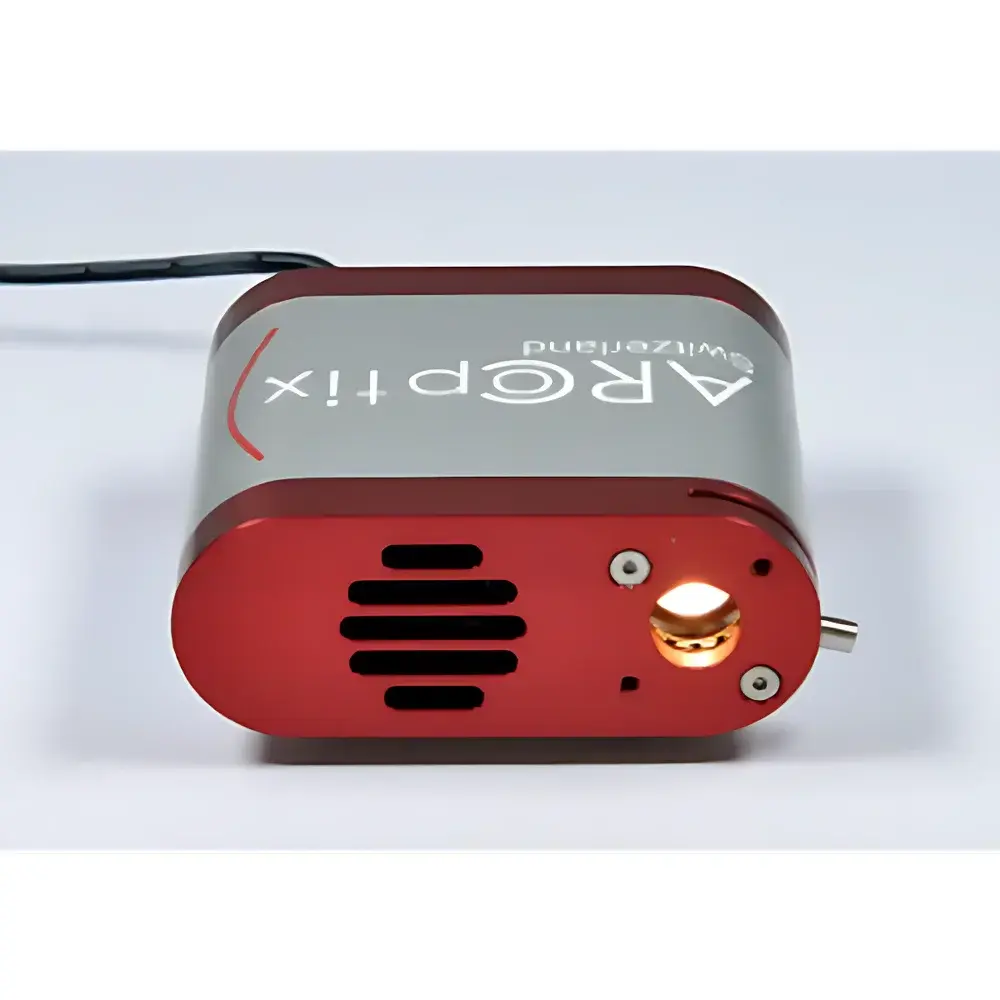
ARClight NIR & MIR Broadband Infrared Light Source by Arcoptix
| Brand | Arcoptix |
|---|---|
| Origin | Switzerland |
| Model | ARCLIGHT-NIR, ARCLIGHT-MIR |
| Light Source Type | Tungsten-Halogen (QTH) / Silicon Carbide (SiC) Globar |
| Spectral Range | 0.4–4 µm (NIR), 1–25 µm (MIR) |
| Spectral Coverage (cm⁻¹) | 25,000–2,500 cm⁻¹ (NIR), 10,000–400 cm⁻¹ (MIR) |
| Color Temperature | ~2850 K (NIR), ~1550 K (MIR) |
| Rated Lifetime | 4,000 h (NIR), 10,000 h (MIR) |
| Power Input | 12 V DC (with integrated 100–240 V AC to 12 V DC converter) |
| Output Diameter | 12.7 mm |
| Fiber Coupling | Removable |
| Attenuation | Manual variable iris |
| Operating Temperature | 5–40 °C |
| Dimensions (L×W×H) | 92 × 92 × 43 mm (body only) |
| Weight | 390 g |
Overview
The ARCLIGHT-NIR and ARCLIGHT-MIR broadband infrared light sources are precision-engineered thermal emitters developed by Arcoptix SA — a Swiss high-tech company founded in 2005 and headquartered in Neuchâtel, at the heart of the Swiss watchmaking valley. Designed for demanding spectroscopic applications, these sources deliver stable, spatially uniform, and spectrally continuous radiation across two complementary spectral domains: the visible–near-infrared (VIS–NIR, 0.4–4 µm) and the mid-infrared (MIR, 1–25 µm). The ARCLIGHT-NIR employs a quartz-tungsten-halogen (QTH) filament optimized for high radiance and color temperature (~2850 K), while the ARCLIGHT-MIR utilizes a silicon carbide (SiC) globar emitter engineered for extended lifetime (10,000 h) and robust thermal stability (~1550 K). Both models feature electronic current stabilization to minimize intensity drift (<0.5% RMS over 8 h), enabling reproducible quantitative measurements in FTIR, reflectance spectroscopy, ellipsometry, and optical component characterization.
Key Features
- Thermally stabilized broadband emission with low temporal noise and high spatial homogeneity
- Integrated manual variable iris attenuator for precise irradiance control without spectral distortion
- Removable fiber coupling optics: CaF₂ aspheric lens (NA = 0.25) for NIR; gold-coated off-axis parabolic mirror (NA = 0.3) for MIR — supporting both free-space and fiber-coupled configurations
- Compact, benchtop-compatible mechanical design (92 × 92 × 43 mm body; <400 g mass) with passive cooling and no moving parts
- Universal AC input (100–240 V, 50/60 Hz) with internal DC conversion to 12 V — eliminating external power supply complexity
- Optimized for integration into OEM systems, portable FTIR platforms, and laboratory-grade optical test benches
Sample Compatibility & Compliance
The ARCLIGHT series is compatible with standard IR-transmissive optics, including ZnSe, Ge, KBr, and CaF₂ beam splitters, windows, and lenses. Its collimated 12.7 mm output beam enables direct coupling into monochromators, interferometers, or integrating spheres without additional focusing optics. The sources meet CE marking requirements for electromagnetic compatibility (EMC Directive 2014/30/EU) and low-voltage safety (LVD Directive 2014/35/EU). While not certified for medical or industrial process control use, they are routinely deployed in GLP-compliant analytical laboratories performing ASTM E1421 (standard practice for near-infrared spectroscopy), ISO 13477 (optical properties of transparent materials), and USP (near-infrared spectroscopy for pharmaceutical analysis). No hazardous substances are used in construction per RoHS Directive 2011/65/EU.
Software & Data Management
The ARCLIGHT units operate as stand-alone hardware with no embedded firmware or digital interface. Intensity calibration is performed externally using NIST-traceable thermopile or pyroelectric detectors. For automated attenuation control or system-level synchronization, users integrate the manual iris via third-party motorized stages (e.g., Thorlabs K10CR1 or Newport ESP300) controlled through LabVIEW, Python (PyVISA), or MATLAB. All optical and electrical specifications are documented in accordance with ISO/IEC 17025:2017 clause 7.6 (traceability of measurements), and calibration certificates (upon request) include uncertainty budgets based on manufacturer-provided spectral radiance data and detector responsivity curves.
Applications
- Reference illumination for FTIR spectrometer alignment and photometric validation
- Broadband excitation source in diffuse reflectance (DRIFTS) and transmission spectroscopy of polymers, pharmaceuticals, and geological samples
- Calibration standard for NIR/MIR imaging systems, hyperspectral cameras, and quantum cascade laser (QCL) reference channels
- Source for measuring spectral responsivity of uncooled microbolometers, InSb detectors, and HgCdTe focal plane arrays
- Stable background emitter in gas-phase absorption studies (e.g., CO, CH₄, NH₃) requiring high signal-to-noise ratio across wide wavenumber ranges
- OEM integration into portable environmental sensors, food quality analyzers, and material sorting systems
FAQ
What is the difference between ARCLIGHT-NIR and ARCLIGHT-MIR in terms of spectral output and thermal management?
The ARCLIGHT-NIR uses a QTH filament operating at ~2850 K, delivering peak radiance in the 1–2 µm range with strong VIS–NIR continuity. The ARCLIGHT-MIR employs a SiC globar at ~1550 K, emphasizing MIR emission (5–15 µm) with reduced visible leakage and superior long-term thermal stability.
Can the ARCLIGHT be used with single-mode fibers?
No — the output NA (0.25 for NIR, 0.3 for MIR) and beam diameter (12.7 mm) are optimized for multimode fiber coupling (e.g., 400–1000 µm core silica or fluoride fibers). Single-mode coupling requires external collimation and focusing optics beyond the included couplers.
Is there a recommended warm-up time before radiometric measurements?
Yes — allow ≥15 minutes after power-on for thermal equilibrium; intensity drift stabilizes to <0.2% after 30 minutes under constant ambient conditions (23 ± 2 °C, no drafts).
Does Arcoptix provide spectral radiance calibration data?
Yes — NIST-traceable spectral radiance curves (W·sr⁻¹·m⁻²·nm⁻¹) are supplied with each unit, measured at 1 m distance using a calibrated FTIR spectroradiometer.
Are replacement lamps or globars available separately?
Yes — QTH lamps (ARCLIGHT-NIR-LAMP) and SiC globars (ARCLIGHT-MIR-GLOBAR) are stocked with full mechanical and electrical interchangeability; typical replacement interval is 4,000 h (NIR) or 10,000 h (MIR) under nominal operating conditions.



