
Carbon Vision AD-Series Carbon Fiber Optical Breadboard
| Brand | Carbon Vision |
|---|---|
| Origin | Germany |
| Model | AD-Version |
| Construction Material | Carbon Fiber Reinforced Polymer (CFRP) |
| Thermal Expansion Coefficient | ~0.2 × 10⁻⁶ /K (axial), ~2.5 × 10⁻⁶ /K (transverse) |
| Density | ~1.6 g/cm³ |
| Stiffness-to-Weight Ratio | >3× higher than aluminum, >8× higher than stainless steel |
| Vibration Damping Enhancement | Up to 60% vs. conventional steel breadboards |
| Magnetic Permeability | μᵣ ≈ 1.0 (non-magnetic) |
| Environmental Tolerance | Humidity-independent |
| Mounting Grid | Standard M6 threaded inserts on 25 mm grid (configurable) |
| Custom Thickness Range | 30–150 mm |
| Typical Natural Frequency Range | 250–850 Hz (size- and thickness-dependent) |
Overview
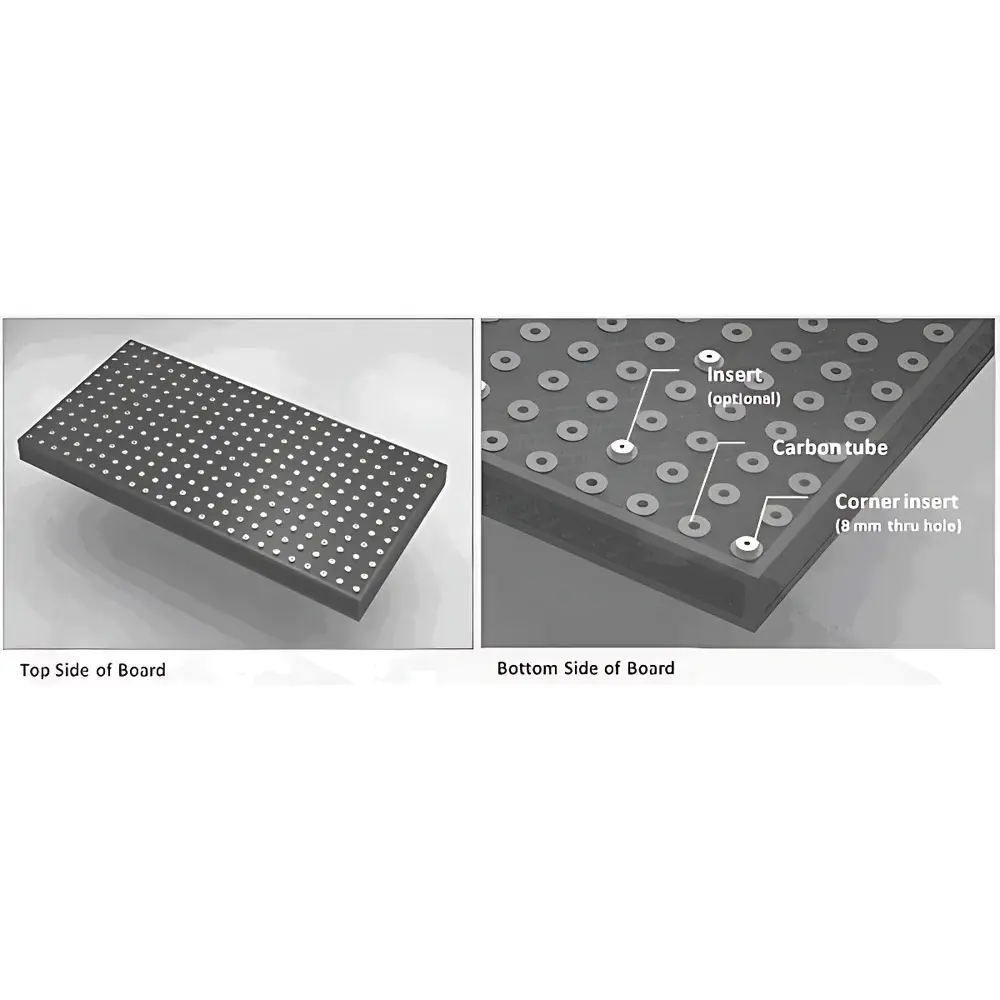
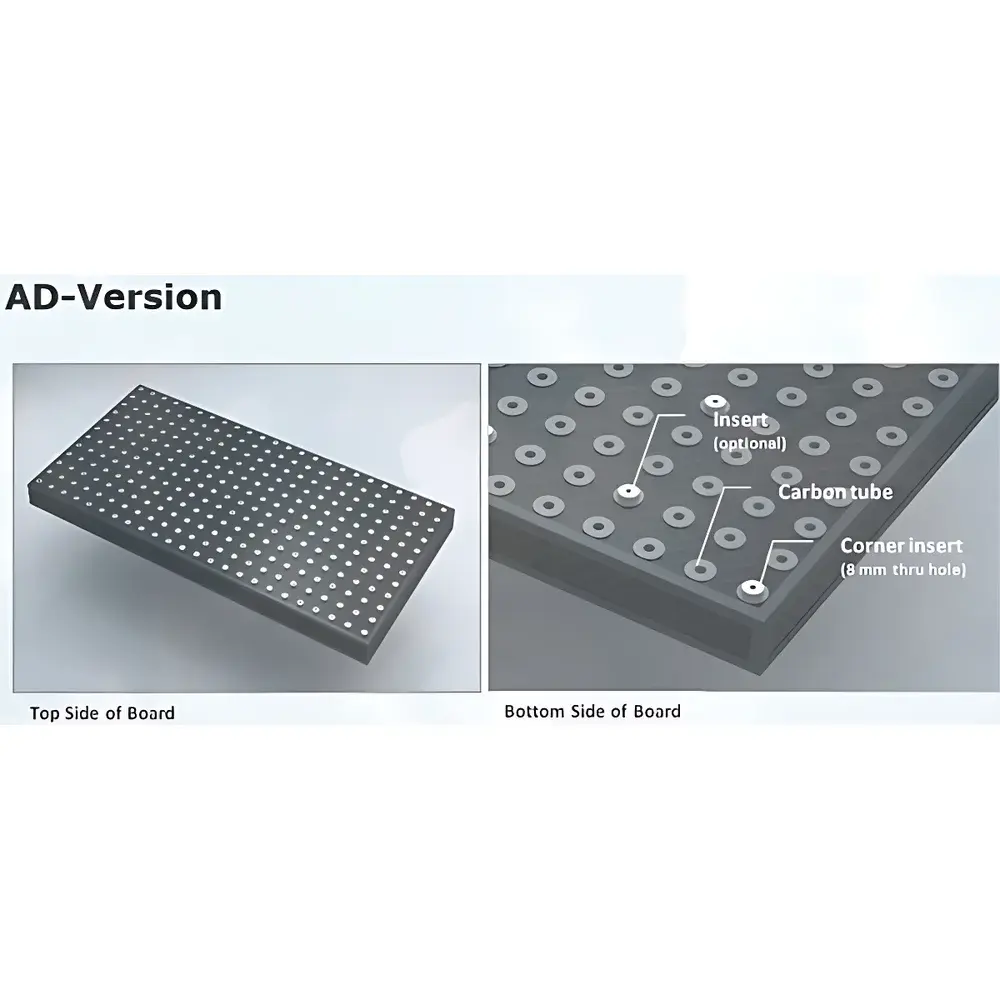
The Carbon Vision AD-Series Carbon Fiber Optical Breadboard is an engineered structural platform designed for ultra-stable optical and precision metrology applications where dimensional stability, dynamic rigidity, and environmental resilience are critical. Built using unidirectional carbon fiber reinforced polymer (CFRP) laminates with optimized fiber orientation and resin matrix formulation, the AD-Series employs a patented sandwich architecture: two CFRP face sheets bonded to a lightweight, high-damping core, with discrete CFRP vertical tubes integrated at every mounting location. These tubes mechanically couple the top and bottom shells, enabling tunable modal response, enhanced bending stiffness, and accessible under-side mounting—without compromising torsional integrity. Unlike traditional steel or aluminum breadboards, the AD-Series exhibits near-zero thermal drift (CTE ≈ 0.2 ppm/K axially), eliminates galvanic corrosion, and maintains structural fidelity across extreme temperature gradients, vacuum environments (<10⁻⁷ mbar), and high-field magnetic systems (up to 12 T). Its non-magnetic nature and low outgassing profile meet ASTM E595 requirements for space-qualified hardware and UHV-compatible instrumentation.
Key Features
- Patented CFRP tube-integrated sandwich design: Provides direct load path continuity between top and bottom surfaces while enabling bottom-side accessory mounting and adaptive damping element insertion.
- Thermal stability: Axial CTE of 0.2 × 10⁻⁶ /K—approximately one-tenth that of stainless steel and one-quarter that of aluminum—ensuring sub-micron positional stability over ±15 °C ambient fluctuations.
- Exceptional dynamic performance: 60% higher vibration attenuation versus equivalent-mass steel breadboards, with natural frequencies tunable via internal damping inserts to avoid resonance coupling with active isolation stages.
- Vacuum and magnetic compatibility: Fully non-magnetic (μᵣ = 1.000±0.002), zero rust/corrosion risk, and certified low-total-mass-loss (TML < 0.5%) and collected-volatile-condensable-material (CVCM < 0.01%) per NASA/ESA space qualification protocols.
- Modular mounting infrastructure: Standard M6 threaded inserts on 25 mm grid (top side); optional dual-grid configurations and custom insert patterns available for OEM integration.
- Scalable architecture: Available in stock sizes from 300 × 450 mm to 1200 × 2400 mm, with thicknesses ranging from 30 mm to 150 mm—each configuration validated via finite-element modal analysis and experimental modal testing (EMT).
Sample Compatibility & Compliance
The AD-Series is compatible with all standard optical components (lenses, mirrors, mounts, translation stages, interferometers) requiring rigid, inert, and thermally neutral support. It is routinely deployed in ISO Class 5–7 cleanrooms, ultra-high-vacuum (UHV) chambers, MRI-adjacent laboratories, and cryogenic test benches. Compliance documentation includes material certification per EN 13782 (composite structural components), outgassing data per ASTM E595, and electromagnetic compatibility (EMC) verification per IEC 61000-4-2 (ESD immunity). The platform meets mechanical interface requirements defined in ISO 10110-7 (optical component mounting) and supports GLP/GMP-aligned calibration traceability when used with NIST-traceable alignment lasers and autocollimators.
Software & Data Management
While the AD-Series is a passive mechanical platform, its design integrates seamlessly with industry-standard metrology software ecosystems. Finite-element models (ANSYS APDL and COMSOL Multiphysics®) are provided upon request for modal prediction, thermal stress simulation, and dynamic compliance mapping. Structural health monitoring is enabled via embedded strain gauge arrays (optional) interfacing with LabVIEW™ or Python-based DAQ frameworks. All custom configurations include digital twin metadata (STEP AP242 format), including mass properties, center-of-gravity coordinates, and principal inertia tensors—essential for multibody dynamics simulation in optical system modeling tools such as Zemax OpticStudio™ and FRED™.
Applications
- Quantum optics experiments requiring long-coherence-time beam paths and sub-nanoradian angular stability (e.g., atom interferometry, cavity QED setups).
- High-resolution interferometric metrology: Michelson, Twyman–Green, and laser Doppler vibrometry platforms where thermal drift induces systematic phase error.
- Aerospace-grade instrument benches for star tracker calibration, laser guide star systems, and space-qualifiable payload integration.
- Ultrafast laser laboratories operating with kHz-repetition-rate amplified systems, where acoustic and mechanical coupling must be minimized below 100 Hz.
- Cryogenic optical tables supporting superconducting nanowire single-photon detectors (SNSPDs) and dilution refrigerator-mounted spectrometers.
- Industrial metrology cells for ISO 10360-compliant coordinate measuring machine (CMM) reference structures and photogrammetry target arrays.
FAQ
Is the AD-Series suitable for ultra-high-vacuum (UHV) applications?
Yes. All CFRP constituents are vacuum-baked and certified to ASTM E595 specifications, with TML < 0.42% and CVCM < 0.005%. Surface finish options include plasma-treated or gold-sputtered variants for enhanced photonics compatibility.
Can mounting holes be added post-manufacture?
No. Threaded inserts are co-cured during laminate fabrication. Custom hole patterns must be specified prior to layup. Retrofitting compromises structural integrity and voids warranty.
What is the maximum recommended load per mounting point?
For static loads, 120 N per M6 insert (tested per DIN 912). Dynamic loading limits depend on frequency content and require modal analysis; contact engineering support for application-specific validation.
Do you provide finite-element models for integration into system simulations?
Yes. Parametric ANSYS Mechanical APDL scripts and STEP AP242 geometry files—including mass properties and constraint definitions—are supplied with all custom orders.
How does the AD-Series compare to granite or steel optical tables in terms of flatness retention?
Initial flatness is ±5 µm over 1 m² (per ISO 10791-7). Unlike granite, it exhibits no hygroscopic warping; unlike steel, it shows negligible creep under sustained load—retaining flatness within ±1 µm over 10,000 hours at 23 °C and 50% RH.





