
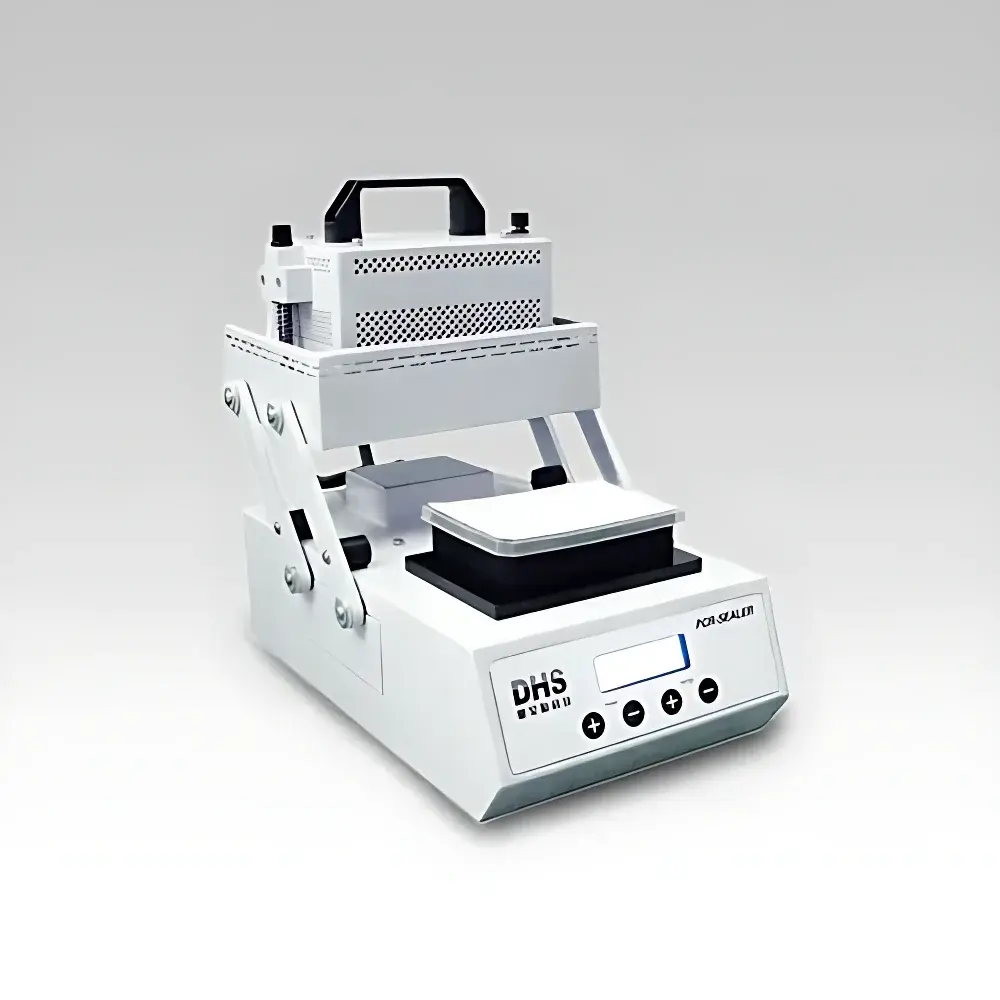
DHS PCR-Sealer 96-Well Microplate Heat Sealer
| Brand | DHS |
|---|---|
| Model | PCR-Sealer |
| Origin | Beijing, China |
| Type | Manual Benchtop Heat Sealer |
| Sealing Temperature Range | 5°C above ambient to 200°C (±1°C accuracy) |
| Sealing Time | 1–9 s (0.5 s increments) |
| Dimensions | 300 × 200 × 300 mm |
| Weight | 9.5 kg |
| Compatible Plates | Standard 96-well PCR plates, ELISA microplates, deep-well plates |
| Compatible Films | Standard thermal sealing films, pierceable films, optical-grade films (qPCR), permanent adhesive films |
Overview
The DHS PCR-Sealer is a compact, manually operated benchtop heat sealer engineered for reliable, reproducible thermal sealing of 96-well microplates used in molecular biology, clinical diagnostics, and life science research. It operates on resistive heating principle: integrated precision-heated sealing bars apply controlled temperature and mechanical pressure to thermally activate adhesive layers on specialized sealing films—forming hermetic, evaporation-resistant seals across all 96 wells simultaneously. Unlike automated or vacuum-assisted sealers, the PCR-Sealer delivers consistent sealing performance without complex programming or compressed air requirements, making it ideal for low-to-medium throughput labs where simplicity, footprint efficiency, and operational robustness are prioritized. Its design adheres to fundamental laboratory safety and sample integrity principles—ensuring minimal risk of cross-contamination, sample degradation, or well-to-well leakage during storage, transport, or downstream thermal cycling.
Key Features
- Manual lever-actuated sealing mechanism ensures uniform pressure distribution across the entire 96-well footprint, eliminating edge lift or incomplete sealing common with non-uniform contact systems.
- Precise digital temperature control (5°C above ambient to 200°C, ±1°C accuracy) with 1°C resolution enables optimization for diverse film chemistries—including standard polypropylene, aluminum-laminated, optical-transparent (qPCR-compatible), and pierceable films.
- Adjustable sealing duration (1–9 seconds, 0.5-second increments) allows fine-tuning for plate material thickness (e.g., thin-wall PCR plates vs. rigid deep-well plates) and film activation kinetics.
- Modular adapter system supports interchangeable plate carriers: dedicated PCR plate holder (0401251-1), universal microplate/deep-well adapter (0401251-2), ensuring compatibility with ANSI/SLAS-standard 96-well formats regardless of skirt type or well geometry.
- Benchtop footprint (300 × 200 × 300 mm) and lightweight construction (9.5 kg) enable flexible placement in biosafety cabinets, cold rooms, or shared instrumentation spaces without structural reinforcement.
Sample Compatibility & Compliance
The DHS PCR-Sealer accommodates all commercially available 96-well microplates conforming to ANSI/SLAS-1-2016 dimensional specifications—including full-skirted, half-skirted, and unskirted PCR plates; flat-bottom and U/V-bottom ELISA plates; and 1.1 mL deep-well plates. It is validated for use with FDA-registered and ISO 13485-manufactured sealing films from major suppliers (e.g., Thermo Fisher ABgene, Excel Scientific, Axygen). While the device itself is not CE-marked or FDA 510(k)-cleared as an IVD instrument, its operation aligns with Good Laboratory Practice (GLP) and ISO/IEC 17025 documentation requirements when integrated into validated workflows—for example, in blood bank specimen archiving (per AABB standards), clinical assay kit manufacturing (under ISO 13485 QMS), or qPCR-based pathogen detection protocols requiring optical film integrity.
Software & Data Management
As a manually operated, non-networked instrument, the DHS PCR-Sealer does not incorporate embedded software, touchscreen interfaces, or data logging capabilities. All parameter settings—temperature and time—are configured via front-panel push-button controls with LED display. This architecture eliminates cybersecurity vulnerabilities, firmware update dependencies, and regulatory validation overhead associated with Class II medical device software. Users maintain full traceability through manual logbook entries or LIMS-integrated SOP documentation referencing batch-specific sealing parameters (e.g., “Sealed 96-well DNA extraction plates with optical film at 165°C for 3.5 s per manufacturer’s IFU”). Audit trails comply with GLP Annex 11 and FDA 21 CFR Part 11 when paired with electronic lab notebook (ELN) systems that capture operator ID, timestamp, and plate lot numbers.
Applications
- Long-term cryogenic storage of clinical specimens (e.g., serum, plasma, PBMCs) in blood banks and biorepositories—preventing freeze-thaw cycle-induced evaporation and contamination.
- Sealing qPCR reaction plates prior to thermal cycling, ensuring optical clarity and pressure stability during ramping phases.
- Final packaging of diagnostic reagent kits (e.g., multiplex PCR master mixes) in certified cleanrooms, meeting ISO 13485 packaging validation criteria.
- High-integrity sealing of NGS library prep plates to avoid index hopping or adapter dimer carryover during storage or shipping.
- Routine sealing of ELISA plates post-coating or pre-incubation to minimize edge effects and solvent loss in humidified incubators.
FAQ
What types of microplates can be sealed with the DHS PCR-Sealer?
Standard, half-skirted, and full-skirted 96-well PCR plates; flat-bottom and round-bottom ELISA plates; and 1.1 mL deep-well plates—all compliant with ANSI/SLAS-1-2016 dimensions.
Is calibration required before first use?
No factory calibration is needed; however, users should verify temperature accuracy annually using a NIST-traceable infrared thermometer or contact probe against the heated sealing bar surface.
Can the sealer accommodate 384-well plates?
No—the DHS PCR-Sealer is specifically engineered for 96-well format only. For 384-well applications, a dedicated high-density sealer with optimized thermal profile and smaller sealing head is recommended.
How often should the sealing bar be cleaned?
After every 50–100 sealing cycles, wipe the bar surface with lint-free cloth moistened with >95% isopropanol to remove residual adhesive buildup and maintain thermal transfer efficiency.
Does the device support programmable presets?
No—it features manual parameter entry only. For labs requiring repeatable multi-step protocols, external SOP documentation or LIMS-triggered checklists are advised to ensure consistency across operators.




