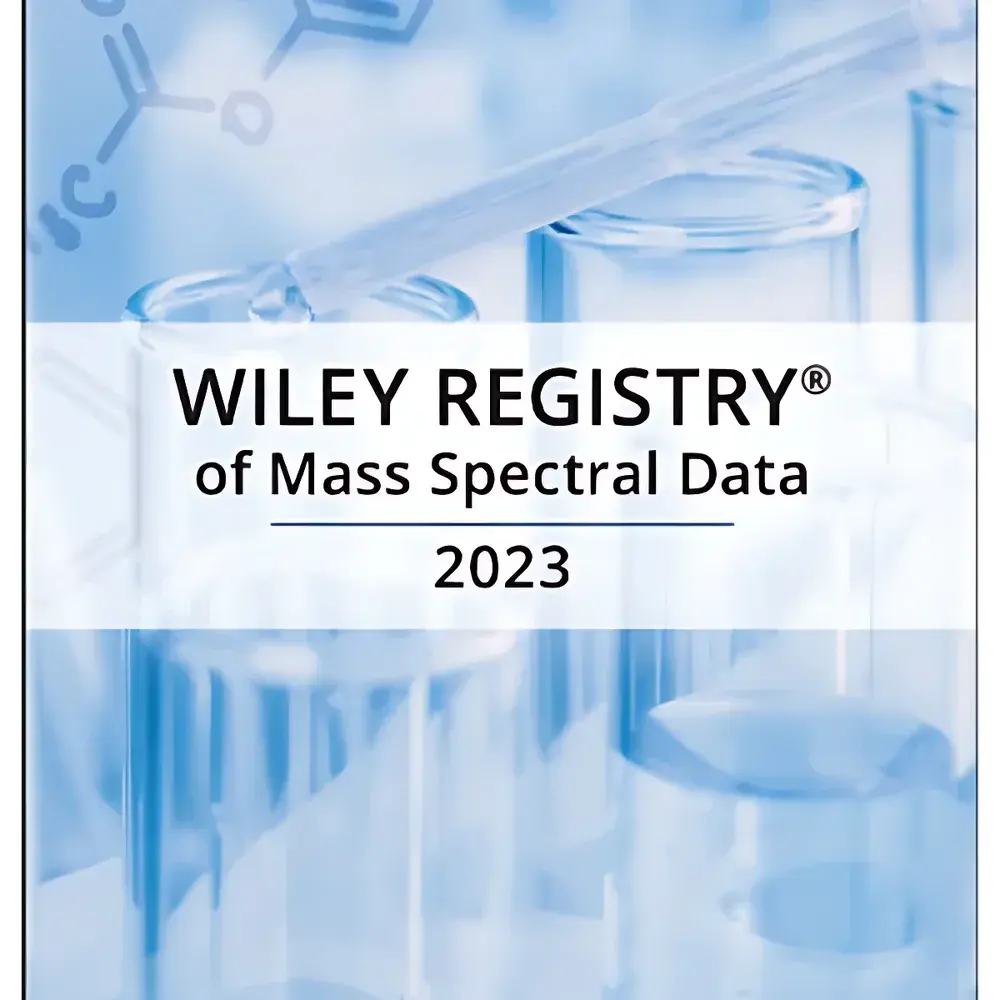
Wiley Registry of Mass Spectral Data 2023
| Brand | Wiley |
|---|---|
| Origin | USA |
| Model | WR2023 |
| Software Type | Mass Spectrometry Library |
| Spectral Entries | >873,000 |
| Coverage | GC-MS, TOF-MS, and high-resolution MS workflows |
| Data Curation | Expert-reviewed, internally and externally validated |
| Structural Metadata | Included (molecular structure, physical properties, DOI where available) |
| Database Architecture | Modular, searchable by mass spectrum, compound name, CAS number, molecular formula, retention index, and structural substructure |
Overview
The Wiley Registry of Mass Spectral Data 2023 (WR2023) is a rigorously curated, vendor-neutral mass spectral reference library engineered for robust compound identification in gas chromatography–mass spectrometry (GC-MS) and time-of-flight (TOF-MS) environments. Unlike algorithmic or instrument-specific spectral libraries, WR2023 is built upon decades of empirical spectral acquisition, expert interpretation, and cross-platform validation—ensuring consistent performance across instruments from Agilent, Thermo Fisher, Shimadzu, Waters, and Bruker. Its core architecture supports both targeted and untargeted workflows, delivering high-confidence matches through peak intensity weighting, retention index correlation, and structural metadata enrichment. Designed for integration into standard GC-MS data systems—including NIST MS Search, AMDIS, ChromaTOF, and OpenChrom—WR2023 functions as a foundational reference resource compliant with analytical validation frameworks required under ISO/IEC 17025 and FDA 21 CFR Part 11 when deployed within auditable laboratory information management system (LIMS) or electronic lab notebook (ELN) infrastructures.
Key Features
- Comprehensive spectral coverage: Contains over 873,000 experimentally acquired, high-fidelity electron ionization (EI) mass spectra, including replicate acquisitions under standardized conditions to support statistical confidence assessment.
- Multi-dimensional search capability: Enables simultaneous querying by mass spectrum, molecular formula, CAS Registry Number, IUPAC name, retention index (RI), and substructure—facilitating rapid dereplication in complex matrices.
- Structural and physicochemical metadata: Each entry includes drawn chemical structures (MOL/SDF format), boiling/melting points, density, refractive index, and Digital Object Identifier (DOI) links where peer-reviewed source literature is available.
- Modular database organization: Spectra are partitioned into application-optimized subsets (e.g., environmental contaminants, pharmaceutical impurities, flavor & fragrance compounds, metabolites), reducing false positives during automated library matching.
- Expert curation pipeline: All spectra undergo dual-review by Wiley’s in-house mass spectrometrists and external academic and industrial collaborators, with traceability logs maintained for audit readiness per GLP and GMP requirements.
Sample Compatibility & Compliance
WR2023 is fully compatible with EI-mode GC-MS datasets generated under standard 70 eV ionization conditions. It supports spectral matching against full-scan, SIM, and deconvoluted chromatographic peaks. The library complies with ASTM E1447–22 (Standard Practice for Identification of Organic Compounds by Mass Spectrometry) and aligns with ISO 17025:2017 clause 7.2.2 on method validation and reference material traceability. While WR2023 itself is not a software platform, its spectral files (in NIST .msp and .lib formats) are validated for use in regulated environments when embedded within validated LIMS or chromatography data systems that implement electronic signatures, audit trails, and user access controls per 21 CFR Part 11.
Software & Data Management
WR2023 is distributed as a set of interoperable spectral libraries—not as standalone executable software. It integrates natively with commercial and open-source GC-MS data analysis tools via standard import protocols. No proprietary runtime environment is required. Spectral files are delivered in compressed archives with SHA-256 checksums for integrity verification. Version control is enforced through annual release cycles (e.g., WR2023 supersedes WR2022); each edition includes revision notes detailing new entries, deprecated spectra, and curation updates. Licensing is perpetual per seat or concurrent user, with optional maintenance agreements covering format compatibility updates and spectral revalidation reports.
Applications
- Regulatory compliance testing (EPA Method 8270, USP <1225>, EU Directive 2009/128/EC)
- Non-targeted screening of environmental samples (soil, water, air particulates)
- Impurity profiling and degradation product identification in pharmaceutical development
- Food authenticity verification and adulterant detection (e.g., essential oil adulteration, pesticide residues)
- Forensic toxicology and doping control laboratories performing routine GC-MS confirmation
- Academic metabolomics and exposomics studies requiring high-confidence annotation of unknown features
FAQ
Is WR2023 compatible with high-resolution mass spectrometry data?
Yes—while optimized for unit-mass EI spectra, WR2023 supports accurate mass filtering and formula-based pre-screening when used alongside HRMS platforms equipped with spectral deconvolution and elemental composition assignment tools.
Does WR2023 include retention index data for all compounds?
Retention indices (Kovats and linear RI) are provided for >92% of entries where experimental GC method details were available and reproducibly reported in primary literature or internal validation studies.
Can WR2023 be deployed on networked LIMS or ELN systems?
Yes—spectral files may be centrally hosted and accessed via shared drives or mounted volumes; integration requires configuration within the host software’s library path settings and adherence to local IT security policies.
How frequently is the database updated?
Wiley releases a new major edition annually (e.g., WR2023), with no interim patches; minor corrections are documented in the release notes and do not require reinstallation.
Is technical support included with purchase?
Basic installation guidance and format compatibility documentation are provided; enterprise customers may contract for advanced deployment consulting and spectral interpretation training sessions.