
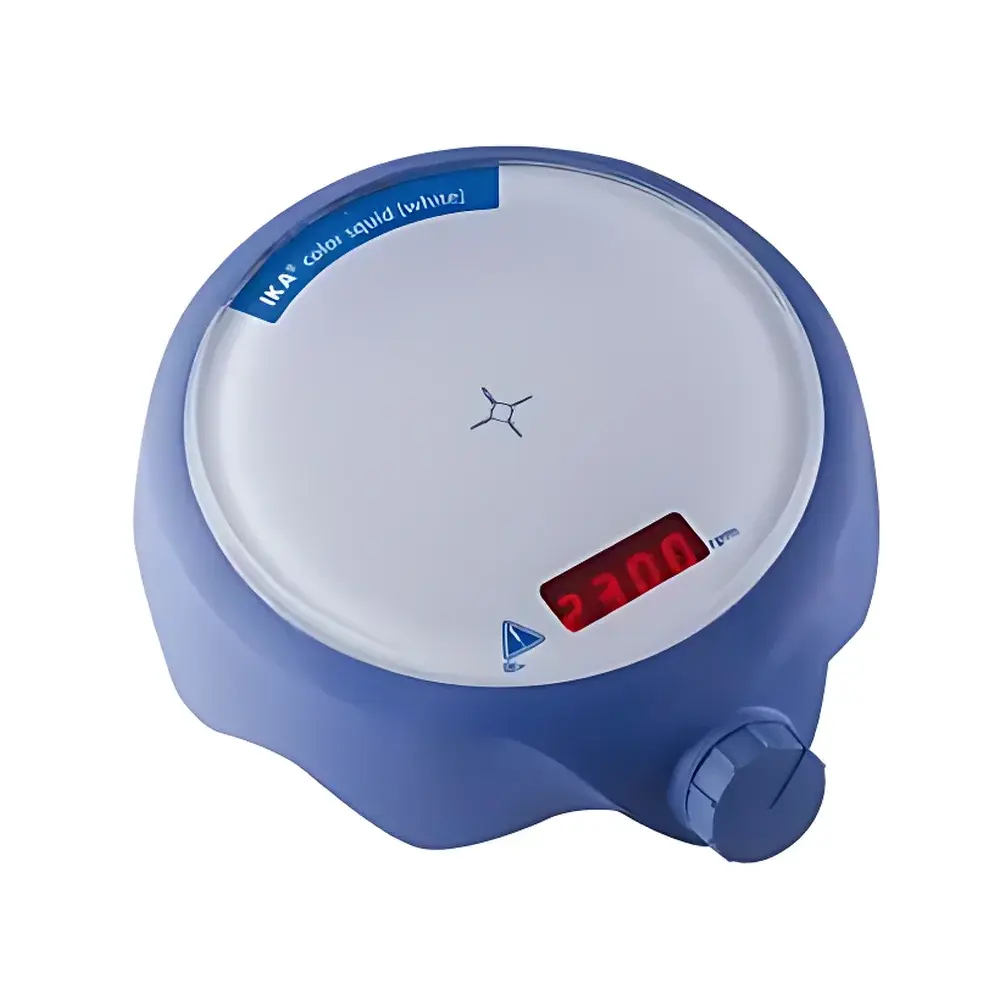
IKA color squid Single-Point Magnetic Stirrer
| Brand | IKA |
|---|---|
| Origin | Germany |
| Model | color squid |
| Stirring Points | 1 |
| Max. Stirring Volume (H₂O) | 0.8 L |
| Motor Input Power | 2 W |
| Motor Output Power | 1 W |
| Speed Range | 0–1500 rpm |
| Max. Stir Bar Length | 30 mm |
| Work Plate Material | Tempered Glass |
| Work Plate Diameter | Ø 110 mm |
| Dimensions (W × H × D) | 130 × 50 × 135 mm |
| Weight | 0.48 kg |
| Ambient Temperature Range | 5–40 °C |
| Relative Humidity Limit | 80 % |
| Ingress Protection | IP54 |
| Voltage | 100–240 V AC |
| Frequency | 50/60 Hz |
| Instrument Input Power | 4 W |
Overview
The IKA color squid is a compact, single-point magnetic stirrer engineered for precision mixing in low-volume laboratory applications where thermal neutrality, chemical resistance, and visual ergonomics are prioritized. Unlike hotplate stirrers, the color squid operates without heating functionality—making it ideal for temperature-sensitive protocols such as enzymatic reactions, polymer dissolution monitoring, or buffer equilibration where exothermic drift must be avoided. Its core operation relies on a brushless DC motor coupled to a high-efficiency magnetic coupling system that transmits rotational force to PTFE- or glass-coated stir bars via a rotating permanent magnet beneath a chemically inert tempered glass plate. The device delivers stable, pulse-free rotation across its full 0–1500 rpm range, with electronic speed control ensuring reproducible shear input for consistent dispersion kinetics.
Key Features
- Chemically resistant work surface: 5-mm-thick tempered glass plate with certified resistance to common solvents (e.g., ethanol, acetone, dilute acids/bases) and mechanical abrasion—compatible with routine cleaning using isopropanol or mild detergent solutions.
- Dual-material housing: Base constructed from Hytrel® thermoplastic elastomer—a DuPont-engineered copolyester offering exceptional impact resilience, low-temperature flexibility (down to –40 °C), and hydrolytic stability—ensuring long-term structural integrity under repeated lab handling.
- Color-customizable interface: Interchangeable decorative overlays (sold separately) allow users to select from multiple geometric or biomimetic patterns printed on PET film; these sit beneath the glass plate and remain fully protected from spills or UV degradation.
- Energy-efficient drive architecture: Low-power consumption (4 W total input) aligns with ISO 50001-aligned lab sustainability initiatives; motor output remains linear and load-compensated up to 0.8 L water-equivalent viscosity (≤ 10 mPa·s).
- Robust environmental rating: IP54 ingress protection certifies resistance to dust ingress and water splashing from any direction—validated per DIN EN 60529—supporting use in shared wet-bench environments or near fume hoods.
Sample Compatibility & Compliance
The color squid supports standard laboratory stir bars up to 30 mm in length, including cylindrical, flea-type, and cross-shaped geometries. It is validated for aqueous and low-viscosity organic media (e.g., methanol, THF, ethyl acetate) at ambient conditions. While not intended for viscous polymer melts or high-density suspensions (>200 cP), its torque profile ensures reliable vortex formation in volumes from 10 mL to 800 mL. The device complies with IEC 61010-1:2010 for electrical safety in laboratory equipment and meets EMC requirements per EN 61326-1:2013. No regulatory certification for GLP/GMP production environments is claimed; however, its traceable serial-numbered build and stable speed calibration support audit-ready documentation when integrated into SOP-controlled workflows.
Software & Data Management
The color squid is a standalone analog-digital hybrid instrument with no embedded firmware, network interface, or data logging capability. Speed setting is adjusted via a rotary encoder with tactile feedback and LED-illuminated RPM readout (0.1 rpm resolution). This design intentionally omits software dependencies—eliminating cybersecurity risks, driver compatibility issues, or validation overhead associated with connected instruments. For labs requiring electronic recordkeeping, external USB-connected tachometers (e.g., Omega HHM120) or time-lapse imaging systems may be used to document operational parameters in accordance with 21 CFR Part 11 Annex 11 principles, provided metadata capture (user ID, timestamp, setpoint) is implemented at the system level.
Applications
- Preparative chemistry: Homogenization of reagent stock solutions prior to HPLC mobile phase preparation or titrant standardization.
- Life sciences: Gentle resuspension of lyophilized proteins or cell pellets without foaming or denaturation risk.
- Quality control: Mixing of reference standards for UV-Vis absorbance calibration curves under ISO/IEC 17025-compliant conditions.
- Education: Visual demonstration of laminar vs. turbulent flow regimes using dyed glycerol/water gradients—enhanced by the transparent glass plate and optional color overlays for pedagogical contrast.
- Materials science: Dispersion of nanomaterials (e.g., graphene oxide, SiO₂ nanoparticles) in aqueous surfactant solutions prior to DLS or zeta potential analysis.
FAQ
Does the color squid support temperature control or heating?
No. It is a non-heating magnetic stirrer exclusively designed for isothermal mixing.
Can it be used with corrosive solvents like concentrated HCl or NaOH?
The glass plate exhibits excellent resistance to short-term exposure; however, prolonged contact with >1 M strong acids or bases is not recommended—consult IKA’s Chemical Resistance Guide for Hytrel® and tempered glass before extended use.
Is speed calibration traceable to national standards?
Yes. Each unit undergoes factory verification against NIST-traceable tachometric references; calibration certificates are available upon request with purchase order number.
What stir bar geometry yields optimal performance at 1500 rpm?
A 25 mm cylindrical PTFE-coated stir bar (diameter 6 mm) provides maximal vortex stability and minimal orbital deviation under full-speed operation in 500 mL aqueous media.
How often does maintenance require motor servicing?
The brushless DC motor is sealed and lubrication-free; no scheduled maintenance is specified. Routine cleaning of the glass plate and vent apertures every 30 days is advised to maintain thermal dissipation efficiency.



