
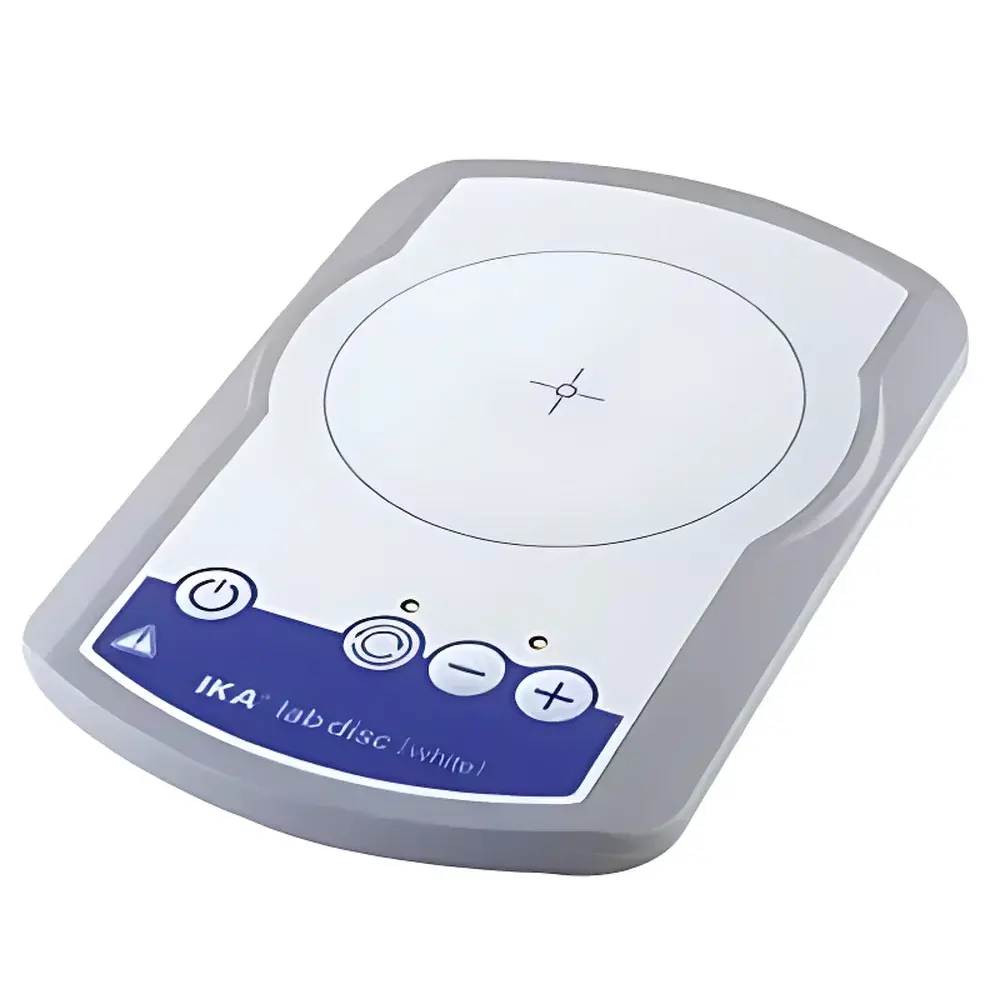
IKA Lab disc Ultra-Thin Magnetic Stirrer
| Brand | IKA |
|---|---|
| Origin | Germany |
| Model | Lab disc |
| Stirring Points | 1 |
| Max. Stirring Volume (H₂O) | 0.8 L |
| Speed Range | 15–1500 rpm |
| Stir Bar Max. Length | 25 mm |
| Plate Material | Polyester Film |
| Plate Diameter | Ø 90 mm |
| Dimensions (W × H × D) | 114 × 12 × 161 mm |
| Weight | 0.3 kg |
| Ambient Temp. | 5–40 °C |
| Relative Humidity | ≤80 % |
| Protection Class | IP65 |
| Explosion Protection | Ex II 3G EEx nC IIB T6, DIN EN 60529 |
| Voltage | 100–240 V AC |
| Frequency | 50/60 Hz |
| Input Power | 5 W |
| Motor Output Power | 3 W |
Overview
The IKA Lab disc Ultra-Thin Magnetic Stirrer is an engineered solution for precise, low-profile magnetic agitation in modern laboratory environments where space efficiency, chemical resistance, and operational safety are critical. Unlike conventional stirrers with rotating motors or mechanical gearboxes, the Lab disc employs a solid-state electromagnetic coil array embedded beneath a seamless polyester film plate—eliminating moving parts, wear-prone bearings, and mechanical failure modes. Its operation relies on controlled alternating magnetic fields that induce synchronous rotation of standard PTFE- or glass-coated stir bars via Lorentz force coupling. Designed for continuous-duty applications under ambient conditions (5–40 °C, ≤80 % RH), it delivers stable rotational output from 15 to 1500 rpm with high torque consistency at low speeds and smooth deceleration profiles—essential for sensitive suspensions, cell culture media preparation, and reagent homogenization without splashing or vortex instability.
Key Features
- Ultra-low profile architecture (only 12 mm height) enables integration beneath fume hoods, inside incubators, or within confined benchtop workflows.
- Directional alternation every 30 seconds—programmable polarity reversal—enhances macro-mixing efficiency by disrupting laminar flow stagnation zones and improving radial distribution uniformity.
- IP65-rated enclosure ensures full protection against dust ingress and low-pressure water jets, supporting cleaning protocols compliant with ISO 14644 cleanroom maintenance standards.
- Explosion-proof certification to Ex II 3G EEx nC IIB T6 (DIN EN 60529 & DIN EN 60079-0/15) permits safe use in Zone 2 hazardous areas handling flammable solvents such as acetone, ethanol, or ethyl acetate.
- Chemically inert plate surface (polyester film) and housing materials resist corrosion from common laboratory acids, bases, and organic solvents—including 1 M HCl, 1 M NaOH, and chloroform—ensuring long-term dimensional stability and surface integrity.
- Non-slip silicone feet and balanced mass distribution prevent lateral displacement during high-speed operation—even on inclined or vibration-prone surfaces.
- Optional color-coded plate graphics support visual workflow differentiation across multiple instruments in shared lab spaces, aiding SOP adherence and reducing operator error.
Sample Compatibility & Compliance
The Lab disc accommodates standard cylindrical or oval stir bars up to 25 mm in length and is optimized for aqueous solutions up to 0.8 L. It maintains consistent rotational performance across viscosities ranging from 1 to 500 mPa·s (e.g., glycerol/water mixtures), provided appropriate bar geometry and speed selection are applied. The device complies with EU Machinery Directive 2006/42/EC, Electromagnetic Compatibility Directive 2014/30/EU, and Low Voltage Directive 2014/35/EU. Its explosion-proof rating satisfies ATEX and IECEx requirements for Group IIB gas atmospheres, making it suitable for QC labs operating under GLP or GMP frameworks where equipment qualification (IQ/OQ/PQ) includes hazardous area verification.
Software & Data Management
As a standalone analog-controlled instrument, the Lab disc does not feature digital connectivity or embedded firmware. All operational parameters—including speed setpoint and directional alternation interval—are adjusted manually via tactile rotary control. This design eliminates software validation requirements under FDA 21 CFR Part 11 and simplifies audit readiness in regulated environments. No electronic logs, timestamps, or user access controls are present—consistent with Category A instrumentation per ASTM E2500-13 guidance for non-critical process equipment. Calibration verification is performed using traceable tachometric measurement (e.g., handheld optical tachometer, NIST-traceable) at three points across the speed range (15, 750, and 1500 rpm).
Applications
- Preparation of homogeneous buffer solutions and dilution series in analytical chemistry workflows.
- Agitation of enzyme reaction mixtures requiring gentle yet uniform mixing to preserve conformational integrity.
- Stirring of sterile cell culture media in biosafety cabinets prior to filtration or dispensing.
- Supporting dissolution testing in pharmaceutical development labs where minimal footprint and chemical compatibility are mandatory.
- Use in environmental testing labs for homogenizing soil leachates or aqueous extracts under controlled humidity conditions.
- Integration into automated sample preparation modules where vertical clearance constraints preclude conventional stirrers.
FAQ
Does the Lab disc support external speed control or RS232/USB communication?
No. It operates exclusively via manual analog adjustment and lacks digital interfaces or programmable logic.
Can it be used with viscous silicone oils or polymer solutions?
It is rated for aqueous systems up to 0.8 L; for viscosities exceeding 500 mPa·s, reduced maximum volume and lower speed limits (≤300 rpm) are recommended to maintain torque stability.
Is the polyester film plate replaceable?
Yes—replacement plates are available as genuine IKA consumables (Order No. 30200000) and can be installed without tools in under 60 seconds.
What stir bar geometry yields optimal performance?
A 25 mm elliptical PTFE-coated bar provides best balance of torque transfer and vortex minimization at speeds above 400 rpm.
Does the device require periodic preventive maintenance?
No scheduled maintenance is specified; routine wipe-down with isopropanol and visual inspection of plate surface integrity suffice per IKA’s maintenance schedule.



