
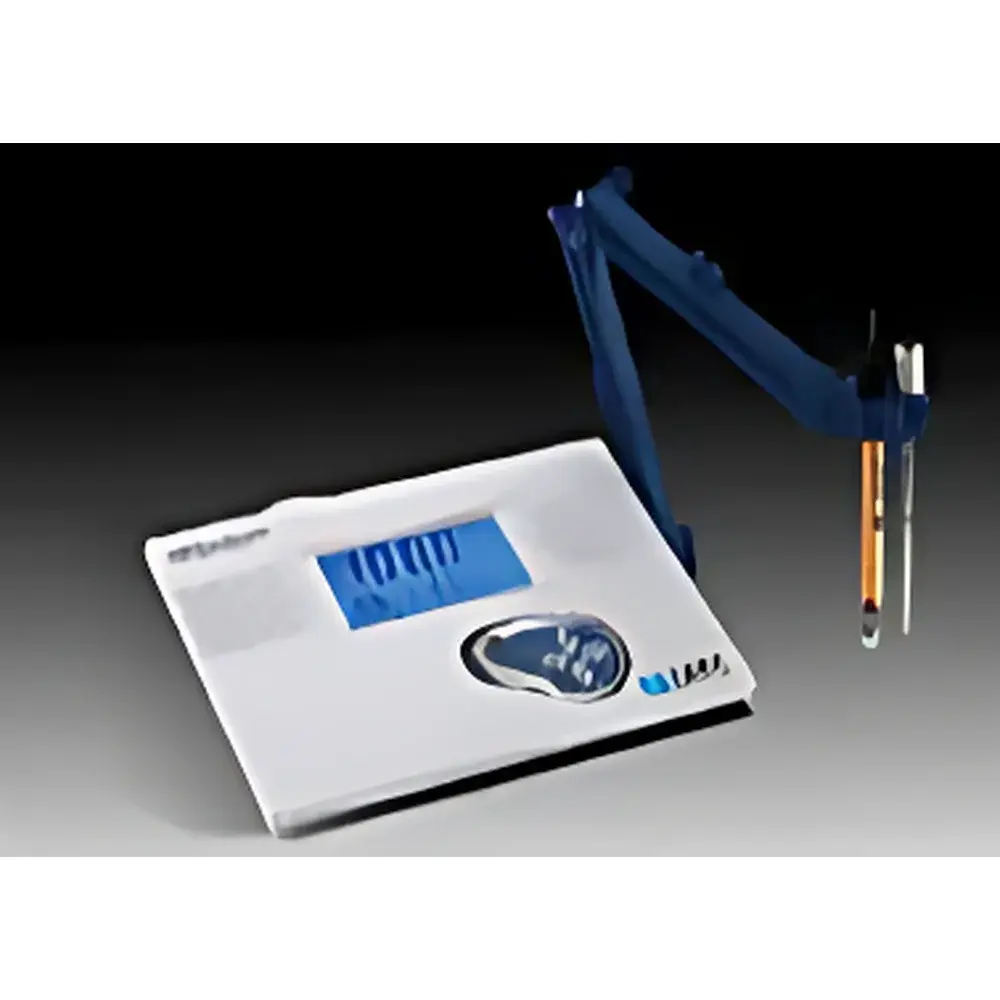
Leici DDS-307A Conductivity Meter
| Brand | Leici |
|---|---|
| Origin | Shanghai, China |
| Model | DDS-307A |
| Conductivity Range | 0–1×10⁵ μS/cm |
| Cell Constants | 0.01, 0.1, 1.0, 10.0 cm⁻¹ |
| Accuracy | ±1.0% FS ±1 digit |
| Temperature Compensation | 15–35°C (ref. 25°C) |
| Sample Temp. Range | 5–60°C |
| Display | Dual-line LCD with blue backlight |
| Compliance | Class 1.0 according to JJG 376–2007 (Chinese national metrological verification regulation) |
Overview
The Leici DDS-307A Conductivity Meter is a benchtop electrochemical instrument engineered for reliable, routine measurement of electrical conductivity in aqueous solutions across research laboratories, quality control environments, and industrial water treatment facilities. It operates on the principle of two-electrode AC conductometry—applying a low-frequency alternating current across a pair of electrodes immersed in the sample and measuring the resulting conductance, which is then converted to conductivity (μS/cm or mS/cm) using the calibrated cell constant. Designed to meet the performance requirements of Class 1.0 instrumentation per JJG 376–2007, the DDS-307A delivers consistent resolution and repeatability for applications ranging from ultrapure water monitoring (using the 0.01 cm⁻¹ titanium alloy electrode) to high-conductivity industrial brines (with the 10.0 cm⁻¹ cell). Its architecture supports both manual and automatic temperature compensation referenced to 25°C, ensuring thermally corrected readings within the 15–35°C ambient operating range.
Key Features
- Dual-line LCD display with uniform blue backlighting for high legibility under varied laboratory lighting conditions
- Four selectable cell constants (0.01, 0.1, 1.0, and 10.0 cm⁻¹), enabling optimized measurement across four distinct conductivity decades
- Automatic frequency selection synchronized with cell constant to minimize polarization error and capacitive interference
- Titanium alloy electrode with 0.01 cm⁻¹ geometry and sealed measurement chamber—specifically engineered for low-conductivity applications such as pharmaceutical water (PW), WFI, and semiconductor rinse water
- Flush-mounted electrical connectors recessed below the front panel surface—reducing electrolyte ingress risk and enhancing long-term corrosion resistance
- Compliance with Chinese national metrological verification standard JJG 376–2007 for conductivity meters (Class 1.0 accuracy grade)
Sample Compatibility & Compliance
The DDS-307A accommodates liquid samples within a temperature range of 5–60°C, making it suitable for ambient, warmed, or cooled aqueous solutions—provided they are non-aggressive toward titanium, stainless steel, and epoxy-sealed components. It is not intended for use with organic solvents, strong oxidizers (e.g., concentrated HNO₃), or highly viscous media. While not certified to ISO/IEC 17025 or GLP/GMP out-of-the-box, the instrument’s documented accuracy (±1.0% FS ±1 digit), stability (±0.33% FS ±1 digit over 3 h), and traceable calibration protocol support integration into regulated workflows when paired with documented procedures, periodic verification using NIST-traceable KCl standards (e.g., 1413 μS/cm at 25°C), and controlled environmental logging. The device meets electromagnetic compatibility (EMC) requirements per GB/T 18268.1–2010 (equivalent to IEC 61326-1).
Software & Data Management
The DDS-307A operates as a standalone, microprocessor-controlled meter without onboard data storage or USB/Bluetooth connectivity. All measurements are displayed in real time; no internal memory or export functionality is provided. Users must manually record values or integrate the unit into external logging systems via analog output (if equipped with optional analog interface module—sold separately). For laboratories requiring audit trails, electronic records, or 21 CFR Part 11 compliance, third-party data acquisition software and validated interfaces are recommended. Calibration history, cell constant assignments, and temperature reference settings are retained in volatile memory and require re-entry after power cycling.
Applications
- Monitoring conductivity of purified water streams in pharmaceutical manufacturing (USP , EP 2.2.38)
- Boiler feedwater and condensate quality assurance in power generation
- Validation of deionized water systems in electronics fabrication
- Routine QC testing of buffer solutions, saline preparations, and electrolyte formulations
- Educational laboratories for fundamental electrochemistry instruction and calibration exercises
- Environmental field labs performing basic water quality screening (as part of multi-parameter assessments)
FAQ
What cell constant should I select for measuring ultrapure water?
Use the 0.01 cm⁻¹ titanium electrode with sealed measurement chamber—this configuration minimizes stray capacitance and enables stable readings down to 0.02 μS/cm.
Does the DDS-307A support automatic temperature compensation for all cell constants?
Yes—ATC is active across all four cell constants, using a built-in NTC thermistor; compensation follows the linear β-model referenced to 25°C.
Is calibration traceable to international standards?
Calibration is performed using aqueous KCl standards; users must source NIST-traceable or equivalent certified reference materials (e.g., 1413 μS/cm at 25°C) to establish metrological traceability.
Can the instrument be used in hazardous locations?
No—the DDS-307A lacks explosion-proof certification (ATEX, IECEx) and is rated for general laboratory use only.
What maintenance is required for long-term accuracy?
Rinse electrodes thoroughly with deionized water after each use; store the 0.01 cm⁻¹ electrode dry and capped; verify calibration weekly or per SOP using fresh standard solution.





