
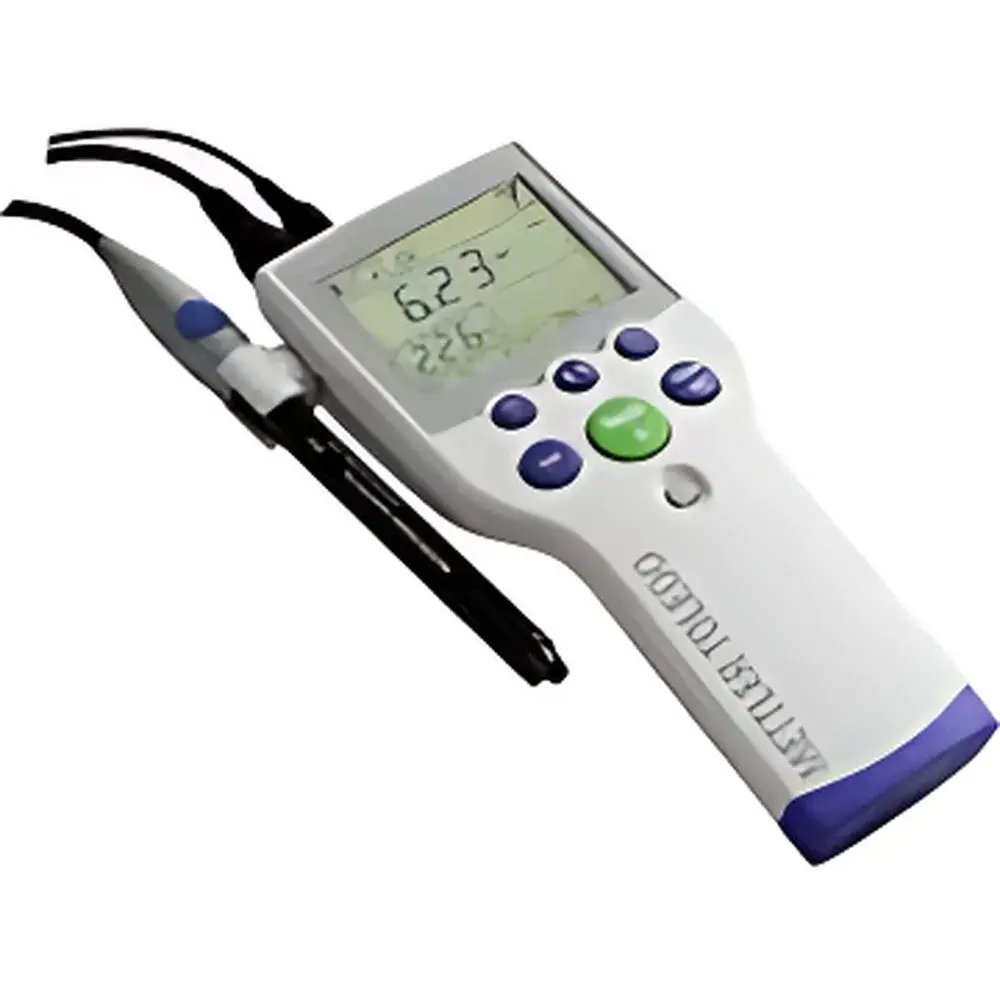
METTLER TOLEDO SevenGo™ SG3 Portable Conductivity Meter
| Brand | METTLER TOLEDO |
|---|---|
| Origin | Switzerland |
| Model | SG3 |
| Conductivity Range | 0.10 µS/cm to 500 mS/cm |
| Temperature Range | –5.0 to 105.0 °C |
| Temperature Resolution | 0.1 °C |
| Temperature Accuracy | ±0.2 °C |
| Conductivity Accuracy | ±0.5% |
| Salt Range | 0.00–80.00 ppt |
| TDS Range | 0.10 mg/L–300 g/L |
| TDS Resolution | 0.01–1 (unit-dependent) |
| TDS Accuracy | ±0.5% |
| Display | Custom LCD |
| Power | 4 × AA alkaline or rechargeable batteries |
| Operating Environment | 5–40 °C, 5–80% RH (non-condensing) |
| Data Storage | 30 measurements |
| IP Rating | IP67 (with InLab® 738/742 electrodes) |
| Compliance | Meets ISO 7888, ASTM D1125, USP <645>, and GLP data integrity requirements for field and lab use |
Overview
The METTLER TOLEDO SevenGo™ SG3 is a handheld, battery-powered conductivity meter engineered for routine measurement of conductivity, resistivity, total dissolved solids (TDS), and salinity in diverse aqueous samples. Based on two-electrode AC conductometric principles with frequency-controlled excitation, the SG3 delivers stable, interference-resistant readings across a broad dynamic range—from ultrapure water (0.10 µS/cm) to concentrated brines (500 mS/cm). Its design emphasizes operational robustness and regulatory readiness: the instrument supports automatic temperature compensation (ATC) using integrated NTC thermistors, implements auto-endpoint detection to minimize user-induced variability, and maintains traceable calibration through documented electrode constants and standard solution verification. As a Class A portable instrument compliant with ISO 7888 (water quality — determination of electrical conductivity) and aligned with ASTM D1125 (standard test methods for electrical conductivity of water), the SG3 serves as a primary field and QC tool for environmental monitoring, pharmaceutical water systems, food & beverage process control, and academic teaching laboratories.
Key Features
- Multi-parameter capability: Simultaneous real-time calculation and display of conductivity, resistivity, TDS (using selectable conversion factors: NaCl, 442™, or user-defined), and salinity (based on PSS-78 practical salinity scale)
- Intelligent ATC: Automatic temperature compensation with linear or non-linear (curvilinear) algorithms, configurable per application; supports manual offset adjustment for non-aqueous or high-viscosity media
- GLP-compliant data handling: Built-in storage for up to 30 measurement records, each timestamped and annotated with temperature, unit, electrode ID (if recognized), and calibration status
- Rugged ergonomic design: Lightweight housing (≈250 g), tactile keypad, and high-contrast custom LCD with intuitive icon-based navigation—optimized for gloved operation and low-light conditions
- IP67-rated electrode compatibility: Seamless integration with METTLER TOLEDO’s InLab® 738 and InLab® 742 sensors—both certified to IP67 for dust/water immersion resistance and suitable for direct field deployment
- Flexible power architecture: Operates on four standard AA alkaline or NiMH rechargeable cells; battery life exceeds 10,000 measurements under typical usage; no external charger required
Sample Compatibility & Compliance
The SG3 is validated for use with aqueous solutions across pH 0–14 and temperatures from –5.0 to 105.0 °C. It accommodates low-conductivity ultrapure water (e.g., WFI, PW), wastewater effluents, seawater, industrial cooling loops, and nutrient solutions. Electrode selection determines matrix suitability: InLab® 738 (cell constant K = 0.1 cm⁻¹) is recommended for low-conductivity samples (<100 µS/cm); InLab® 742 (K = 1.0 cm⁻¹) is optimized for mid-range applications (100 µS/cm–20 mS/cm); optional InLab® 738/10m (10-m cable) enables remote or submerged sampling. The system conforms to ISO/IEC 17025 documentation requirements when used with certified reference standards (e.g., 84 µS/cm KCl traceable to NIST SRM 3194). All configurations support audit-trail-ready operation per FDA 21 CFR Part 11 when paired with LabX® software (via optional USB interface).
Software & Data Management
While the SG3 operates autonomously without PC connectivity, its internal memory enables structured export via optional RS232 or USB-to-PC cable (not included). Raw data files (.csv) retain full metadata—including date/time stamp, measured value, unit, temperature, electrode serial number, and calibration history—for import into LIMS or Excel. Calibration logs include slope, offset, cell constant, and reference standard ID. For centralized fleet management, METTLER TOLEDO’s LabX® Light software provides remote firmware updates, template-driven report generation, and electronic signature-enabled calibration workflows compliant with GMP Annex 11 and EU GMP Part IV. All stored measurements meet ALCOA+ principles (Attributable, Legible, Contemporaneous, Original, Accurate, Complete, Consistent, Enduring, Available) when exported and archived.
Applications
- Environmental field testing: On-site monitoring of river, lake, and groundwater conductivity for EPA Method 120.1 compliance
- Pharmaceutical water systems: Routine checks of Purified Water (PW) and Water for Injection (WFI) per USP , EP 2.2.38, and JP 2.05
- Food & beverage QA: Batch verification of brine concentration, syrup solids, and rinse water purity
- Academic instruction: Student labs requiring reliable, low-maintenance instrumentation for electrochemistry fundamentals
- HVAC and boiler water treatment: Conductivity trending to detect scaling ion buildup or antifreeze dilution
- Aquaculture and hydroponics: Real-time salinity and nutrient solution strength assessment
FAQ
Does the SG3 require annual recalibration?
No—calibration frequency depends on usage intensity and regulatory context. Daily verification with a certified standard is recommended for GLP/GMP environments; formal multi-point calibration is typically performed before each analytical session or at least once per shift.
Can the SG3 measure conductivity in non-aqueous solvents?
It is not validated for organic solvents (e.g., ethanol, acetone) due to dielectric limitations and potential electrode coating. Only aqueous or predominantly aqueous matrices are supported.
Is the instrument compatible with third-party conductivity electrodes?
No—SG3 communicates exclusively with METTLER TOLEDO InLab® digital electrodes featuring embedded EEPROM chip recognition; analog probes without chip identification will not be detected or configured.
What happens if the battery voltage drops during measurement?
The instrument continuously monitors supply voltage and displays a low-battery warning ≥24 hours prior to shutdown; measurements remain valid until power loss, and no data is corrupted during graceful shutdown.
How is measurement uncertainty determined for a given reading?
Total uncertainty combines ±0.5% of reading (conductivity accuracy), ±0.2 °C (temperature sensor error), and electrode-specific repeatability (typically ±0.2% RSD for InLab® 738/742 under controlled conditions), per ISO/IEC Guide 98-3 (GUM).




