
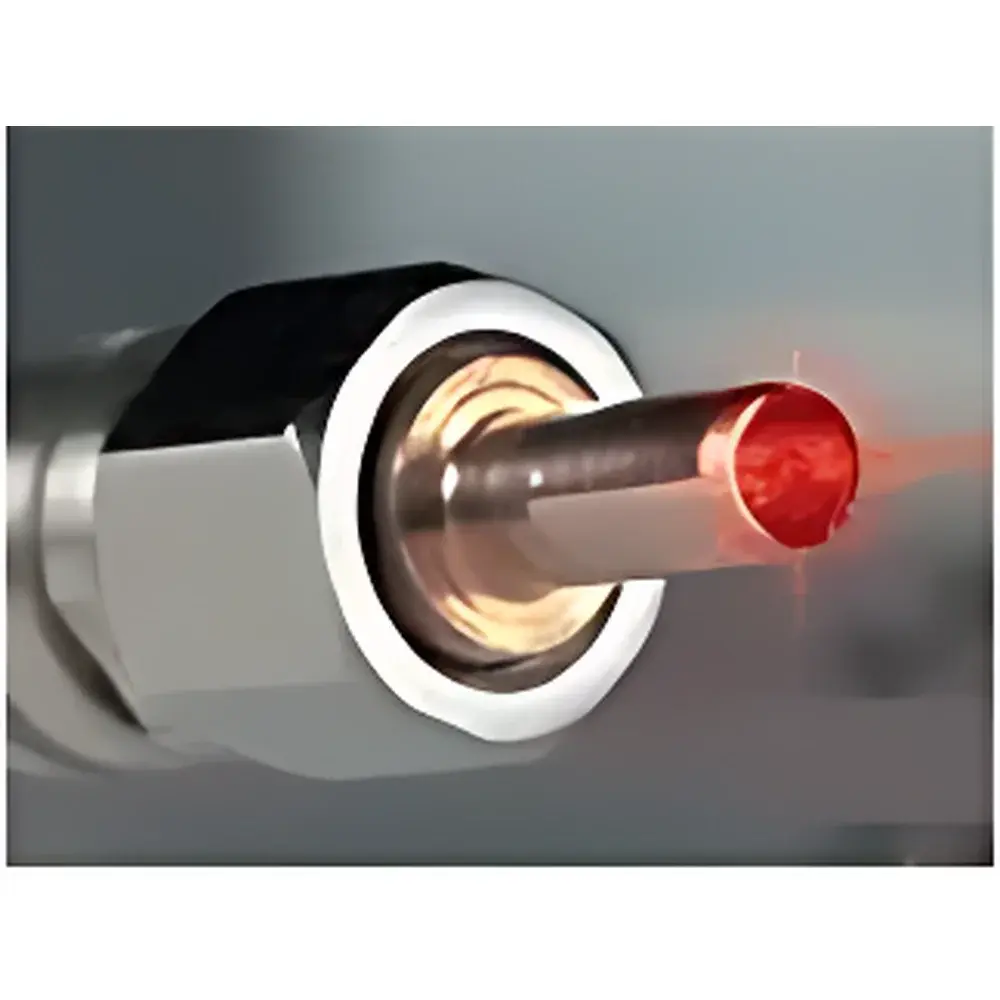
ART Photonics ART Fiber Series High-Power Laser Delivery Fiber
| Brand | ART Photonics |
|---|---|
| Origin | Germany |
| Manufacturer Type | Authorized Distributor |
| Product Category | Imported Optical Component |
| Model | ART Fiber Series |
| Component Type | Optical Fiber Assembly |
| Core Shape | Round (custom shapes available) |
| Core Diameters | 100 µm, 200 µm, 300 µm, 400 µm, 600 µm, 800 µm |
| Core Material Options | High-OH Silica (0.18–1.2 µm), Low-OH Silica (0.35–2.5 µm) |
| Cladding | Fluorine-Doped Fused Silica |
| Numerical Aperture (Standard) | 0.22 ± 0.02 (Full Acceptance Angle: 25°) |
| Optional NA | 0.12 ± 0.02 (14°), 0.26 ± 0.02 (30°) |
| Protective Jacket Materials | Nylon, Tefzel®, Acrylate, Polyimide, Metal |
| Cable Tube | Polymer-Coated Stainless Steel |
| Length Range | 5 cm to 50 m |
| Connector Types | HP-SMA, D80 |
| Power Handling (HP-SMA) | 100 W (100 µm), 200 W (200 µm), 300 W (400 µm), 400 W (600 µm) |
| Power Handling (D80) | 150 W (100 µm), 400 W (200 µm), 600 W (400 µm), 800 W (600 µm) |
Overview
The ART Photonics ART Fiber Series is a high-performance laser delivery fiber engineered for reliable, low-loss transmission of continuous-wave (CW) and pulsed laser radiation across ultraviolet (UV), visible (VIS), and near-infrared (NIR) spectral ranges. Designed in accordance with stringent optical fiber manufacturing standards in Germany, this series leverages precisely controlled fused silica preforms and optimized core/cladding refractive index profiles to ensure exceptional beam quality preservation, minimal thermal lensing, and long-term stability under high irradiance conditions. Unlike standard multimode fibers, the ART Fiber Series incorporates fluorine-doped cladding and carefully selected OH-content variants—High-OH for UV–VIS applications (180 nm–1200 nm) and Low-OH for extended NIR operation (350 nm–2500 nm)—to minimize intrinsic absorption peaks at 1.4 µm, 1.9 µm, and 2.7 µm. Its robust mechanical architecture—including polymer-coated stainless steel cable tubing and thermally stable jacket materials—ensures resistance to bending fatigue, vibration, and ambient thermal cycling typical in industrial laser workstations and medical OEM systems.
Key Features
- German-engineered fused silica construction with certified material traceability and batch-specific optical characterization reports
- Multiple core diameter options (100–800 µm) enabling optimization for power density, beam parameter product (BPP), and coupling efficiency
- Three standardized numerical aperture (NA) configurations (0.12, 0.22, 0.26) supporting tailored angular acceptance and spatial mode control
- High-power connector interfaces: HP-SMA (for compact integration up to 400 W) and D80 (industrial-grade, water-cooled compatible, rated up to 800 W)
- Thermally resilient jacketing options—including polyimide (up to 300 °C short-term), metal (hermetic, EMI-shielded), and Tefzel® (chemical-resistant)—suitable for cleanroom, surgical, or harsh-environment deployment
- Factory-terminated assemblies with interferometrically verified end-face geometry (radius of curvature, apex offset, scratch-dig compliance per MIL-PRF-13830B)
Sample Compatibility & Compliance
The ART Fiber Series is compatible with solid-state lasers (Nd:YAG, Yb:fiber, disk), diode lasers (808 nm, 915 nm, 976 nm), excimer sources (193 nm, 248 nm), and ultrafast Ti:sapphire and fiber-amplified systems (fs–ns pulse widths). All fibers meet ISO 10110-3 surface quality specifications and are supplied with full test documentation including attenuation spectra (per IEC 60793-1-40), proof testing (≥100 kpsi), and connector return loss (>30 dB typical). For regulated environments, optional documentation packages support GLP/GMP validation protocols, including IQ/OQ templates and traceable calibration records aligned with ISO/IEC 17025 requirements. The D80 connector variant complies with DIN 47200 mechanical interface standards and supports optional FDA 21 CFR Part 11–compliant audit trails when integrated with ART’s certified laser control software suite.
Software & Data Management
While the fiber itself is a passive optical component, ART Photonics provides optional configuration management tools for system integrators. These include a web-based Fiber Specification Configurator that enables parametric selection of core/clad geometry, NA, jacket type, length, and connector pairing—generating PDF datasheets and BOMs with part-number traceability. For OEM customers, ART supplies XML-based device descriptors compliant with SEMI E122 standards, facilitating automated integration into laser system diagnostics and preventive maintenance logs. Full spectral attenuation data (190–2500 nm) and power-handling derating curves (as function of pulse duration, repetition rate, and spot size) are delivered in CSV and MATLAB-compatible formats for modeling in Zemax OpticStudio, COMSOL Multiphysics, or Python-based beam propagation simulations.
Applications
- Industrial material processing: fiber-coupled laser welding (e.g., battery tab joining), remote cutting of thin-gauge metals, and selective laser melting in additive manufacturing
- Medical laser systems: flexible delivery for urology (Ho:YAG lithotripsy), dermatology (vascular lesion treatment), and dentistry (Er:YAG ablation)
- Scientific instrumentation: pump delivery for OPOs and Raman spectroscopy probes, cavity-dumping in ultrafast oscillators, and beam transport in vacuum-compatible optical tables
- Defense & sensing: eye-safe LIDAR transceivers (1550 nm), directed-energy testbeds, and ruggedized free-space-to-fiber coupling in field-deployable spectrometers
- OEM integration: embedded fiber pigtails for laser diode modules, hermetically sealed feedthroughs in semiconductor process chambers, and articulated arm replacements in robotic laser cells
FAQ
What is the maximum average power this fiber can handle continuously?
Power handling depends on core diameter, NA, wavelength, cooling conditions, and connector type. Under forced-air convection and optimal beam homogenization, the 600 µm Low-OH fiber with D80 connector sustains 800 W at 1070 nm. Derating is required for UV wavelengths and pulsed operation—consult the included thermal load chart.
Can this fiber be used with femtosecond pulses?
Yes—when specified with low-dispersion design and AR-coated connectors, the series supports pulses down to 30 fs (transform-limited) at 800 nm. Group velocity dispersion (GVD) compensation must be implemented externally for applications requiring sub-100-fs fidelity.
Is there a version suitable for vacuum or UHV environments?
Polyimide-jacketed and metal-sheathed variants are UHV-compatible (outgassing rates <1×10⁻⁹ Pa·m³/s·cm² per ASTM E595); custom bake-out certification and flange-mounted D80 feedthroughs are available upon request.
Do you provide beam profile measurement reports for terminated fibers?
Yes—each assembly undergoes near-field and far-field M²-integrated profiling using a calibrated Ophir BeamWatch system; reports include beam radius (1/e²), ellipticity, pointing stability (<5 µrad), and modal content analysis.
Are custom lengths and hybrid connector combinations supported?
All lengths from 5 cm to 50 m are available; hybrid terminations (e.g., HP-SMA on input / D80 on output) and angled physical contact (APC) polishing are offered as standard customization options with no minimum order quantity.







