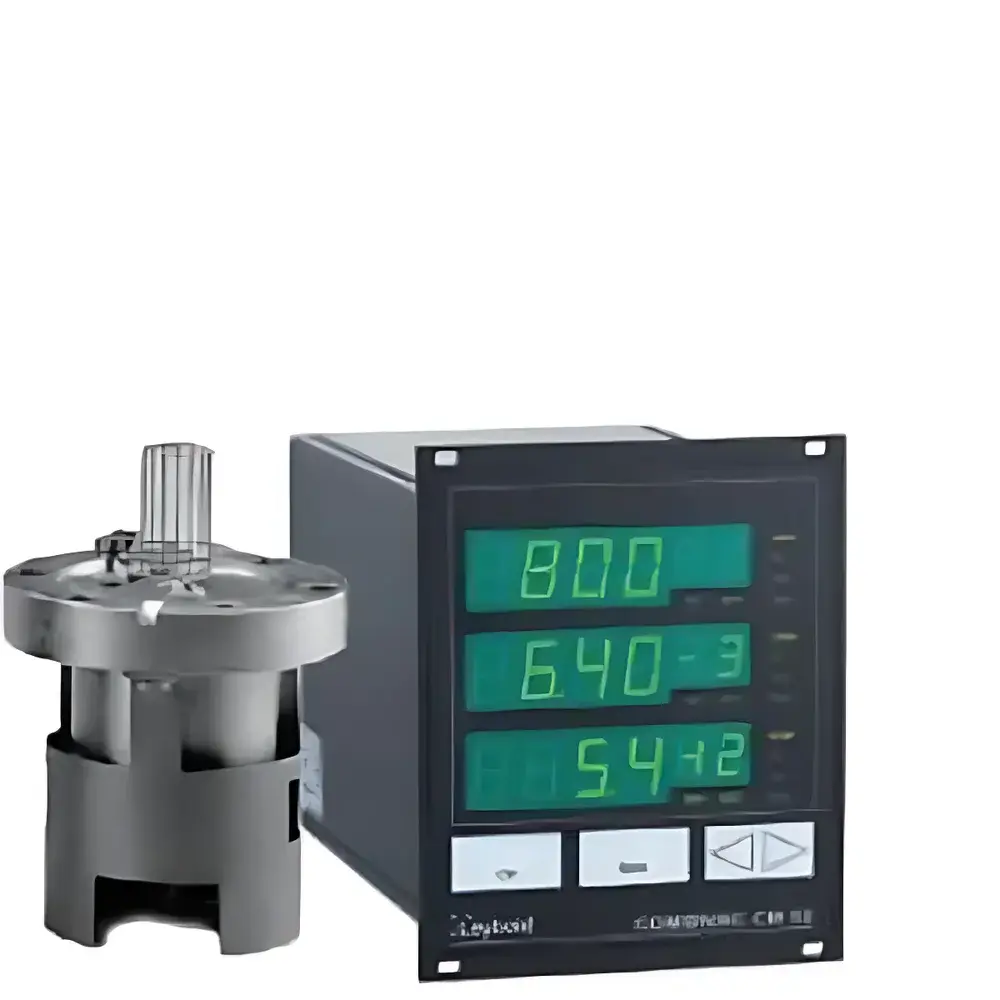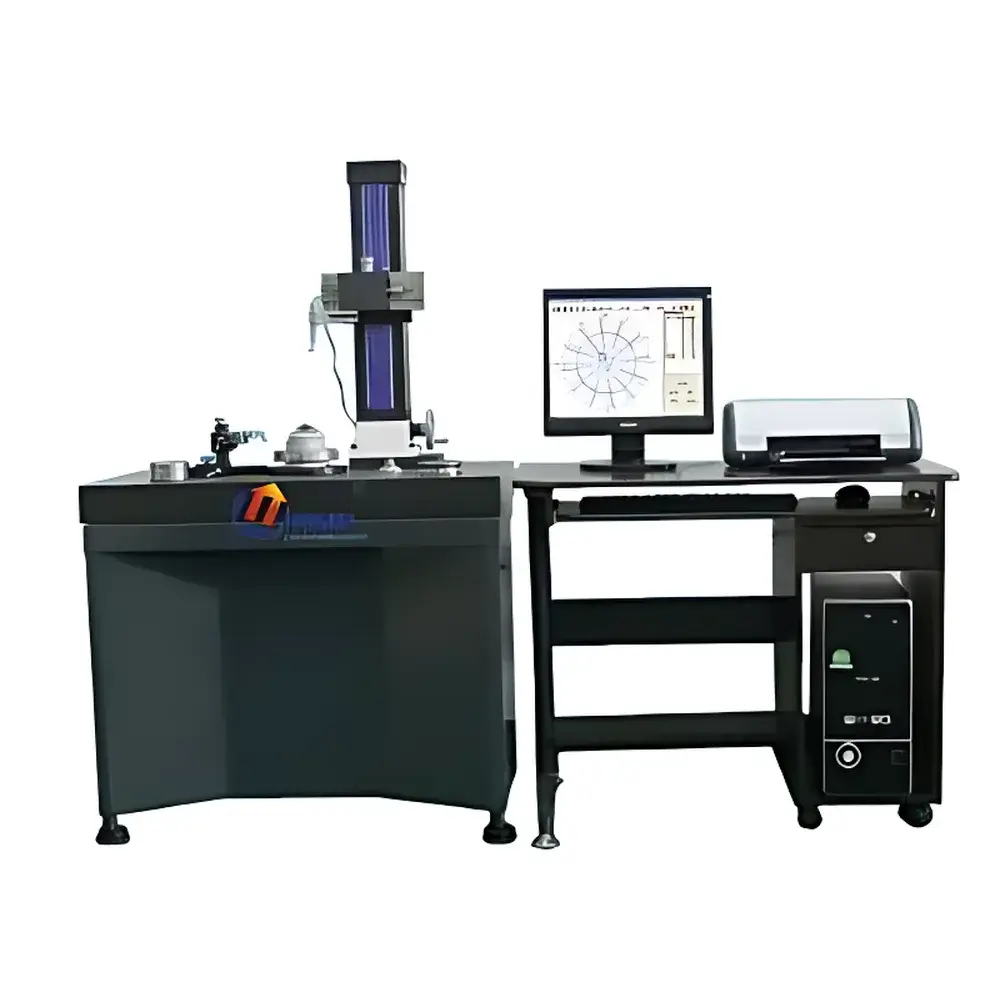
MC012-Y9025DG Roundness and Waviness Measuring Instrument
| Origin | China |
|---|---|
| Manufacturer Type | Authorized Distributor |
| Model | MC012-Y9025DG |
| Spindle Radial Error | ±0.0125 µm |
| System Accuracy | 0.03 µm |
| Max. External Diameter | Ø200 mm (expandable) |
| Min. Internal Diameter | Ø3 mm |
| Max. Measurement Height | 300 mm (extendable) |
| Range | ≤400 µm (radial deviation) |
| Sensor Resolution | 0.01 µm |
| Max. Load Capacity | 15 kg |
| Rotational Speed | 6 rpm |
| Power Supply | 220 V, 50 Hz, 250 W |
| Air Supply Pressure | ≥0.45 MPa |
| Encoder | Imported HEIDENHAIN precision rotary encoder |
Overview
The MC012-Y9025DG Roundness and Waviness Measuring Instrument is a high-precision geometric metrology system engineered for deterministic evaluation of rotational symmetry and surface periodicity in axisymmetric components. Based on the principle of rotating part measurement with high-stability air-bearing spindle rotation and contact-type tactile probing, it quantifies deviations from ideal geometry—including roundness, waviness, concentricity, perpendicularity, parallelism, and flatness—using traceable, NIST-aligned methodologies. Its dual-capability architecture supports both full-circular and partial-arc evaluation, with automated discontinuity detection and configurable filtering (e.g., harmonic analysis up to 50th order) to isolate waviness bands (e.g., ISO 1101-defined 1–15 undulations per revolution). Designed for compliance with ISO 12181-1 (roundness), ISO 12180-1 (cylindricity), and ISO 1101 (geometrical tolerancing), the instrument delivers metrological integrity suitable for first-article inspection, process validation, and supplier quality audits in automotive, aerospace, and precision motor manufacturing.
Key Features
- Air-bearing spindle with radial error of ±0.0125 µm and zero mechanical wear, ensuring long-term repeatability and thermal stability across extended operational cycles.
- HEIDENHAIN high-resolution optical rotary encoder (13-bit or higher resolution) integrated into the main drive system, enabling sub-arcsecond angular positioning accuracy and robust immunity to electromagnetic interference.
- Windows-based proprietary metrology software with intuitive GUI; real-time polar/cartesian plots, dynamic waveform overlays, and synchronized parameter tables for simultaneous multi-parameter assessment (e.g., roundness + runout + phase angle).
- Motorcommutator-specific module supporting concurrent acquisition and analysis of commutator segment roundness, single-segment runout, adjacent-segment differential runout, and eccentricity vector magnitude/direction—fully compliant with IEC 60034-14 and IEEE 112B vibration and alignment criteria.
- Universal leveling base with three-point kinematic adjustment, enabling rapid workpiece setup without recalibration; accommodates irregular or asymmetric fixtures within the 15 kg load limit.
- Modular probe system featuring ruby-tipped styli (standard lengths: 3 mm, 10 mm, 25 mm) and optional nylon-tipped probes for low-force measurement of soft or coated surfaces (e.g., anodized aluminum, polymer composites).
- Onboard spectral analysis engine performing fast Fourier transform (FFT) on acquired profiles, reporting amplitude and phase of user-selectable harmonic orders—essential for diagnosing bearing-induced vibration signatures or machining tool harmonics.
Sample Compatibility & Compliance
The MC012-Y9025DG accepts cylindrical, annular, disc-shaped, and segmented rotary parts with outer diameters from Ø3 mm to Ø200 mm and heights up to 300 mm. It supports interrupted surfaces (e.g., keyways, splines, cooling slots) via automatic gap recognition and configurable interpolation logic. All measurement routines adhere to ISO/IEC 17025 calibration traceability requirements when operated with certified reference artifacts (e.g., NIST-traceable roundness standards SRM 2101). The system meets environmental robustness criteria per ISO 22476-1 for workshop deployment, requiring only standard industrial compressed air (≥0.45 MPa, oil-free, <5 µm particulate filtration) and line power (220 V ±10 %, 50 Hz). No climate-controlled room is mandated—performance remains validated at ambient temperatures of 15–25 °C with ≤60 % RH.
Software & Data Management
The embedded Windows 10 IoT Enterprise platform hosts version-controlled metrology software compliant with FDA 21 CFR Part 11 requirements for electronic records and signatures. Audit trails log all user actions—including profile acquisition, filter selection, datum assignment, and report generation—with immutable timestamps and operator IDs. Data export formats include CSV (for statistical process control integration), DXF (for CAD comparison), and PDF/A-1b (archival-grade reports with embedded measurement uncertainty budgets). Calibration certificates are auto-generated using internal verification routines against built-in master ring gauges, with full GLP/GMP documentation support including revision history, instrument ID tagging, and certificate expiry alerts.
Applications
- Precision bearing races and shaft journals—evaluating waviness bands that influence lubricant film formation and fatigue life.
- Automotive camshafts and crankshaft journals—quantifying lobe symmetry, journal out-of-roundness, and axial taper under production-line conditions.
- Electric motor commutators and slip rings—validating segment-level geometry to prevent brush arcing and torque ripple.
- Optical lens mounts and laser cavity components—verifying coaxial alignment and surface periodicity critical for beam path integrity.
- Aerospace turbine blade root forms—assessing fir-tree interface roundness and flank angle consistency per ASME Y14.5 geometric dimensioning standards.
- Medical device components (e.g., orthopedic implant stems)—supporting ISO 14242-1 wear testing prequalification through baseline roundness certification.
FAQ
What standards does the MC012-Y9025DG comply with for roundness measurement?
It implements ISO 12181-1 (definition and evaluation of roundness), ISO 1101 (geometrical tolerancing), and ISO 5436-1 (profile measurement instrumentation requirements), with traceability maintained via NIST-traceable calibration artifacts.
Can the system measure parts with keyways or other interruptions?
Yes—its intelligent gap-detection algorithm identifies discontinuities automatically; users may apply manual exclusion zones or select partial-arc evaluation modes (e.g., 120° arc) with harmonic re-synthesis for full-circle error estimation.
Is FFT-based waviness analysis included in the base software package?
Yes—real-time frequency-domain decomposition is standard, allowing selective band-pass filtering (e.g., isolating 1–50 UPV for grinding-related waviness) and amplitude/phase reporting per harmonic order.
What is the recommended maintenance interval for the air-bearing spindle?
No scheduled lubrication or replacement is required; periodic verification of air supply cleanliness (via inline filter inspection every 6 months) and annual calibration against certified roundness masters constitute the full preventive maintenance protocol.
Does the system support automated report generation for quality audits?
Yes—customizable templates generate PDF reports with embedded uncertainty budgets, operator credentials, equipment ID, environmental logs, and pass/fail status per GD&T callouts, fully compatible with ASQ CQA and ISO 9001 audit workflows.