
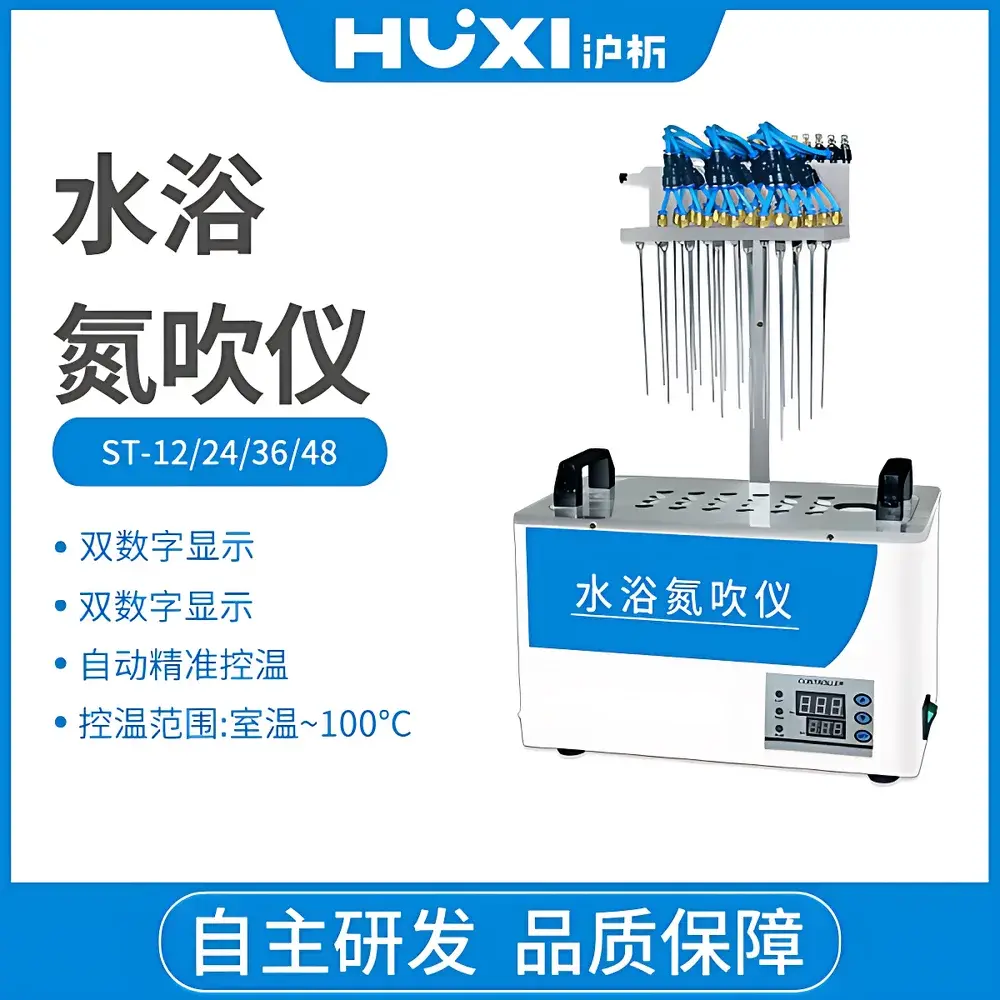
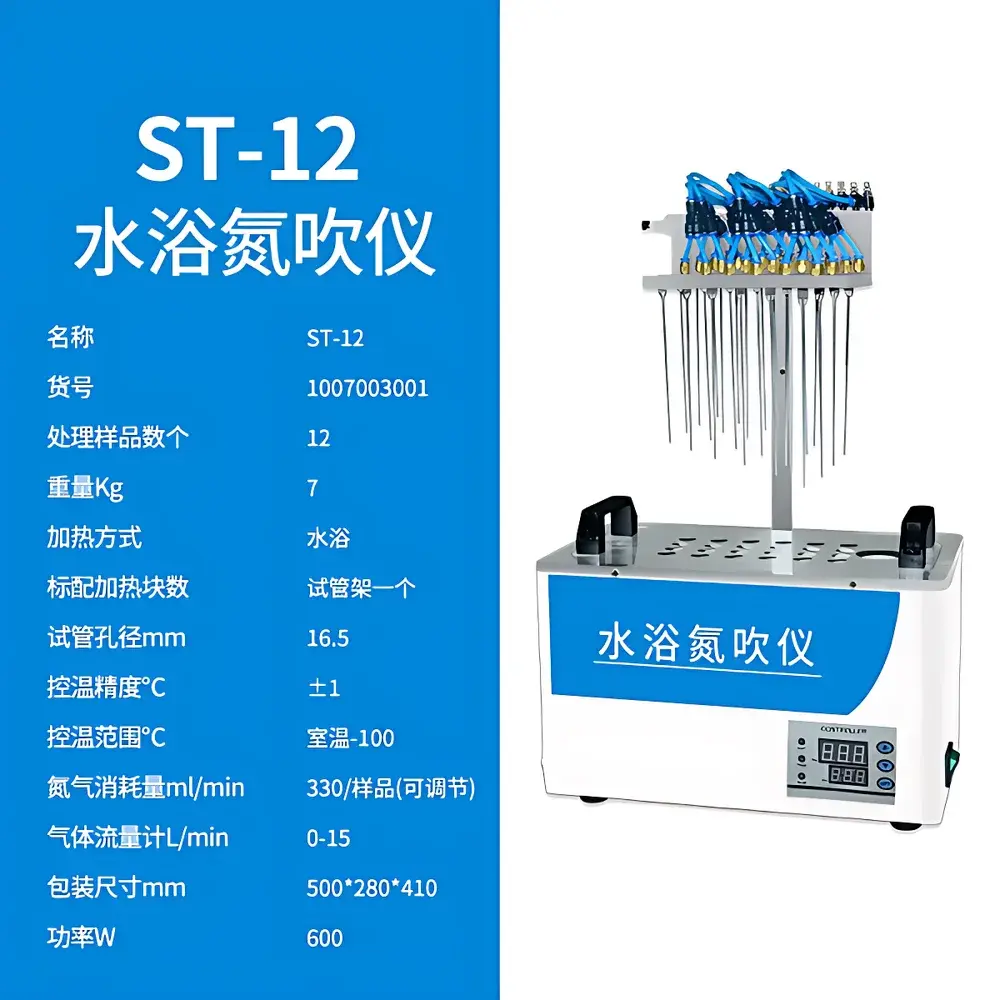
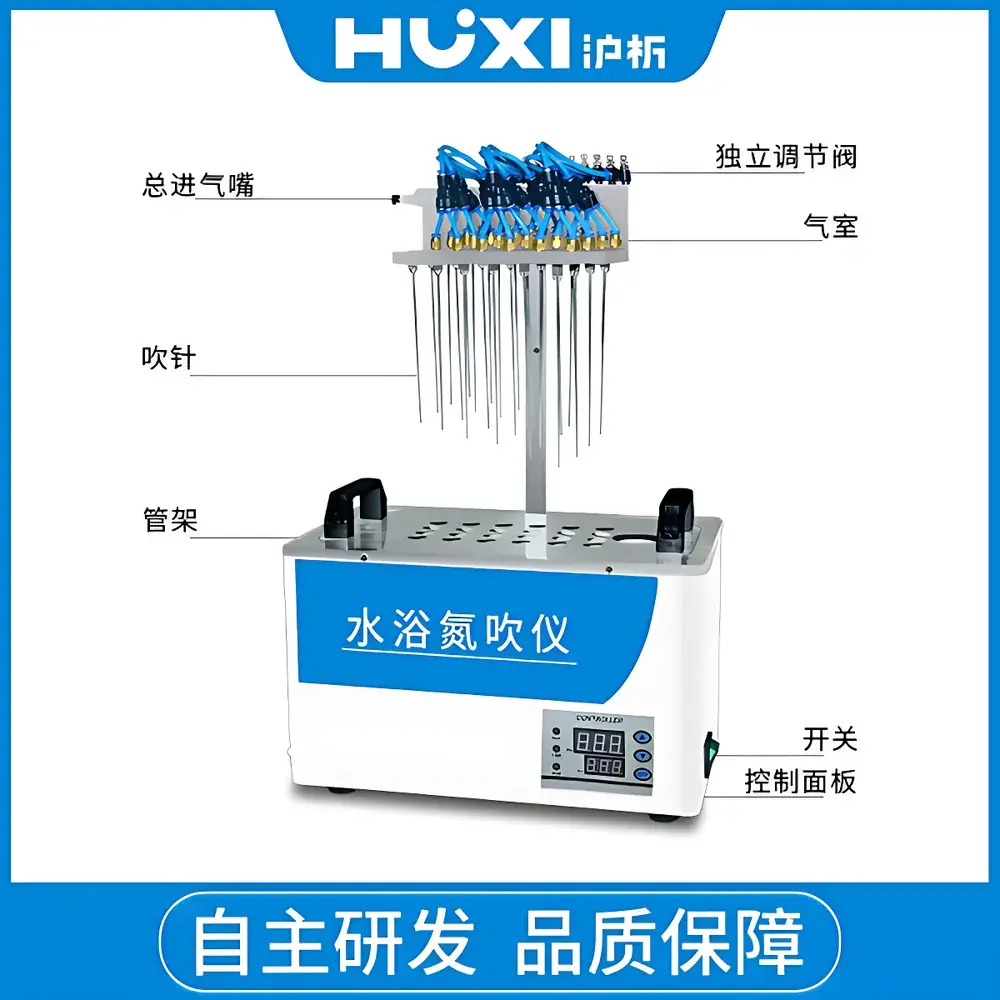
HUXI ST-12 Water Bath Nitrogen Evaporator
| Brand | HUXI |
|---|---|
| Origin | Shanghai, China |
| Manufacturer Type | Direct Manufacturer |
| Country of Origin | China |
| Model | ST-12 |
| Heating Method | Water Bath |
| Temperature Range | Ambient to 100 °C |
| Temperature Stability | ±1 °C |
| Sample Capacity | 12 positions |
| Tube Diameter Compatibility | 16.5 mm |
| Gas Flow Rate | 0–15 L/min |
| Heating Power | 600 W |
| Dimensions (W×D×H) | 340 × 200 × 460 mm |
| Weight | 7 kg |
| Material in Contact with Solvents | 316 Stainless Steel |
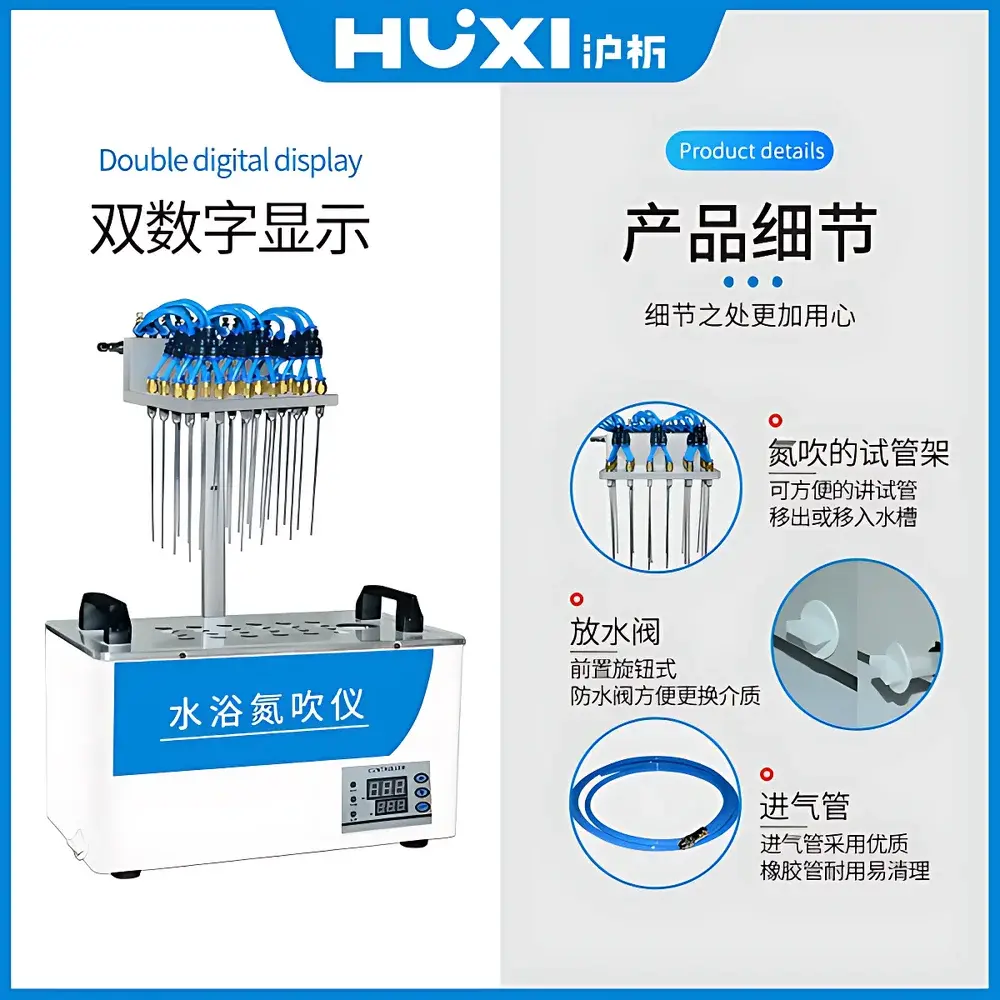
| Control System | Digital PID Temperature Controller with Dual LED Display and Over-Temperature Alarm |
Overview
The HUXI ST-12 Water Bath Nitrogen Evaporator is an engineered solution for gentle, reproducible solvent removal from multiple small-volume samples under inert atmospheric conditions. Unlike rotary evaporation—which imposes thermal stress, requires manual intervention, and struggles with low-volume or thermolabile analytes—the ST-12 employs controlled nitrogen gas flow combined with precise water bath heating to achieve rapid, oxygen-free concentration. Its operation follows the principle of gas-phase mass transfer enhancement: a stream of dry, inert nitrogen is directed perpendicularly onto the liquid surface of each sample, lowering the partial pressure of volatile solvents and accelerating evaporation at temperatures significantly below their boiling points. This method preserves analyte integrity—particularly critical for heat-sensitive compounds such as pharmaceutical metabolites, pesticide residues, steroid hormones, and nucleic acid derivatives—while enabling parallel processing of up to 12 samples. The water bath design ensures uniform thermal distribution across all positions, minimizing inter-sample variability and supporting compliance with method validation requirements in regulated environments.
Key Features
- Independent gas flow control per channel (0–15 L/min), adjustable via precision needle valves—eliminating cross-channel flow imbalance common in fixed-flow systems
- Height-adjustable gas distribution manifold with self-balancing suspension mechanism, allowing vertical positioning optimization for varying tube lengths and solvent volumes
- Dual-display digital PID temperature controller with real-time setpoint/actual temperature readout and programmable over-temperature cut-off (±1 °C stability over 20–100 °C range)
- 316 stainless steel gas nozzles, sample holder, and water bath chamber—resistant to corrosion from organic solvents including acetonitrile, methanol, ethyl acetate, and chlorinated hydrocarbons
- Compact footprint (340 × 200 × 460 mm) and fully enclosed design compatible with standard laboratory fume hoods—ensuring operator safety during volatile solvent handling
- Modular configuration: optional integrated gas flow meters and pressure regulators available for trace-level method transfer and SOP documentation
Sample Compatibility & Compliance
The ST-12 accommodates standard 16.5 mm OD test tubes—including borosilicate glass, polypropylene, and screw-cap vials—without requiring adapters. Custom tube racks (e.g., 13 mm, 18 mm, or staggered arrays) can be fabricated upon request to support specialized workflows in clinical toxicology or environmental analysis. All wetted materials conform to USP Class VI biocompatibility standards, and the unit’s construction supports GLP-compliant operation when paired with calibrated thermometers and documented maintenance logs. While not certified to ISO/IEC 17025 or FDA 21 CFR Part 11 out-of-the-box, its digital temperature logging capability (via external data logger interface) and stable thermal performance enable audit-ready validation for ISO 17025-accredited laboratories performing residue analysis per AOAC 2007.01, EPA Method 525.3, or EU SANTE/11312/2021 guidelines.
Software & Data Management
The ST-12 operates as a stand-alone instrument with embedded firmware; no proprietary software is required for basic operation. However, temperature setpoints and runtime parameters may be recorded externally using third-party data acquisition systems (e.g., LabVIEW, WinCC OA) via analog 0–5 V output or RS-232 serial interface (optional accessory). For GxP environments, users commonly integrate the device into electronic lab notebook (ELN) platforms via CSV export of calibration certificates and maintenance records. The dual LED display provides immediate visual confirmation of operational status—critical during unattended overnight runs—and the over-temperature alarm triggers audible and visual alerts before thermal excursion exceeds ±2 °C beyond setpoint.
Applications
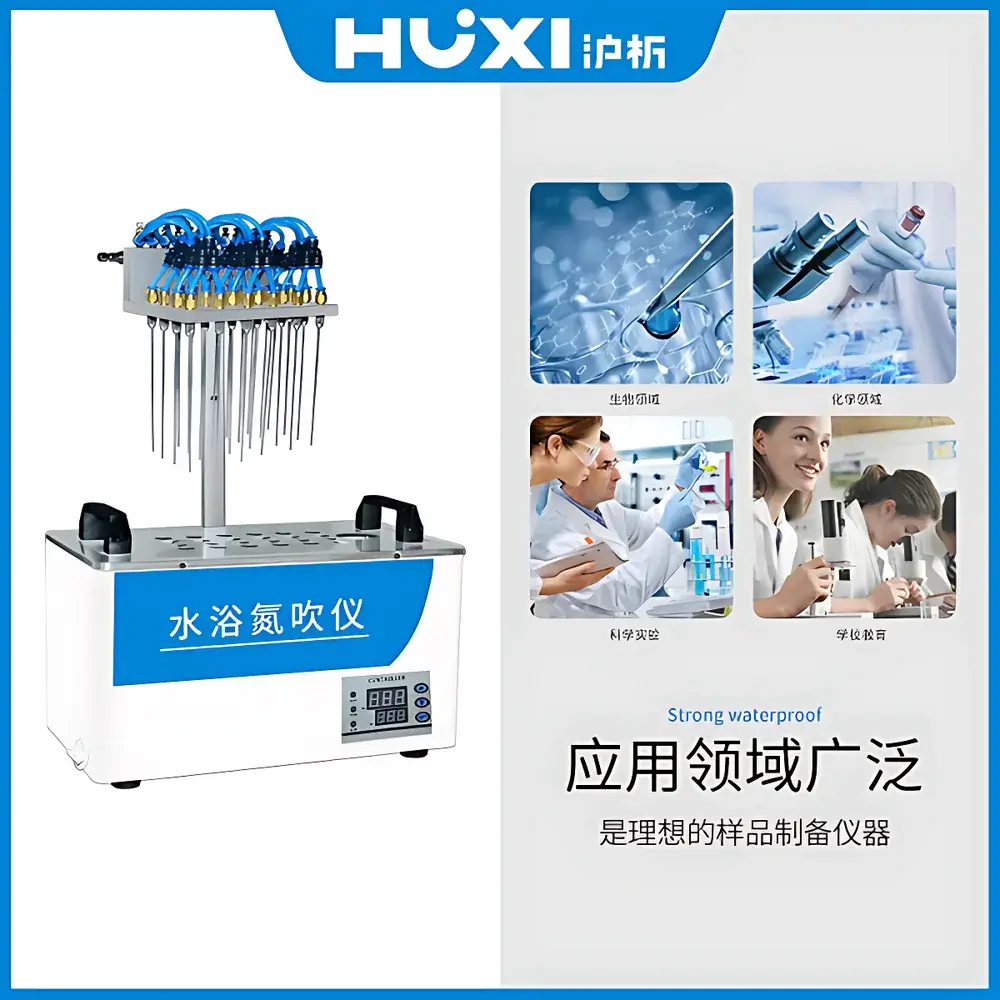
- Residue analysis: Pre-concentration of pesticide extracts (e.g., QuEChERS supernatants) prior to GC-MS/MS or LC-MS/MS injection
- Clinical pharmacokinetics: Reduction of plasma/urine volumes for therapeutic drug monitoring of immunosuppressants (tacrolimus, cyclosporine) and antiepileptics (lamotrigine, valproic acid)
- Food safety testing: Cleanup and concentration of mycotoxin standards (aflatoxins, ochratoxin A) in cereal and nut matrices
- Environmental monitoring: Final volume adjustment of PAH and PCB extracts from soil/sediment leachates prior to instrumental analysis
- Forensic toxicology: Solvent exchange and drying steps in hair or blood sample preparation for benzodiazepine and opioid screening
FAQ
Is the ST-12 suitable for use with corrosive solvents such as concentrated HCl or HF?
No. While 316 stainless steel offers broad resistance to organic solvents and dilute acids, it is not compatible with hydrochloric acid, hydrofluoric acid, or strong oxidizers like nitric acid. Use only with solvents listed in ASTM D471 and ISO 1817 compatibility charts.
Can the water bath be filled with silicone oil instead of water for higher temperature operation?
No. The ST-12 is specifically engineered for aqueous media only. Substituting silicone oil risks thermal runaway, sensor drift, and voiding of the warranty due to altered heat transfer dynamics and potential fluid ingress into control electronics.
Does the unit include a nitrogen gas supply or regulator?
No. The ST-12 requires an external nitrogen source (≥99.998% purity) and a dedicated pressure-reducing regulator capable of delivering 0–15 L/min at 0.1–0.3 MPa inlet pressure. Gas line fittings comply with BSPP 1/8″ standard.
What is the recommended maintenance interval for the water bath heater and temperature sensor?
Calibration verification should be performed quarterly using a NIST-traceable thermometer. Descaling of the water bath chamber is advised every 200 operating hours when using tap water; deionized water reduces scaling frequency by >80%.
Is remote monitoring or Ethernet connectivity supported?
Not natively. Optional RS-232 or 0–5 V analog output modules enable integration with building management systems (BMS) or centralized lab monitoring networks, but Ethernet or Wi-Fi interfaces are not available.



