
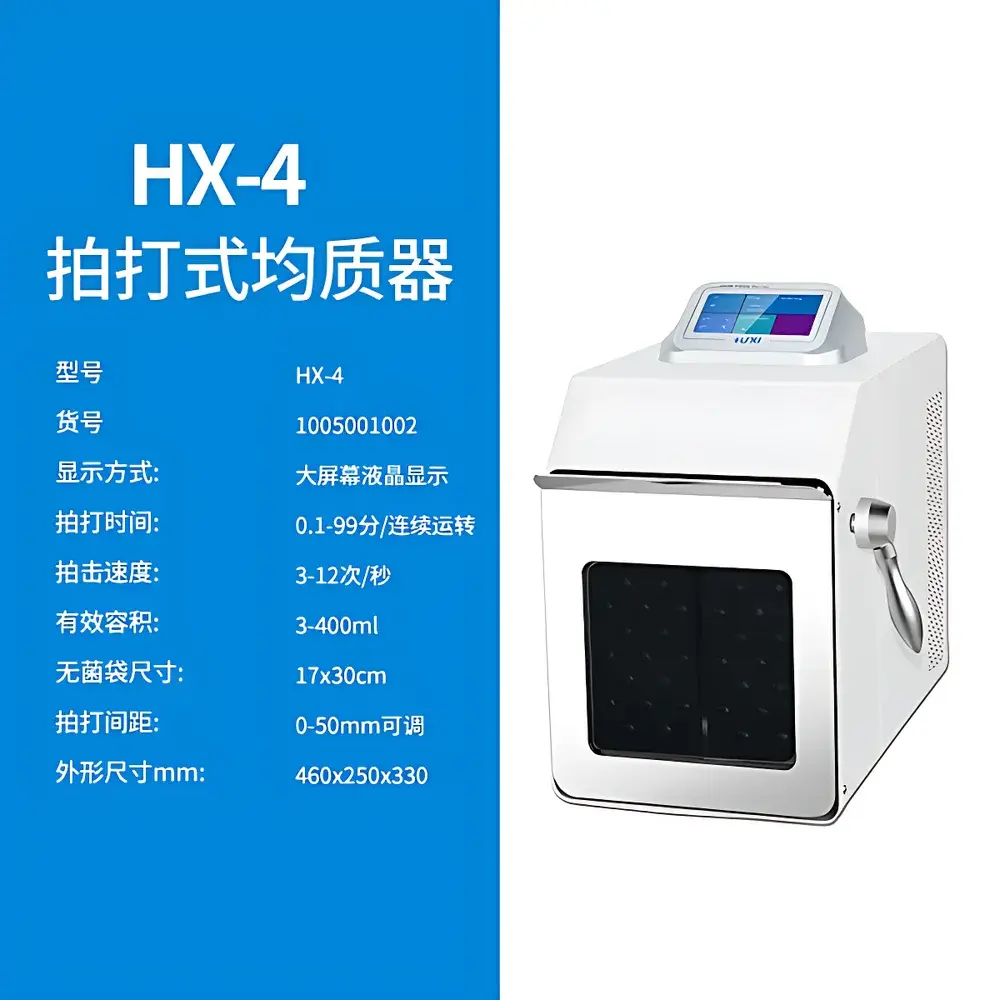
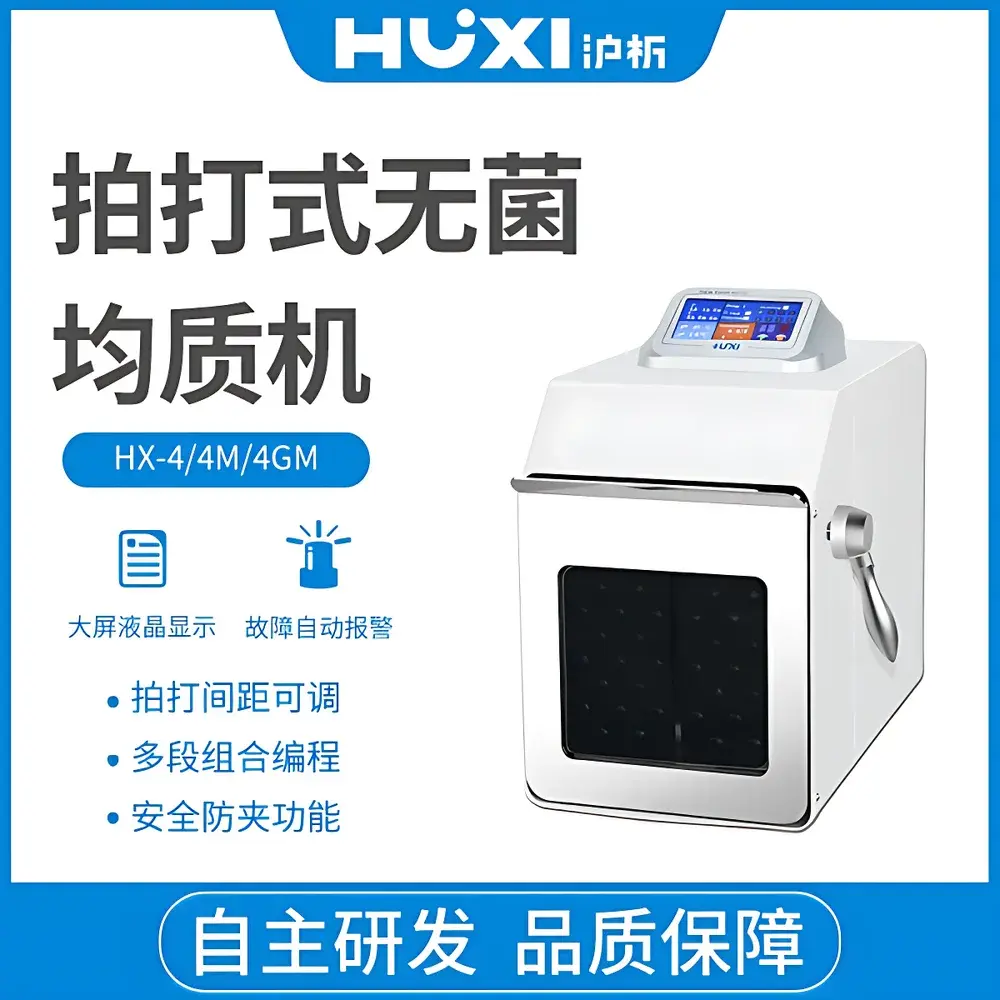
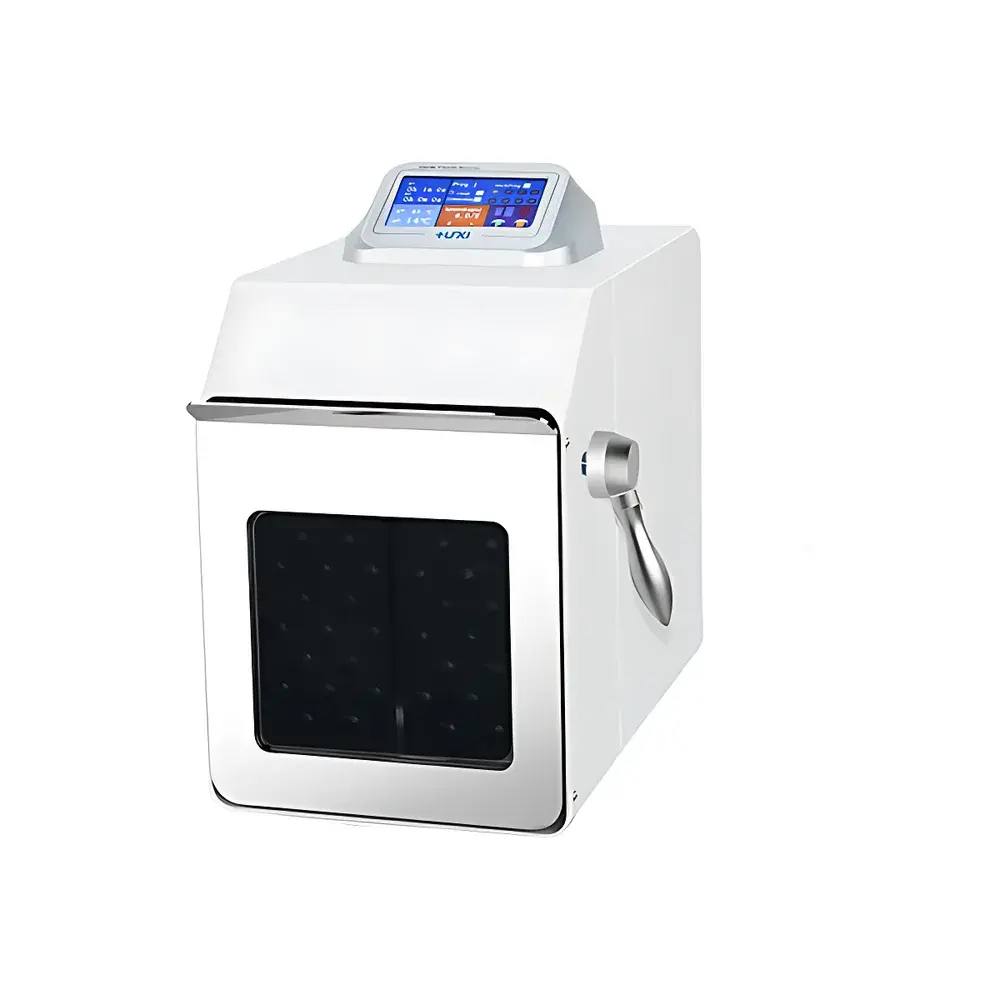
HUXI HX-4 Sterile Stomacher Homogenizer
| Brand | HUXI |
|---|---|
| Origin | Shanghai, China |
| Manufacturer Type | Direct Manufacturer |
| Country of Origin | China |
| Model | HX-4 |
| Instrument Type | Stomacher-type (Paddle-beating) |
| Dimensions (W×D×H) | 420 × 230 × 330 mm |
| Sample Volume Range | 3–400 mL |
| Display | Large LCD |
| Control System | Microprocessor-based with 8 programmable protocols |
| Beat Duration | 0.1 s – 99 h 59 min 59 s or continuous mode |
| Beat Frequency | 3–12 beats/sec |
| Sterile Bag Size | 17 × 30 cm |
| Beat Chamber Material | Stainless steel + corrosion-resistant coating |
| Adjustable Beat Gap | 0–50 mm |
| Safety Features | Soft-start activation, automatic stop on obstruction, tempered glass safety door with removable viewing window |
| Power Supply | 220 V AC / 200 W |
| Weight | 22 kg |
| Noise Reduction | Integrated acoustic enclosure |
Overview
The HUXI HX-4 Sterile Stomacher Homogenizer is a microprocessor-controlled, paddle-beating homogenization system engineered for reproducible, contamination-free sample preparation in microbiological and life science laboratories. Operating on the principle of controlled mechanical agitation—where rhythmic, reciprocating motion of stainless-steel paddles applies uniform shear and impact forces to samples contained within sterile, single-use polyethylene bags—the HX-4 achieves rapid, homogeneous dispersion of microorganisms from solid or semi-solid matrices without thermal stress, enzymatic degradation, or cross-contamination. Unlike rotor-stator or ultrasonic homogenizers, the stomacher design isolates the sample entirely within a sealed, disposable bag, eliminating direct contact between biological material and instrument surfaces. This architecture inherently satisfies critical requirements for aseptic processing, GLP-compliant workflows, and regulatory traceability in food safety, clinical diagnostics, and pharmaceutical quality control.
Key Features
- Microprocessor-driven control interface with large backlit LCD display supporting up to eight user-defined homogenization protocols—including beat frequency (3–12 beats/sec), duration (0.1 s to 99 h 59 min 59 s), and ramped soft-start activation.
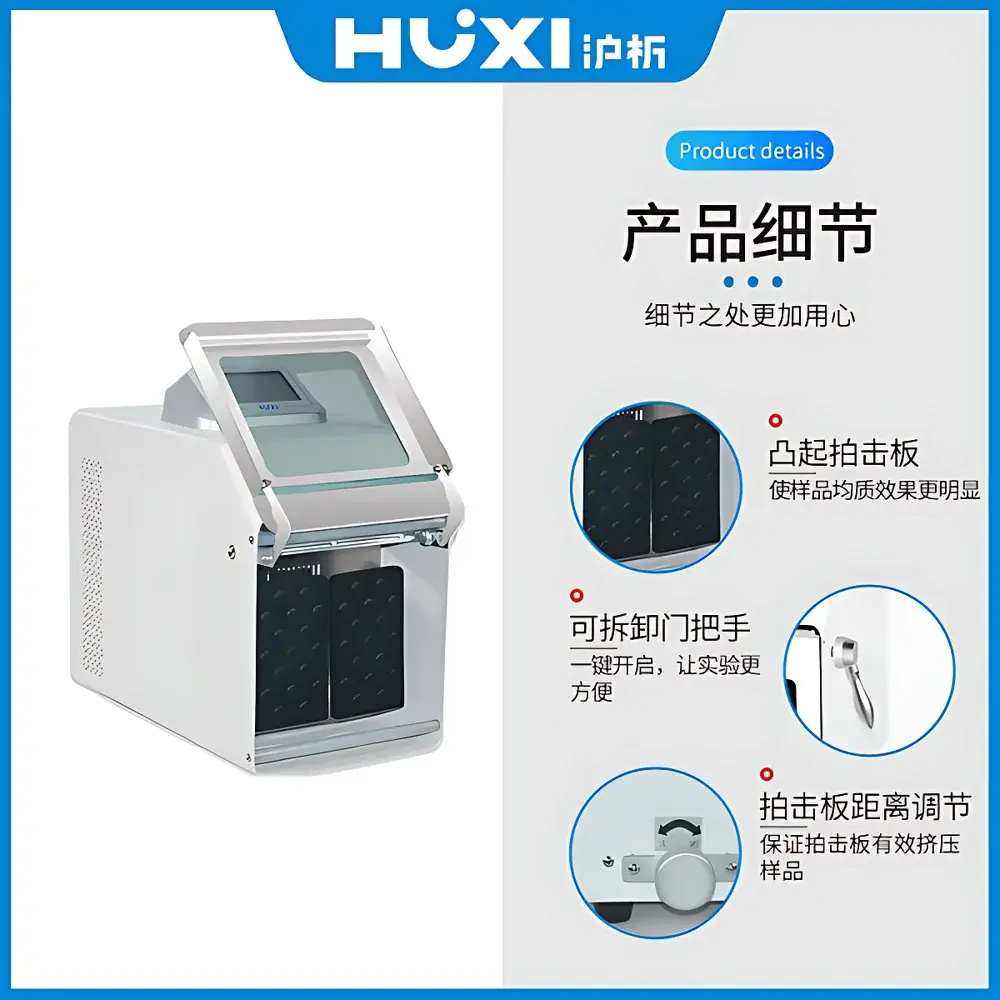
- Adjustable beat gap (0–50 mm) enables optimization of mechanical energy transfer across diverse sample viscosities and particulate loads—from soft tissue homogenates to fibrous plant materials.
- Full-opening, tempered glass safety door with removable viewing window facilitates visual monitoring during operation and simplifies post-run decontamination of the stainless-steel beat chamber.
- Integrated acoustic damping enclosure reduces operational noise to ≤65 dB(A), meeting ISO 7779 standards for laboratory ambient noise levels.
- Obstruction-sensing circuitry triggers immediate motor cutoff upon abnormal resistance, preventing bag rupture and ensuring operator safety per IEC 61000-4-11 electromagnetic compatibility guidelines.
- No internal wetted parts; no cleaning, sterilization, or calibration required between runs—only disposal of the used sterile bag (17 × 30 cm standard format).
Sample Compatibility & Compliance
The HX-4 accommodates sample volumes from 3 mL to 400 mL within commercially available, gamma-irradiated, low-binding polyethylene stomacher bags—validated for use in ISO 6887-1:2017 (microbiological examination of food and animal feeding stuffs) and AOAC Official Method 990.12 (enumeration of aerobic bacteria in foods). It supports homogenization of heterogeneous matrices including raw meat, poultry, seafood, leafy vegetables, dairy products, cosmetic emulsions, and clinical swab transport media. The system complies with ISO/IEC 17025:2017 general requirements for competence of testing and calibration laboratories, and its protocol storage capability meets data integrity expectations under FDA 21 CFR Part 11 when paired with audit-trail-enabled LIMS integration.
Software & Data Management
While the HX-4 operates as a standalone instrument, its microprocessor logs timestamped execution records for each run—including protocol ID, start time, actual beat count, and final duration—stored in non-volatile memory for retrieval via front-panel navigation. Optional RS-232 or USB-to-serial interface (available upon request) enables automated data export to laboratory information management systems (LIMS) or electronic lab notebooks (ELN), supporting ALCOA+ principles (Attributable, Legible, Contemporaneous, Original, Accurate, Complete, Consistent, Enduring, Available) for regulated environments.
Applications
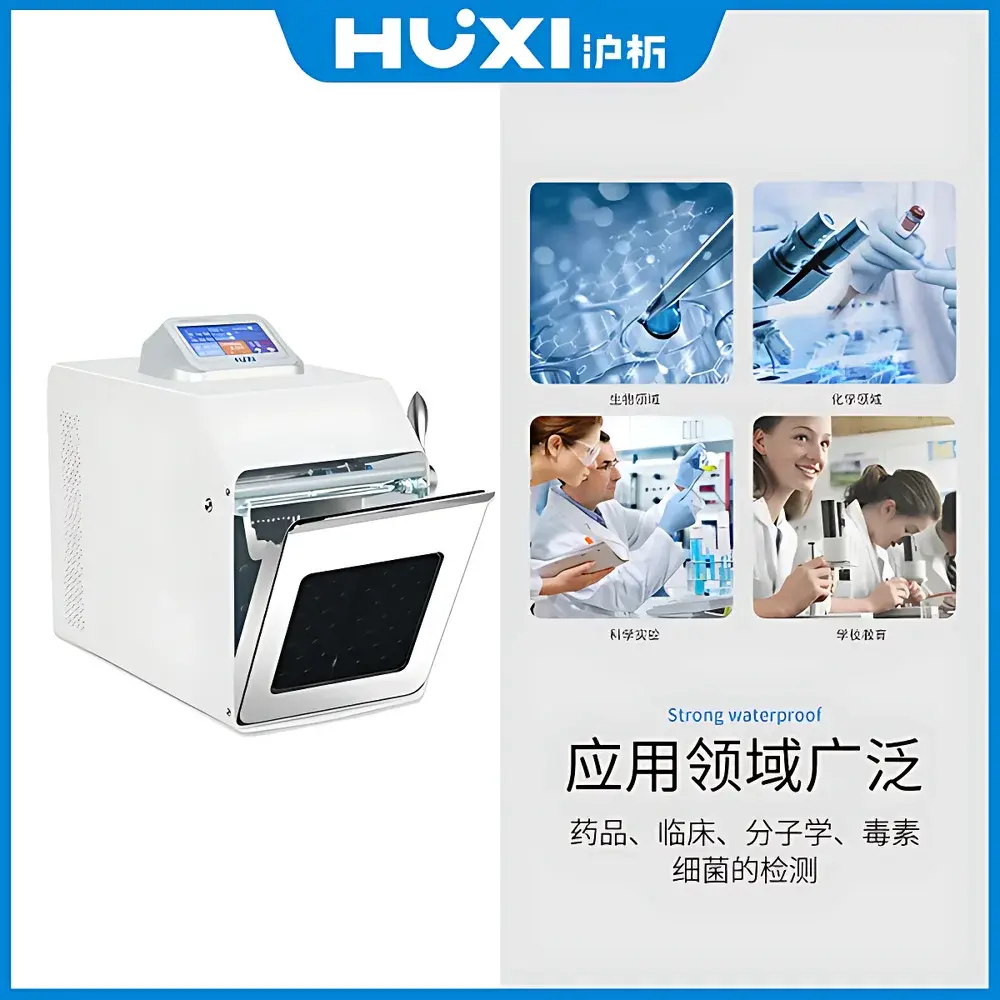
- Food microbiology: Enumeration of Salmonella, Listeria monocytogenes, and E. coli O157:H7 from meat, produce, and ready-to-eat products per USDA-FSIS and EFSA guidelines.
- Clinical & diagnostic labs: Homogenization of tissue biopsies, stool specimens, and environmental swabs prior to culture, PCR, or MALDI-TOF MS analysis.
- Pharmaceutical QC: Preparation of suspension samples for microbial limit testing (USP ) and sterility testing (USP ).
- Academic research: Extraction of intracellular proteins or nucleic acids from plant tissues while preserving structural integrity and minimizing proteolytic activity.
- Cosmetic safety assessment: Recovery of viable microorganisms from preservative-challenged formulations per ISO 11930.
FAQ
What types of sterile bags are compatible with the HX-4?
The HX-4 accepts standard 17 × 30 cm stomacher bags made from medical-grade, low-extractable polyethylene—certified for gamma irradiation (25–35 kGy) and compliant with USP Class VI biocompatibility testing.
Does the HX-4 require routine calibration?
No. As a mechanical homogenizer without transducers or sensors requiring traceable metrological validation, it relies on factory-set motor timing and beat geometry; periodic verification using reference bags and known sample types is recommended per internal SOPs.
Can the HX-4 be integrated into automated lab workflows?
Yes—via optional serial communication modules enabling trigger-based start/stop commands and protocol synchronization with robotic liquid handlers or sample tracking systems.
Is the beat frequency adjustable during operation?
No. Frequency is fixed per selected protocol; real-time adjustment is intentionally omitted to maintain repeatability and prevent operator-induced variability in validated methods.
What maintenance is required beyond daily wipe-down of the chamber?
Annual inspection of drive belt tension, paddle alignment, and door interlock switch functionality is advised; no lubrication or component replacement is necessary under normal usage conditions.



