
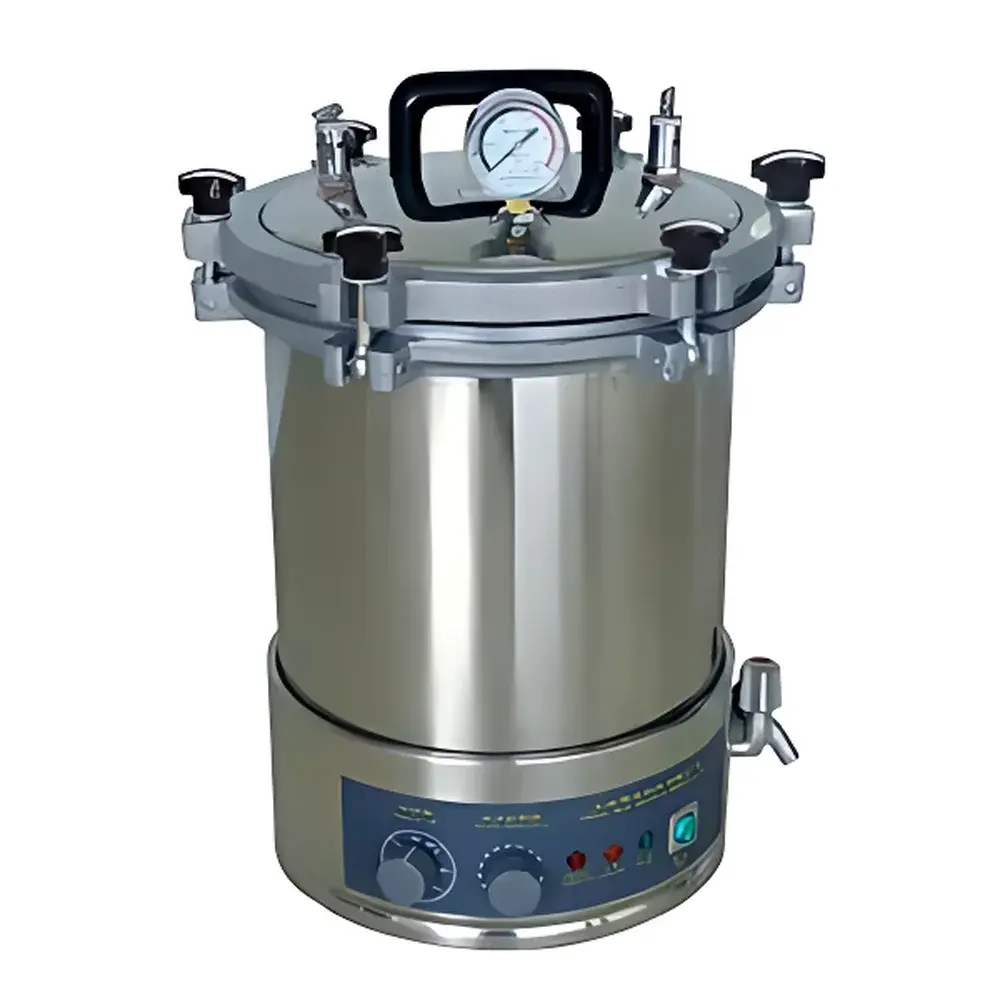
BOXUN YXQ-LS-18SI Automatic Portable Steam Sterilizer
| Brand | BOXUN |
|---|---|
| Origin | Shanghai, China |
| Manufacturer Type | Direct Manufacturer |
| Product Category | Domestic |
| Model | YXQ-LS-18SI |
| Instrument Type | Portable |
| Max Temperature | 126 °C |
| Max Pressure | 0.142 MPa |
| Chamber Dimensions | Φ280 × 290 mm |
| External Dimensions | Φ390 × 530 mm |
| Chamber Volume | 18 L |
| Heating Power | 2 kW |
| Voltage/Frequency | 220 V ±10%, 50 Hz ±2% |
| Operating/Design Temp | 126 °C / 128 °C |
| Operating/Design Pressure | 0.142 MPa / 0.165 MPa |
| Timer Range | 0–60 min |
Overview
The BOXUN YXQ-LS-18SI Automatic Portable Steam Sterilizer is a compact, electrically heated Class B-type gravity displacement steam sterilizer engineered for reliable terminal sterilization of heat-stable laboratory and clinical materials. It operates on the principle of saturated steam under controlled pressure and temperature—leveraging the well-established microbiocidal efficacy of moist heat at ≥121 °C. Designed for benchtop or mobile deployment in resource-constrained or space-limited environments—including teaching laboratories, field clinics, veterinary practices, and agricultural research stations—the unit delivers consistent, repeatable sterilization cycles compliant with core requirements of ISO 17665-1 (Sterilization of health care products — Moist heat) and aligned with fundamental principles of ANSI/AAMI ST79:2017. Its self-contained architecture eliminates dependency on external steam generators, making it suitable for facilities without centralized steam infrastructure.
Key Features
- Stainless Steel Construction: Inner chamber and jacket fabricated from SUS304 stainless steel—resistant to corrosion from repeated exposure to condensate, saline solutions, and alkaline cleaning agents.
- Automatic Cycle Control: Integrated microprocessor-based controller enables independent adjustment of sterilization temperature (110–127 °C) and dwell time (0–60 minutes), with real-time digital display of chamber temperature and elapsed time.
- Safety-Engineered Pressure System: Dual-scale pressure gauge (0–0.25 MPa) with overpressure relief valve set at 0.165 MPa design limit; automatic steam discharge when internal pressure exceeds safe operational threshold (0.142 MPa).
- Self-Sealing Mechanism: Spring-loaded, self-expanding silicone gasket ensures uniform radial sealing force across the lid interface, minimizing steam leakage and enhancing thermal efficiency.
- Low-Water Protection: Immersed heating element incorporates integrated low-water cutoff sensor to prevent dry firing and thermal damage during operation.
- Thermal Stability Design: Insulated outer casing maintains surface temperatures below 45 °C during full-cycle operation, meeting IEC 61010-1 safety requirements for laboratory equipment.
Sample Compatibility & Compliance
The YXQ-LS-18SI accommodates standard laboratory loads including wrapped or unwrapped surgical instruments, cotton gauze, rubber tubing, glassware (e.g., pipettes, flasks), aqueous culture media (e.g., nutrient agar, LB broth), and non-porous polymer components. It is not intended for sterilizing oils, powders, or porous materials requiring vacuum-assisted air removal (i.e., does not meet full Class B vacuum cycle requirements per EN 13060). All sterilization protocols must be validated per institutional SOPs and referenced against national standards such as YY 0504–2016 (Chinese standard for portable steam sterilizers) and general guidance in WHO Technical Report Series No. 912. The device supports basic GLP documentation workflows through manual logbook recording; however, it does not include electronic audit trail or 21 CFR Part 11-compliant data integrity features.
Software & Data Management
This model operates via embedded firmware without external software dependency. Cycle parameters (temperature setpoint, duration, start time) are retained in non-volatile memory across power cycles. No USB, Ethernet, or Bluetooth connectivity is provided; all operational data must be recorded manually. For regulated environments requiring traceability, users are advised to integrate the unit into facility-wide validation protocols using calibrated external temperature and pressure dataloggers (e.g., Vaisala, Omega) placed within representative load configurations. Calibration intervals should follow ISO/IEC 17025 guidelines and be documented per internal quality management system requirements.
Applications
- Routine sterilization of reusable labware in academic teaching labs and undergraduate microbiology courses.
- Preparation of sterile liquid media and agar plates in plant tissue culture and mycology laboratories.
- Decontamination of veterinary surgical tools and animal husbandry equipment in field clinics.
- Validation support for small-batch sterilization processes in R&D settings prior to scale-up to larger autoclaves.
- Emergency sterilization capability in mobile diagnostic units or disaster-response field hospitals.
FAQ
What is the maximum recommended load volume for effective sterilization?
The 18 L chamber is rated for up to 12 L of porous load (e.g., wrapped instruments) or 15 L of liquid load—maintaining minimum 30% free airspace above the load to ensure adequate steam penetration and air removal.
Can this unit sterilize liquids in sealed containers?
No. Liquids must be processed in vented vessels (e.g., bottles with loosened caps or tubes with breathable closures) to prevent boil-over or container rupture during heating and cooling phases.
Is third-party calibration certification available?
While BOXUN provides factory calibration documentation, users must engage ISO/IEC 17025-accredited service providers for periodic verification of temperature sensors and pressure transducers in accordance with local regulatory expectations.
Does the unit comply with FDA or EU MDR requirements?
As a Class I medical device under Chinese NMPA classification (registration number pending), it meets essential safety and performance criteria outlined in GB 4793.1–2019. CE marking is not applicable; export to EU requires conformity assessment under Directive 2014/68/EU (PED) for pressure equipment and 2012/19/EU (WEEE) for electrical compliance.
How often should the sealing gasket be replaced?
Inspect visually before each use; replace every 6–12 months depending on cycle frequency and exposure to aggressive cleaning agents—typical service life is ~300 cycles under normal operating conditions.
Related Products



