
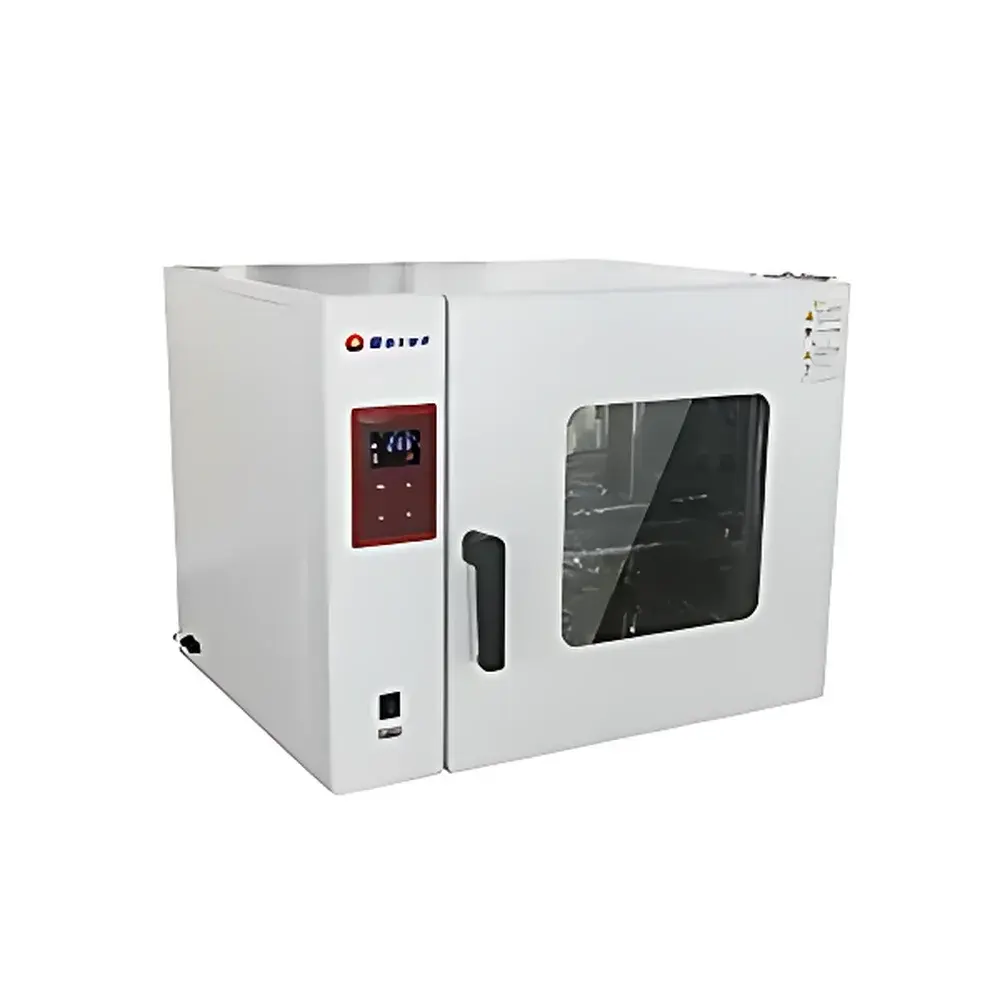
Boxun BGZ-240 High-Temperature Forced-Air Drying Oven
| Brand | Boxun |
|---|---|
| Origin | Shanghai, China |
| Manufacturer Type | Direct Manufacturer |
| Product Category | Domestic |
| Model | BGZ-240 |
| Price Range | USD 700–1,150 (FOB) |
| Instrument Type | High-Temperature Drying Oven |
| Temperature Range | Ambient +5°C to 250°C |
| Temperature Uniformity | ±2% (at setpoint) |
| External Dimensions (W×D×H) | 890 × 745 × 905 mm |
| Internal Chamber Dimensions (W×D×H) | 600 × 520 × 750 mm |
| Chamber Material | Mirror-Finish Stainless Steel (SUS304) |
| Heating Method | Forced-Air Circulation with Adjustable Fan Speed (6-step) |
| Control Resolution | 0.1°C |
| Temperature Stability | ±1°C at 100°C |
| Rated Power | 2150 W |
| Chamber Volume | 234 L |
| Standard Shelves | 3 pcs (max. 10 pcs) |
| Shelf Load Capacity | 15 kg per shelf |
| Timer Range | 0–9999 min/h |
| Delay Start Range | 0–999 min |
| Programmable Stages | 10 segments × 100 cycles |
| Interface | RS-485 for PC connectivity |
| Power Supply | AC 220 V ±10%, 50 Hz ±2% |
| Recovery Function | Auto-restart with parameter retention after power interruption |
Overview
The Boxun BGZ-240 is a high-performance forced-air drying oven engineered for precision thermal processing in regulated laboratory and industrial quality control environments. It operates on the principle of convection-based heat transfer, utilizing a rear-mounted, shielded centrifugal blower and optimized internal airflow ducting to ensure uniform temperature distribution across the entire 234 L chamber. Designed for applications requiring stable, repeatable heating up to 250°C—including moisture loss determination, polymer curing, pharmaceutical stability testing, pre-weighing sample conditioning, and wax melting—the BGZ-240 meets fundamental thermal performance requirements aligned with ISO 17025-compliant calibration practices and supports routine adherence to ASTM D1654 (coating drying), ISO 5725 (precision of measurement methods), and USP (thermometric validation). Its robust architecture features double-wall construction with high-density mineral fiber insulation and a dual-stage rotary door latch system, achieving low thermal leakage and consistent sealing integrity under repeated thermal cycling.
Key Features
- Mirror-finish SUS304 stainless steel interior chamber with seamless, radius-corner design for easy cleaning and corrosion resistance
- 6-step adjustable fan speed control to optimize air velocity—minimizing particle dispersion during drying of powders or granular samples
- PMMA II touchscreen controller with color LCD interface, supporting real-time monitoring of temperature, time, program stage, and alarm status
- Programmable logic with up to 100 cycles across 10 user-defined segments, enabling complex ramp-soak-hold profiles for method-driven workflows
- Precision temperature control with 0.1°C resolution, ±1°C stability at 100°C, and ±2% uniformity across the working volume
- Preheated air inlet system: ambient air is heated externally and blended before entering the chamber, reducing thermal overshoot and accelerating ramp rates
- RS-485 serial interface compliant with Modbus RTU protocol for integration into centralized lab data acquisition systems
- Power failure recovery function retains all active settings and resumes operation post-interruption without manual reconfiguration
Sample Compatibility & Compliance
The BGZ-240 accommodates standard laboratory glassware (e.g., weighing dishes, crucibles, Petri dishes) and metal trays up to 600 × 520 mm footprint. Its maximum shelf load capacity of 15 kg per tier supports stacked sample configurations used in bulk moisture analysis (e.g., ASTM E1868, ISO 1183). The chamber’s inert stainless steel surface and absence of catalytic materials prevent sample contamination during extended thermal exposure. While not certified to IEC 61010-1 Annex BB for explosion-proof operation, the oven complies with general safety requirements for Class II, Division 1 laboratory equipment. Its temperature uniformity and stability characteristics support validation protocols required under GLP and GMP frameworks—particularly for analytical method development where thermal consistency directly impacts gravimetric repeatability.
Software & Data Management
The PMMA II operating system provides embedded logging of temperature setpoints, actual chamber readings, elapsed time, and alarm events (e.g., overtemperature, door open, sensor fault). All logs are timestamped and stored internally for ≥30 days. When connected via RS-485 to a host PC running compatible SCADA or LIMS middleware, real-time telemetry and historical export (CSV/Excel) are supported. Audit trail functionality records operator ID (via optional login module), parameter changes, and program edits—meeting baseline traceability expectations under FDA 21 CFR Part 11 for non-critical thermal processes. No cloud dependency or proprietary software installation is required for basic data retrieval.
Applications
- Moisture content analysis per AOAC 950.46 and ISO 5519 in food, feed, and agricultural commodities
- Thermal aging studies of elastomers and composites per ASTM D573 and ISO 188
- Drying of filter papers and silica gel prior to gravimetric residue determination
- Conditioning of reference standards and hygroscopic reference materials in metrology labs
- Pre-baking of PCB substrates and ceramic green bodies in R&D prototyping
- Stabilization of catalyst supports and adsorbent materials prior to BET surface area measurement
FAQ
What is the maximum validated operating temperature for long-term use?
The BGZ-240 is rated for continuous operation at 250°C; however, for optimal heater longevity and sensor stability, sustained use above 220°C is recommended only for short-duration (<4 h) protocols.
Can the oven be validated using external PT100 probes?
Yes—the chamber includes two dedicated 3 mm diameter probe ports (one at top center, one at rear wall) for insertion of calibrated reference sensors during IQ/OQ/PQ qualification.
Is the RS-485 interface compatible with LabVIEW or Python-based control scripts?
Yes—Modbus RTU implementation allows direct integration via standard serial libraries (e.g., PyModbus, NI-VISA); register maps and command syntax are provided in the technical manual.
How often does the temperature sensor require recalibration?
Annual verification against a NIST-traceable dry-block calibrator is recommended; drift exceeding ±0.5°C at 100°C warrants sensor replacement.
Are custom shelf configurations available?
Standard shelves are perforated SUS304 trays (600 × 520 mm); non-perforated, wire-mesh, or Teflon-coated variants can be ordered as OEM accessories.



