
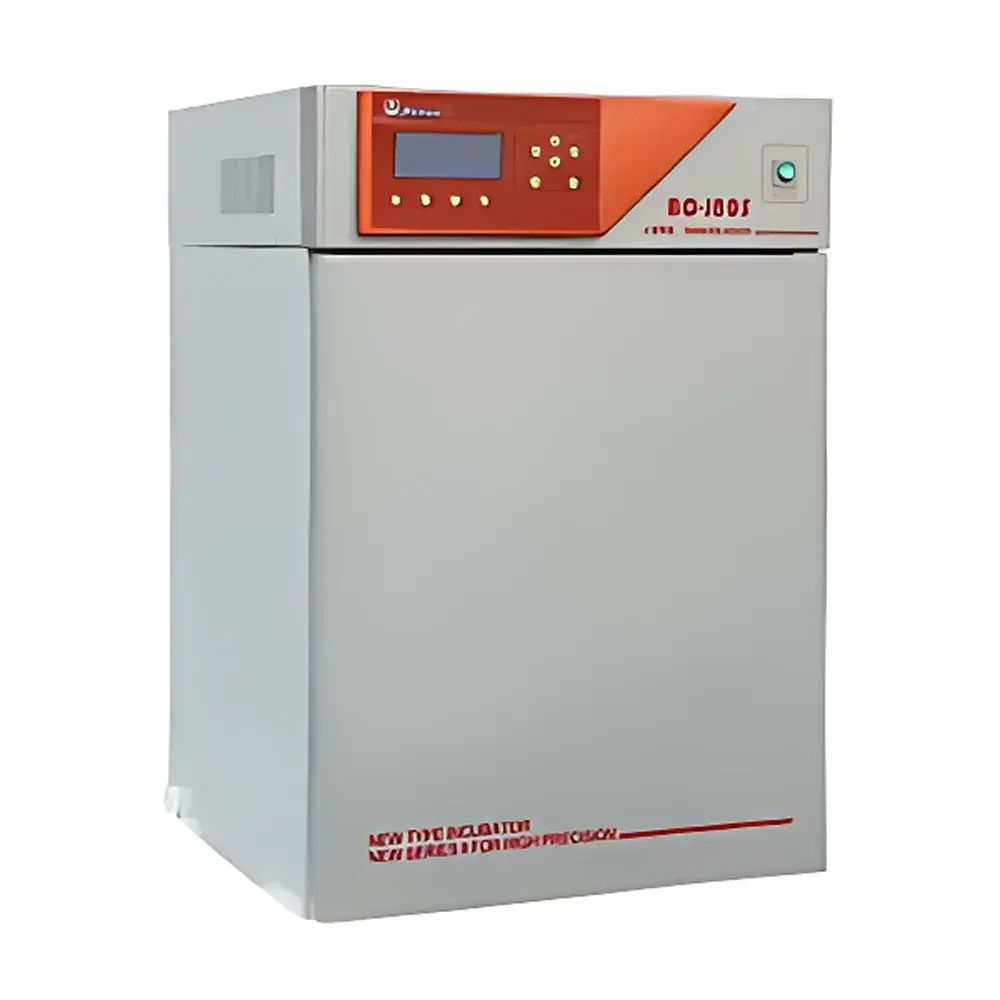
BOXUN BC-J160S Water-Jacketed CO₂ Incubator with Infrared CO₂ Sensing
| Brand | BOXUN |
|---|---|
| Origin | Shanghai, China |
| Manufacturer Type | Direct Manufacturer |
| Origin Category | Domestic (China) |
| Model | BC-J160S (Water-Jacketed, Infrared CO₂ Sensor) |
| Temperature Range & Accuracy | Ambient +5°C to 60°C |
| Temperature Uniformity | ≤ ±0.5°C at 37°C |
| Chamber Capacity | 160 L |
| CO₂ Range | 0–20% |
| CO₂ Recovery Time | ≤ (setpoint %) × 1.2 min |
| Temperature Fluctuation | ≤ ±0.3°C at 37°C |
| Temperature Resolution | 0.1°C |
| Humidification Method | Natural Evaporation |
| Power Supply | AC 220 V ±10%, 50 Hz ±2% |
| Input Power | 900 W |
| Internal Dimensions (W×D×H) | 540 × 490 × 680 mm |
| External Dimensions (W×D×H) | 682 × 611 × 1090 mm |
| Shelving | 3 Adjustable Stainless Steel Shelves |
| Filtration Efficiency | ≥99.998% for particles ≥0.3 µm |
| Interface | RS-485 for PC/Recorder Integration |
Overview
The BOXUN BC-J160S is a precision-engineered water-jacketed CO₂ incubator designed for reliable, long-term cell and tissue culture under tightly controlled physiological conditions. It operates on the principle of maintaining a stable 5% CO₂ atmosphere—critical for buffering bicarbonate-based culture media—and combines passive humidity stabilization via natural evaporation with high-fidelity infrared (IR) CO₂ sensing for real-time gas concentration feedback. The water-jacketed thermal architecture provides superior temperature stability and recovery performance compared to air-jacketed alternatives, minimizing thermal gradients across the chamber during door openings or ambient fluctuations. Engineered for routine use in academic research laboratories, biopharmaceutical QC environments, and GMP-aligned cell banking facilities, the BC-J160S meets foundational requirements for ISO 13485-supported equipment qualification and supports alignment with GLP documentation practices through its data logging interface and dual-redundant control architecture.
Key Features
- Water-jacketed thermal design ensures exceptional temperature uniformity (≤ ±0.5°C at 37°C) and low fluctuation (≤ ±0.3°C), critical for sensitive primary cell lines and stem cell expansion.
- Infrared CO₂ sensor delivers rapid response (<1.2 min per % CO₂ setpoint) and high long-term stability without calibration drift—eliminating the need for frequent zero-point adjustments common with thermal conductivity sensors.
- Dual independent temperature sensing system with chip-based auto-suppression logic actively compensates for transient thermal disturbances caused by door opening, ensuring minimal deviation from setpoint during routine access.
- Integrated UV germicidal lamp (254 nm) and dual-stage HEPA filtration (≥99.998% efficiency for ≥0.3 µm particles) provide continuous decontamination of internal air circulation paths, reducing risk of mycoplasma, fungal, and bacterial contamination.
- Intelligent door-heating system prevents condensation on inner glass, preserving optical clarity for uninterrupted microscopic observation and minimizing moisture loss during incubation.
- RS-485 serial interface enables integration with laboratory information management systems (LIMS), environmental monitoring platforms, or third-party data loggers—supporting audit-ready traceability per FDA 21 CFR Part 11 when paired with compliant software.
Sample Compatibility & Compliance
The BC-J160S accommodates standard T-25, T-75, and T-175 flasks, multi-well plates (6–96-well), Petri dishes, and roller bottles up to 1 L volume. Its 160 L stainless steel chamber (540 × 490 × 680 mm) features three fully adjustable, autoclavable stainless steel shelves with reinforced load-bearing capacity. All wetted surfaces are electropolished 304 stainless steel, complying with ASTM F899 for corrosion resistance in humid, CO₂-rich environments. The unit conforms to IEC 61010-1:2010 safety standards for laboratory equipment and includes overtemperature cut-off, CO₂ overpressure venting, and audible/visual alarms for temperature deviation, CO₂ failure, and door-open duration exceeding user-defined thresholds. Optional GPRS alarm modules support remote notification per ISO/IEC 17025 clause 5.9 on equipment malfunction reporting.
Software & Data Management
While the BC-J160S operates via an embedded microcontroller with high-brightness LCD interface (displaying real-time temperature, relative humidity, and CO₂ concentration), its RS-485 port enables bidirectional communication with external software platforms. When connected to validated PC-based monitoring tools, it supports time-stamped parameter logging (with configurable sampling intervals), automated report generation, and electronic signature workflows compatible with ALCOA+ data integrity principles. Built-in power-failure recovery retains all setpoints and operational history in non-volatile memory, ensuring continuity after unexpected outages—a requirement referenced in USP Analytical Instrument Qualification guidelines. Optional printer module provides hard-copy curve output for batch records; optional GPRS module transmits alerts to designated mobile numbers or email gateways.
Applications
This incubator serves as a core platform for mammalian cell line maintenance (e.g., CHO, HEK293, HeLa), primary neuronal and mesenchymal stem cell expansion, hybridoma culture for monoclonal antibody production, and microbiological studies requiring CO₂-enriched atmospheres (e.g., Campylobacter jejuni, Helicobacter pylori). Its stable thermal and gaseous environment supports applications in regenerative medicine process development, vaccine seed train propagation, and toxicology assays where phenotypic consistency directly correlates with environmental fidelity. The water-jacketed configuration is particularly suited for extended-duration experiments (>72 h) and facilities with variable ambient temperatures.
FAQ
What is the difference between water-jacketed and air-jacketed CO₂ incubators?
Water-jacketed models use circulating heated water around the chamber walls to achieve higher thermal mass and slower heat dissipation—resulting in improved temperature stability and recovery post-door-opening. Air-jacketed units rely on forced convection and respond more quickly to setpoint changes but exhibit greater susceptibility to ambient fluctuations.
Does the BC-J160S support humidity control beyond natural evaporation?
No—humidity is maintained passively via stainless steel water pan(s) and chamber surface area. Relative humidity typically stabilizes at ~95% RH at 37°C/5% CO₂. For active humidification or precise RH setpoint control, a separate steam-generating incubator model is recommended.
Is the infrared CO₂ sensor factory-calibrated and field-serviceable?
Yes—the IR sensor is pre-calibrated at the manufacturing facility and does not require routine recalibration under normal operating conditions. Field replacement is supported via modular sensor assembly with plug-and-play connectorization.
Can the BC-J160S be qualified for GMP environments?
Yes—its dual-sensor control, alarm logging, RS-485 interface, and hardware-level redundancy meet baseline IQ/OQ/PQ prerequisites. Full qualification requires user-defined protocols aligned with Annex 15 and internal SOPs, including mapping studies and alarm response verification.
What validation documentation is supplied with the unit?
Each BC-J160S ships with a Factory Acceptance Test (FAT) report, electrical safety certificate (IEC 61010-1), and CO₂ sensor performance verification sheet. As-built drawings and component traceability logs are available upon request for regulated users.




