
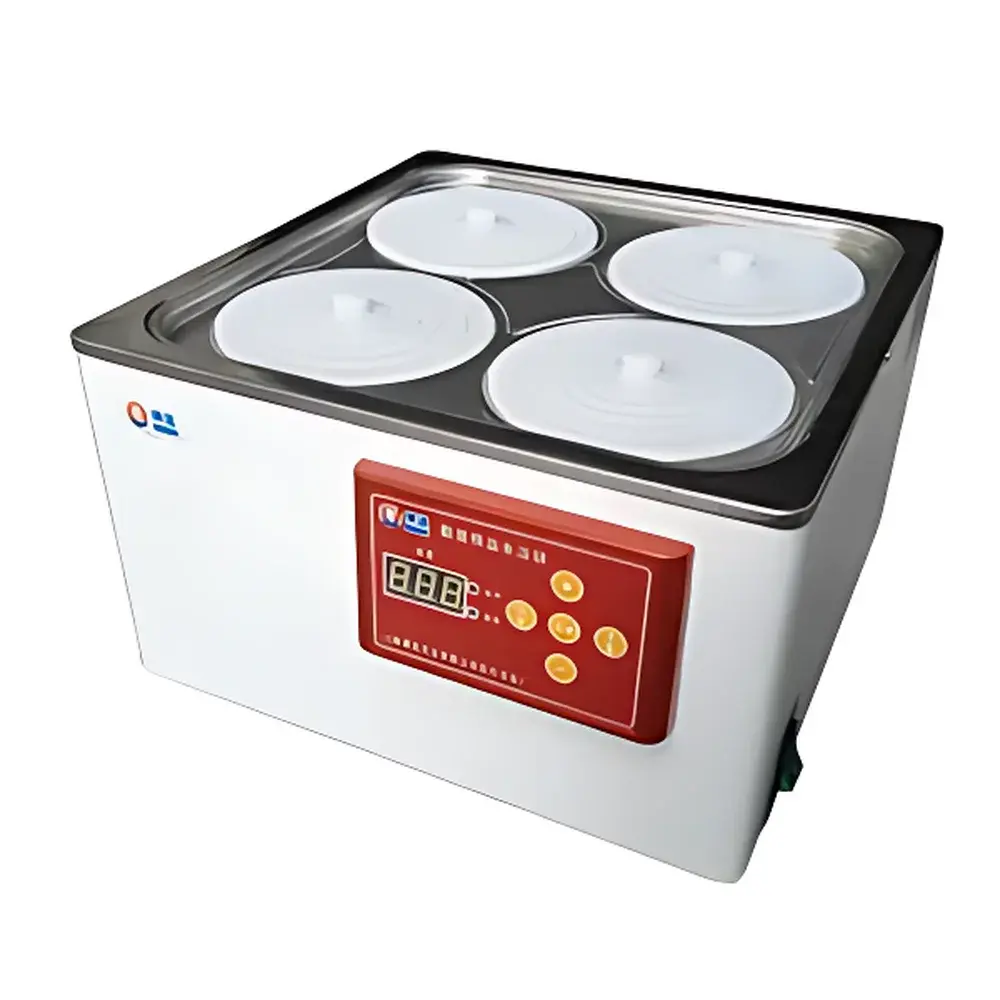
BOXUN HH.S21-4 Dual-Row Four-Hole Precision Water Bath
| Brand | BOXUN |
|---|---|
| Origin | Shanghai, China |
| Manufacturer Type | Direct Manufacturer |
| Country of Origin | China |
| Model | HH.S21-4 |
| Price Range | USD 140–700 |
| Construction | Cold-Rolled Steel Exterior with Epoxy Powder Coating, 304 Stainless Steel Interior Chamber |
| Dimensions (W×D×H) | 345 × 345 × 210 mm |
| Chamber Dimensions (W×D×H) | 305 × 305 × 130 mm |
| Heating Power | 0.8 kW |
| Temperature Range | RT + 5 °C to 100 °C |
| Temperature Uniformity | ±1 °C at setpoint |
| Control System | PID-Based Digital Thermostat with High-Accuracy RTD Sensor |
| Diagnostic Function | Built-in Electronic Component Self-Diagnostic Routine |
Overview
The BOXUN HH.S21-4 Dual-Row Four-Hole Precision Water Bath is a laboratory-grade thermostatic immersion system engineered for stable, uniform heat transfer in aqueous media. It operates on the principle of conduction and natural convection within a temperature-controlled water reservoir, delivering consistent thermal energy to samples placed in standard-sized test tubes, flasks, or beakers. Designed for routine use in clinical laboratories, biomedical research facilities, pharmaceutical quality control labs, and industrial R&D environments, this unit maintains precise thermal conditions required for enzyme assays, serum incubation, reagent warming, dissolution testing, and microbiological sample preparation. Its robust architecture supports continuous operation under GLP-aligned workflows, with thermal stability verified across the full operating range (RT + 5 °C to 100 °C) and calibrated repeatability within ±1 °C.
Key Features
- Stainless steel interior chamber (AISI 304) ensures corrosion resistance, ease of cleaning, and long-term compatibility with aqueous buffers, saline solutions, and mild chemical reagents.
- Cold-rolled steel housing with epoxy powder coating provides mechanical durability and resistance to ambient lab contaminants including humidity and incidental solvent exposure.
- Digital PID temperature controller with platinum RTD (Pt100) sensor delivers high-resolution feedback and minimizes overshoot during ramp-up or setpoint changes.
- Integrated electronic self-diagnostic function continuously monitors critical circuit components—including heating element continuity, sensor signal integrity, and power supply regulation—alerting users to potential fault conditions before operational deviation occurs.
- Dual-row, four-hole configuration accommodates multiple parallel sample vessels (e.g., 16 mm or 20 mm diameter tubes), supporting batch processing without cross-contamination risk.
- Over-temperature protection circuit automatically de-energizes the heater if the bath exceeds 105 °C, complying with IEC 61010-1 safety requirements for laboratory electrical equipment.
Sample Compatibility & Compliance
The HH.S21-4 is compatible with glass, polypropylene, and polycarbonate sample containers commonly used in life science and analytical workflows. Its open-bath design permits unrestricted access for pipetting, stirring, or manual intervention during incubation. The unit meets essential safety and performance benchmarks for general-purpose laboratory water baths, including conformity with GB/T 28001 (China Occupational Health and Safety Management Systems) and alignment with ISO/IEC 17025 clause 5.4.2 regarding equipment suitability for intended use. While not certified for sterile applications or regulated GMP manufacturing processes, it satisfies baseline thermal validation requirements for non-critical QC procedures under ASTM E2251-22 (Standard Practice for Calibration of Liquid-in-Glass Thermometers) when paired with traceable reference thermometers.
Software & Data Management
This analog-digital hybrid water bath does not include embedded software, remote connectivity, or data logging capabilities. Temperature setpoints and real-time readings are displayed via a 3-digit LED interface. For laboratories requiring audit-ready records, external validation protocols—such as periodic calibration using NIST-traceable thermistors and documented temperature mapping across all four wells—are recommended. The unit supports integration into broader lab infrastructure through manual SOP documentation and can be included in equipment maintenance logs compliant with FDA 21 CFR Part 11 where handwritten or scanned entries are permitted under local QA policy.
Applications
- Clinical pathology: Warming blood serum prior to immunoassay analysis; thawing frozen plasma aliquots under controlled thermal profiles.
- Pharmaceutical development: Pre-conditioning dissolution media per USP ; maintaining buffer temperature during HPLC mobile phase preparation.
- Microbiology: Incubating culture media for viability studies; activating lyophilized bacterial strains at defined temperatures.
- Academic research: Facilitating DNA ligation reactions, restriction digests, and protein denaturation controls requiring precise thermal input.
- Industrial QA/QC: Verifying viscosity-temperature relationships in polymer emulsions or surfactant solutions using standardized immersion methods.
FAQ
What is the maximum recommended operating duration for continuous use?
The HH.S21-4 is rated for unattended operation up to 72 hours under nominal load conditions, provided ambient room temperature remains between 15–30 °C and relative humidity does not exceed 80% RH.
Can this water bath be used with organic solvents such as ethanol or acetone?
No. The stainless steel chamber and sealing materials are not chemically resistant to low-surface-tension organic solvents. Only aqueous solutions, saline, and buffered media are recommended.
Is calibration certificate included with shipment?
A factory calibration report (non-accredited) is supplied with each unit. For ISO/IEC 17025-accredited calibration, third-party service is required.
Does the unit support external temperature probes for independent verification?
Yes—there is a dedicated 6 mm probe port located on the rear panel, compatible with standard PT100 or thermistor-based external monitoring systems.
What maintenance intervals are recommended?
Bi-weekly descaling (using 5% citric acid solution) is advised for hard-water environments; annual inspection of heater terminals and thermostat wiring is recommended for sustained accuracy.



