
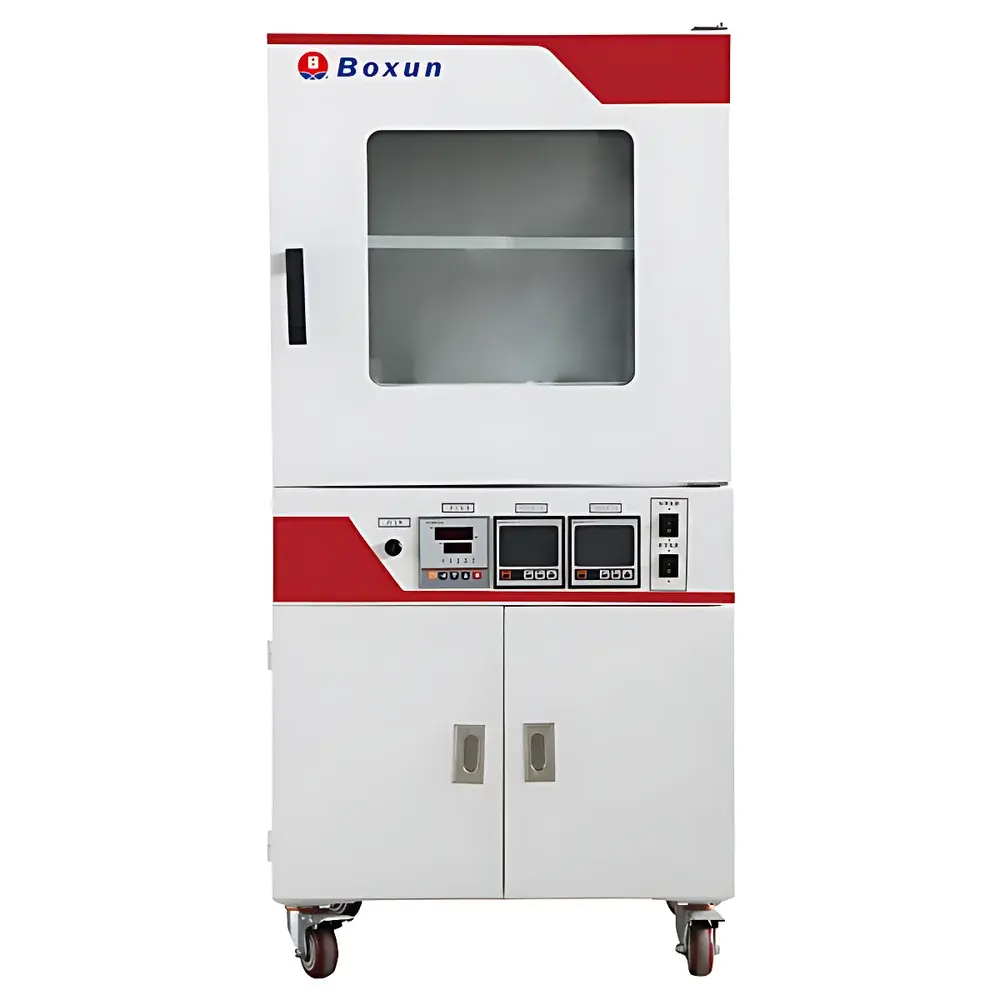
Boxun BXK-500S Vacuum Drying Oven
| Brand | Boxun |
|---|---|
| Origin | Shanghai, China |
| Manufacturer | Boxun Scientific Instrument Co., Ltd. |
| Type | Vacuum Drying Oven |
| Model | BXK-500S |
| Temperature Range | Ambient +2°C to 250°C |
| Temperature Uniformity | ±0.5°C |
| Chamber Dimensions (W×D×H) | 630 × 810 × 845 mm |
| External Dimensions (W×D×H) | 800 × 990 × 1660 mm |
| Chamber Volume | 500 L |
| Chamber Material | Stainless Steel (SUS304) |
| Heating Method | Heated Shelf System (Multi-zone Independent Control) |
| Vacuum Level | ≤133 Pa |
| Pump Flow Rate | 2 L/s |
| Power Supply | 380 V ±10%, 50/60 Hz |
| Rated Power | 3900 W |
| Timer Range | 0–9999 min |
| Shelf Quantity | 4 pcs (individually temperature-controlled) |
| Display | LCD with Microprocessor-based Controller |
Overview
The Boxun BXK-500S Vacuum Drying Oven is an engineered solution for precise, low-temperature dehydration of thermolabile, oxidation-sensitive, and complex-composition samples in regulated laboratory environments. Operating on the principle of reduced-pressure evaporation, it lowers the boiling point of solvents and moisture—enabling efficient drying below conventional thermal thresholds. Unlike forced-air convection ovens, this system eliminates convective disturbance of particulate or fragile specimens while suppressing oxidative degradation and thermal decomposition. Its design conforms to core requirements for GLP-compliant sample preparation in pharmaceutical stability studies, polymer characterization, battery electrode drying, and analytical sample conditioning per ISO 5725 (accuracy and precision), ASTM E202 (standard test methods for water in organic liquids), and USP (drying procedures). The chamber’s 500 L capacity supports batch processing of large-format glassware, multi-tiered trays, or assembled components without compromising vacuum integrity or thermal homogeneity.
Key Features
- Four independently controlled heated shelves with embedded heating elements—each monitored and regulated via dedicated PID loops to ensure inter-shelf temperature deviation ≤±0.8°C at setpoint.
- Integrated noise-reduction cabinet housing a 2 L/s dual-stage rotary vane vacuum pump; acoustic enclosure reduces operational noise by ≥40 dB(A) compared to external pump configurations.
- LCD microprocessor controller with real-time vacuum pressure display (0–100 kPa range), automatic vacuum compensation during solvent outgassing, and programmable ramp-hold drying profiles.
- SUS304 stainless steel chamber with radius-corner construction for CIP-compatible cleaning; reinforced double-glazed tempered observation window (heat-resistant up to 300°C) with anti-fog coating.
- Intelligent safety architecture: over-temperature cut-off (hardware-independent), power-failure data retention with auto-resume function, and silicone gasket-sealed door with adjustable torque latches ensuring leak rate <5×10⁻³ Pa·m³/s.
- Energy-optimized operation: selective shelf activation allows partial-load drying—reducing power consumption by up to 35% when only 1–2 shelves are engaged.
Sample Compatibility & Compliance
The BXK-500S accommodates heterogeneous sample formats including lyophilized powders, ceramic green bodies, lithium-ion cathode slurries, botanical extracts, and sterilized surgical instruments. Its vacuum-tight chamber (leak-tested to ISO 2859-1 acceptance criteria) ensures reproducible residual moisture levels below 0.1% w/w under validated protocols. The system meets structural and electrical safety requirements per IEC 61010-1 (Laboratory Equipment Safety) and electromagnetic compatibility per EN 61326-1. Optional validation packages support IQ/OQ documentation aligned with FDA 21 CFR Part 11 for audit-ready electronic records—including timestamped vacuum logs, temperature traces, and alarm event histories with user ID attribution.
Software & Data Management
The embedded controller stores up to 100 programmable drying cycles with 10-segment ramp/soak profiles. All operational parameters—including actual vs. setpoint temperature per shelf, real-time vacuum pressure, elapsed time, and alarm status—are logged at user-defined intervals (1 s to 60 min resolution). Data export is supported via USB 2.0 interface in CSV format for traceability and post-processing in MATLAB, Python Pandas, or LIMS platforms. Audit trail functionality complies with ALCOA+ principles: attributable, legible, contemporaneous, original, accurate, complete, consistent, enduring, and available—ensuring full data integrity across GxP workflows.
Applications
- Pharmaceutical R&D: Moisture removal from amorphous solid dispersions prior to DSC/TGA analysis; desolvation of co-crystals without polymorphic transition.
- Materials Science: Controlled drying of sol-gel precursors for mesoporous silica synthesis; pre-sintering conditioning of metal-organic frameworks (MOFs).
- Environmental Testing: Gravimetric determination of total suspended solids (TSS) and volatile solids (VS) per EPA Method 160.2.
- Electronics Manufacturing: Outgassing of PCB substrates and conformal coatings to prevent delamination during reflow soldering.
- Agricultural Research: Preservation of enzyme-active plant tissue extracts and pollen viability assays requiring oxygen-free dehydration.
FAQ
What vacuum level can the BXK-500S achieve, and how is it maintained during extended drying cycles?
The system achieves and sustains ≤133 Pa using its integrated 2 L/s vacuum pump; active pressure regulation compensates for vapor load fluctuations via proportional valve control synchronized with real-time sensor feedback.
Is the temperature uniformity verified across all four heated shelves—and how is calibration performed?
Yes—uniformity is validated per ISO 14644-3 using 9-point thermocouple mapping at 105°C and 150°C; factory calibration includes NIST-traceable RTD verification with certificate of conformity.
Can the oven be integrated into a central laboratory monitoring system (e.g., via Modbus or Ethernet)?
Standard configuration supports RS485 Modbus RTU; optional Ethernet/IP module enables SCADA integration and remote parameter adjustment through secure TLS 1.2 communication.
Does the system comply with explosion-proof requirements for solvent-rich samples?
While not certified as Class I Div 1, the inert-atmosphere capability (N₂ purge port optional) and absence of internal ignition sources meet IEC 60079-0 general requirements for non-incendive operation with low-flashpoint solvents.
What maintenance intervals are recommended for the vacuum pump and sealing system?
Vacuum pump oil replacement every 500 operating hours; door gasket inspection and cleaning every 3 months; full preventive maintenance (including vacuum gauge recalibration) annually per ISO/IEC 17025 guidelines.



