
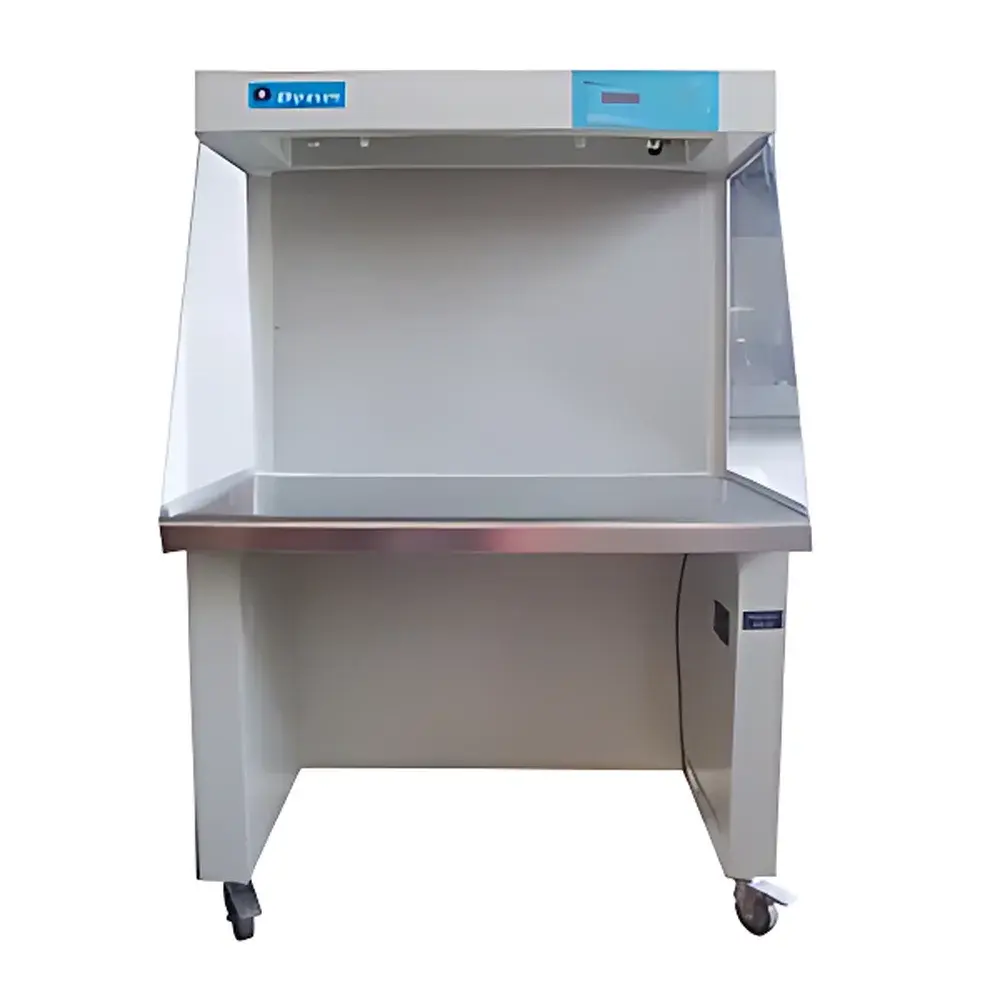
BOXUN SW-CJ-1BU Horizontal Laminar Flow Clean Bench
| Brand | BOXUN |
|---|---|
| Origin | Shanghai, China |
| Manufacturer Type | Direct Manufacturer |
| Instrument Category | Horizontal Laminar Flow Clean Bench |
| Model | SW-CJ-1BU |
| Cleanliness Class | ISO Class 5 (100 @ ≥0.5 µm, ≥99.99% filter efficiency) |
| Noise Level | ≤67 dB(A) |
| User Configuration | Single-user, single-frontal workface |
| Airflow Pattern | Horizontal unidirectional laminar flow |
| Work Area Dimensions (W×D×H) | 910 × 480 × 570 mm |
| Overall Dimensions (W×D×H) | 910 × 790 × 1380 mm |
| HEPA Filter Specification | 815 × 575 × 50 mm (1 unit) |
| Pre-filter | Medium-efficiency panel filter |
| Illumination | ≥300 lx (20 W fluorescent lamp) |
| UV Germicidal Lamp | 20 W, timer-controlled (0–999 min) |
| Operating Wind Speed Range | 0.3–0.6 m/s (6-step adjustable) |
| Vibration Peak-to-Peak | ≤5 µm (X/Y/Z axes) |
| Power Supply | AC 220 V ±10%, 50/60 Hz |
| Power Consumption | 0.15 kW |
| Net Weight | 110 kg |
Overview
The BOXUN SW-CJ-1BU Horizontal Laminar Flow Clean Bench is an ISO Class 5-certified local containment system engineered for applications requiring particle-free working environments in microbiological, pharmaceutical, and analytical laboratories. It operates on the principle of horizontal unidirectional laminar airflow—air is drawn through a pre-filter and then forced through a certified HEPA filter (≥99.99% efficiency for particles ≥0.5 µm) before being delivered across the work surface at a controlled, uniform velocity (0.3–0.6 m/s). This airflow pattern sweeps contaminants away from the operator and sample zone toward the front grille, minimizing cross-contamination and protecting both personnel and sensitive processes. Designed for single-user operation, the unit complies with core design principles outlined in ISO 14644-1 for cleanroom performance verification and aligns with general laboratory safety expectations for non-hazardous biological work as defined by WHO Laboratory Biosafety Manual (4th ed.) and CLSI guidelines.
Key Features
- Robust structural construction: Cold-rolled steel cabinet with electrostatic powder coating; work surface and vertical side panels fabricated from brushed SUS304 stainless steel for corrosion resistance, chemical compatibility, and ease of decontamination.
- Optimized airflow management: Centrifugal blower with stable rotational speed and low acoustic signature (≤67 dB[A]), integrated with six-step microswitch-controlled fan speed regulation via LCD interface.
- Dual-lighting system: Independently switchable 20 W fluorescent lamp (≥300 lx illumination) and 20 W UV-C germicidal lamp with programmable timer (0–999 minutes), supporting routine surface decontamination protocols.
- Human-centered ergonomics: Horizontal sliding sash window ensures consistent laminar integrity across the full work area while limiting external air intrusion; transparent acrylic side panels provide optical clarity and impact resistance without compromising structural rigidity.
- Extended filter service life: Integrated medium-efficiency pre-filter captures coarse particulates upstream of the primary HEPA filter, reducing loading and extending certified filter lifespan—critical for operational continuity and cost-of-ownership optimization.
Sample Compatibility & Compliance
The SW-CJ-1BU is intended for use with non-hazardous biological agents (BSL-1 and select BSL-2 procedures under institutional risk assessment), cell culture manipulations, media preparation, sterile packaging, and precision instrumentation handling. It is not suitable for volatile organic compounds, toxic chemicals, or aerosol-generating procedures requiring negative-pressure containment. The unit meets mechanical and electrical safety requirements per IEC 61010-1 and conforms to electromagnetic compatibility standards EN 61326-1. While not classified as medical device under FDA 21 CFR Part 820, its design supports GLP-aligned documentation practices—including logbook entries for UV exposure time, airflow verification, and filter replacement history—facilitating internal audit readiness.
Software & Data Management
This model features a dedicated embedded LCD control module with no external software dependency. All operational parameters—including fan speed setting, UV timer value, and runtime counters—are retained in non-volatile memory. No network connectivity, data export, or remote monitoring capability is provided. For laboratories operating under regulated environments (e.g., ISO/IEC 17025, GMP Annex 1), users are advised to implement manual calibration logs and scheduled HEPA filter integrity testing (e.g., DOP/PAO scanning per ISO 14644-3) as part of their documented quality system.
Applications
- Preparation of sterile culture media and reagents in academic and industrial microbiology labs.
- Aseptic transfer of mammalian or microbial cell lines during expansion and passaging.
- Assembly and handling of sensitive optical or electronic components where particulate contamination must be minimized.
- Environmental sampling kit preparation and field equipment sterilization prior to deployment.
- Supporting ISO 8573-1 compressed air testing workflows where background particle counts must remain below threshold limits.
FAQ
What ISO cleanliness class does the SW-CJ-1BU achieve?
It delivers ISO Class 5 (formerly Federal Standard 209E Class 100) performance at the work surface, verified for ≥99.99% removal efficiency of particles ≥0.5 µm.
Can this unit be used for handling pathogenic organisms?
No. It provides personnel and product protection only—not environmental protection—and is unsuitable for BSL-2+ agents requiring biosafety cabinets with inward airflow and exhaust filtration.
Is HEPA filter integrity testing required? How often?
Yes. Per ISO 14644-3, initial certification and annual retesting (or after filter replacement or physical impact) using aerosol photometer scanning is recommended.
Does the unit comply with FDA 21 CFR Part 11?
No. As a standalone hardware-only bench without electronic records or signature functionality, it falls outside the scope of Part 11 requirements.
What maintenance intervals are recommended?
Pre-filter cleaning every 2–4 weeks depending on ambient dust load; HEPA filter replacement every 18–36 months based on differential pressure monitoring and integrity test results.



