
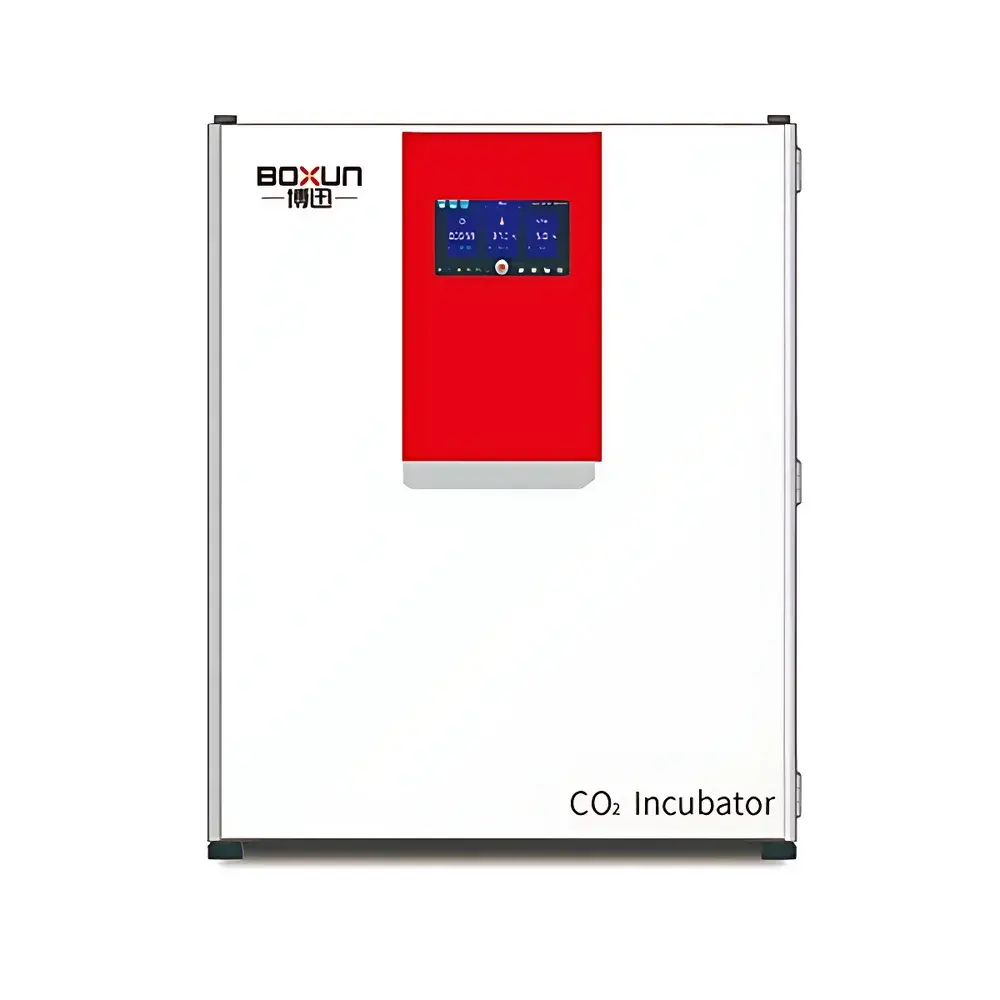
BOXUN BG-185CS Advanced CO₂ Incubator with BRIGHT II Intelligent Control System and Integrated HEPA Filtration
| Brand | BOXUN |
|---|---|
| Origin | Shanghai, China |
| Manufacturer Type | Direct Manufacturer |
| Instrument Type | Air-Jacketed CO₂ Incubator |
| CO₂ Detection | Dual-Wavelength Infrared (IR) Sensor |
| Temperature Range & Accuracy | RT+3°C to 60°C, ±0.05°C stability, ≤±0.25°C uniformity |
| CO₂ Concentration Range & Accuracy | 0–20% vol, ±0.1% (full scale) |
| Humidity Control | High-Humidity Mode >90% RH, Low-Humidity Mode >80% RH |
| Chamber Volume | 185 L |
| External Dimensions (W×D×H) | 685 × 700 × 870 mm |
| Internal Dimensions (W×D×H) | 500 × 570 × 650 mm |
| Standard Configuration | 150°C Dry-Heat Sterilization, High-Efficiency Air Filtration (HEPA + 0.2 µm inlet filter), Triple-Zone Heated Air Jacket, BRIGHT II Touch Interface (7″ HD) |
Overview
The BOXUN BG-185CS is an air-jacketed, microprocessor-controlled CO₂ incubator engineered for precision cell culture applications in academic research laboratories, biopharmaceutical QC/QA environments, and clinical cell therapy facilities. It employs a true air-jacketed heating architecture—featuring eight independent heating units distributed across three thermal zones and all six chamber surfaces—to deliver rapid temperature ramp-up (90% RH in high-humidity mode while minimizing water consumption and contamination risk.
Key Features
- Air-jacketed thermal architecture with triple-zone, 6-surface heating for uniform temperature distribution and fast thermal recovery
- Dual-wavelength IR CO₂ sensor with built-in drift compensation and NIST-traceable calibration protocol
- BRIGHT II intelligent operating system with 7-inch capacitive touch interface, real-time parameter visualization, and adaptive environmental compensation algorithms
- Integrated dry-heat sterilization cycle at 150°C (optional 180°C configuration available), fully compatible with internal HEPA filters and stainless-steel components
- High-efficiency air filtration system: 0.2 µm inlet particulate filter + high-temperature-rated HEPA filter (≥99.97% @ 0.3 µm) for internal recirculation
- Three-tier user permission management with immutable audit trail logging of all parameter changes, event triggers, and operational actions
- Comprehensive safety architecture: dual independent temperature limiters, door-open alarm with configurable timeout, low-water level detection, CO₂ deviation alert, and filter life monitoring
- Stainless-steel mirror-finish 304 interior with seamless large-radius corners and perforated reinforced shelves (496 × 440 mm, 20 kg load capacity)
Sample Compatibility & Compliance
The BG-185CS supports long-term cultivation of sensitive mammalian cell lines—including stem cells, primary cultures, and hybridomas—under tightly controlled physiological conditions. Its internal pressure-balancing system ensures stable operation during high-humidity and high-temperature sterilization cycles, preventing chamber deformation or seal failure. All wetted and exposed surfaces are coated with antimicrobial powder coating (≥99% bacterial inhibition per ISO 22196). The incubator complies with IEC 61010-1 (Safety Requirements for Electrical Equipment for Measurement, Control, and Laboratory Use) and meets essential requirements for GLP/GMP-aligned environments. Data integrity features—including non-volatile internal memory storing ≥500,000 timestamped records, UVC-verified export to USB in read-only format, and full event logging—support adherence to FDA 21 CFR Part 11 and EU Annex 11 data governance expectations.
Software & Data Management
The embedded BRIGHT II control firmware provides native data logging without external SD cards or cloud dependencies. All temperature, CO₂, humidity, and alarm events are time-stamped with millisecond resolution and stored in a tamper-evident binary log. Users may export logs via USB in .csv format with cryptographic hash verification to ensure file integrity. The system supports RS-485 Modbus RTU communication for integration into centralized laboratory infrastructure (e.g., LIS, BMS, or SCADA platforms). Audit trails capture operator ID (via permission tier), action type, parameter value before/after change, and exact UTC timestamp—fully traceable for regulatory inspection. No proprietary software installation is required for basic data retrieval; exported files are natively readable in Excel or validated statistical analysis tools.
Applications
- Long-term maintenance and expansion of human mesenchymal stem cells (hMSCs) under hypoxic or normoxic CO₂ setpoints
- Monoclonal antibody production workflows requiring strict batch-to-batch consistency in CHO or HEK293 cultures
- Regulatory-compliant cell banking where documented environmental history is mandated per USP and ISO 56002
- High-throughput screening assays involving co-cultures or organoid models demanding stable humidity and gas composition over multi-day runs
- Institutional core facilities supporting shared-use access with role-based parameter restrictions and usage accountability
FAQ
Does the BG-185CS support remote monitoring via Ethernet or Wi-Fi?
No—this model relies on local RS-485 and USB interfaces only. Network connectivity is not implemented to minimize cybersecurity exposure in regulated lab environments.
Can the internal HEPA filter be sterilized in place during the 150°C cycle?
Yes—the filter is rated for continuous operation at 150°C and requires no removal prior to dry-heat sterilization.
What is the minimum recommended ambient room temperature for stable operation?
18°C–34°C, as specified in the technical documentation; operation outside this range may affect humidity recovery kinetics and CO₂ sensor response time.
Is the CO₂ sensor calibrated at the factory, and does it require periodic user recalibration?
Yes—the dual-wavelength IR sensor is NIST-traceably calibrated prior to shipment and designed for zero-drift performance; no field recalibration is necessary under normal use conditions.
How is data integrity ensured when exporting logs to USB?
Exported files include SHA-256 checksums and are written in write-once mode; modification attempts trigger validation failure upon re-import or manual verification.





