
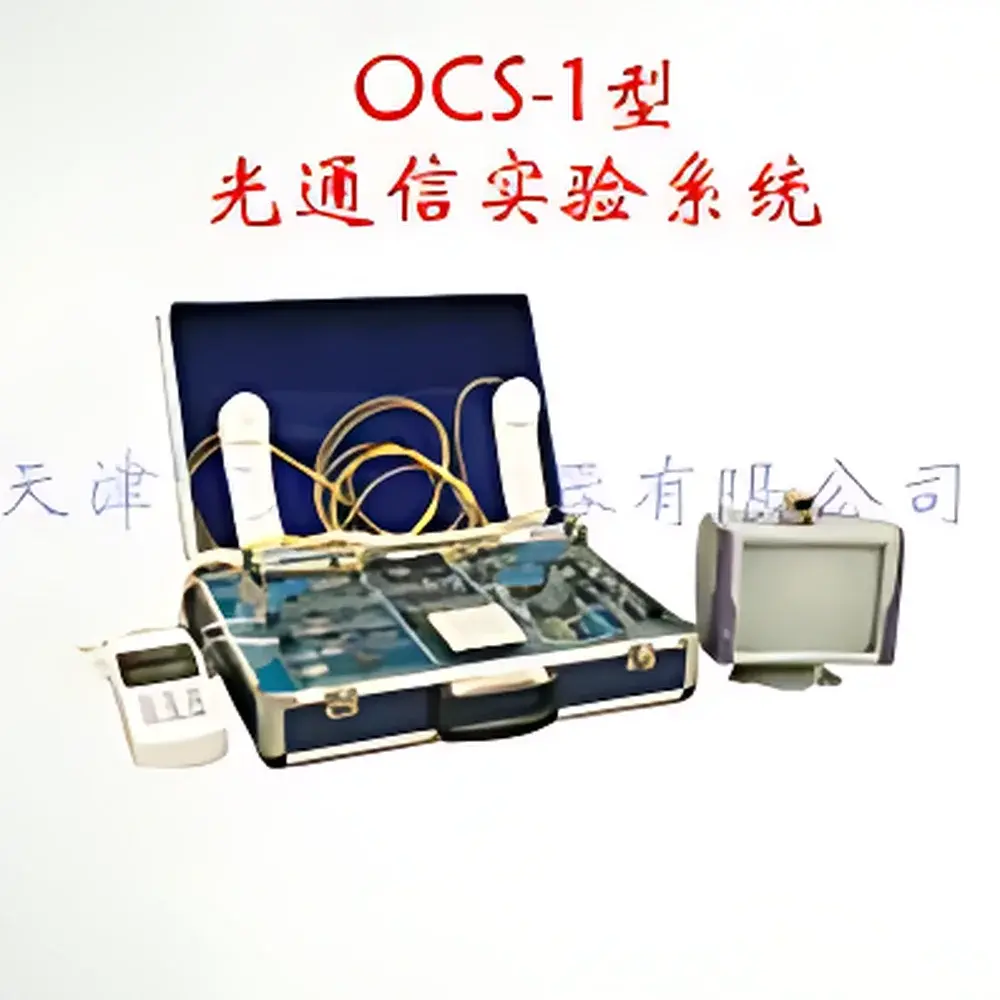
Topo OCS-1 Optical Communication Training System
| Brand | Topo / TP |
|---|---|
| Origin | Tianjin, China |
| Manufacturer Type | OEM Manufacturer |
| Country of Origin | China |
| Model | OCS-1 |
| Pricing | Upon Request |
Overview
The Topo OCS-1 Optical Communication Training System is a modular, hands-on educational platform engineered for undergraduate and graduate-level laboratory instruction in fiber optics, optical communication principles, photonic device characterization, and system-level performance evaluation. Built upon fundamental physical optics and guided-wave propagation theory, the system implements core telecommunication functions—including light generation (LED/LD), modulation (analog and digital), transmission through single-mode and multimode fiber, detection (PIN/APD), and signal recovery—enabling students to observe real-world phenomena such as dispersion-induced pulse broadening, modal noise, insertion loss, extinction ratio degradation, and bit-error accumulation. Designed for pedagogical fidelity and experimental repeatability, the OCS-1 supports both time-domain (oscilloscope-based) and power-domain (optical power meter-based) measurement methodologies, aligning with standard laboratory practices defined in IEEE 802.3, ITU-T G.652, and IEC 61280-2 series specifications.
Key Features
- Modular architecture supporting configurable experiment sequences—from component-level characterization (e.g., LD P–I curve, connector IL, WDM crosstalk) to full-link demonstrations (PCM voice over fiber, 2 Mbps digital transmission, CWDM channel multiplexing)
- Dual-mode operation: analog (voice band, 300–3400 Hz) and digital (NRZ, RZ, PCM, 2.048 Mbps E1 frame structure) signal paths with synchronized clock recovery
- Integrated instrumentation interface: 20 MHz dual-channel oscilloscope, calibrated optical power meter (±0.2 dB accuracy), multimeter, and reference telephone sets for end-to-end functional validation
- Comprehensive passive component set: FC/PC and SC/PC adapters, X-coupler, polarization-insensitive isolator, dual-band (1310/1550 nm) WDM filters, and continuously adjustable variable optical attenuator (VOA)
- Student-centric design emphasizing procedural autonomy—each experiment includes documented setup schematics, measurement protocols, expected waveform references, and error analysis guidelines
Sample Compatibility & Compliance
The OCS-1 accommodates industry-standard fiber types (SMF-28, MMF 62.5/125 µm), common connector interfaces (FC, SC, ST), and commercially available optoelectronic components (850 nm VCSELs, 1310/1550 nm DFB lasers, PIN photodiodes). All optical measurements conform to IEC 61280-2-1 (optical power), IEC 61280-2-9 (extinction ratio), and IEC 61280-2-13 (BER testing). The system’s electrical signal integrity meets ANSI/TIA-568-C.3 for fiber optic cabling performance verification. Documentation includes traceable calibration references for power meter and oscilloscope modules, supporting GLP-aligned lab reporting requirements.
Software & Data Management
While the OCS-1 operates primarily in hardware-defined mode—emphasizing direct instrument interaction and manual data acquisition—it provides structured data logging templates compatible with Excel and MATLAB. Experimental results (e.g., P–I curves, BER vs. received power, eye diagram jitter metrics) are recorded using standardized forms aligned with IEEE Std 1139–2008 for uncertainty reporting. Optional USB-based data capture modules (sold separately) enable automated waveform acquisition and CSV export, facilitating statistical analysis and student report generation. All instructional materials—including lab manuals, safety protocols, and troubleshooting guides—are provided in English and comply with ISO/IEC 17025 documentation hierarchy standards.
Applications
- Undergraduate photonics labs: fiber mode field diameter estimation, numerical aperture measurement, cutoff wavelength determination
- Optoelectronics courses: semiconductor laser threshold identification, photodetector responsivity calibration, dynamic range mapping of optical receivers
- Telecom engineering curricula: eye diagram analysis, jitter budgeting, dispersion compensation demonstration, WDM channel isolation assessment
- Capstone design projects: development of custom transceivers, implementation of FEC schemes, characterization of plastic optical fiber (POF) links
- Industry training programs: technician certification in fiber splicing, OTDR-free loss verification, and passive component qualification per Telcordia GR-326-CORE
FAQ
Is the OCS-1 compatible with third-party optical test equipment?
Yes—the system features standard FC/PC and SC/PC ports, SMA electrical connectors, and TTL-synchronized trigger outputs, enabling integration with external sources, spectrum analyzers, or bit-error-rate testers.
Does the system support single-mode and multimode fiber experiments?
Yes—both fiber types are supported via interchangeable patch cords and source/detector modules optimized for 850 nm (MMF) and 1310/1550 nm (SMF) operation.
Are calibration certificates included for the embedded instruments?
Factory calibration reports are supplied for the optical power meter and oscilloscope; NIST-traceable recalibration services are available upon request.
Can the OCS-1 be used for research-grade measurements?
While designed for pedagogy, its component-level modularity and metrologically sound interfaces allow adaptation for applied research in low-speed optical interconnects, sensor network prototyping, and teaching-oriented photonic IC characterization.
What safety standards does the system meet?
All optical sources comply with IEC 60825-1 Class 1 laser safety requirements; electrical subsystems meet IEC 61010-1 for laboratory equipment.




