
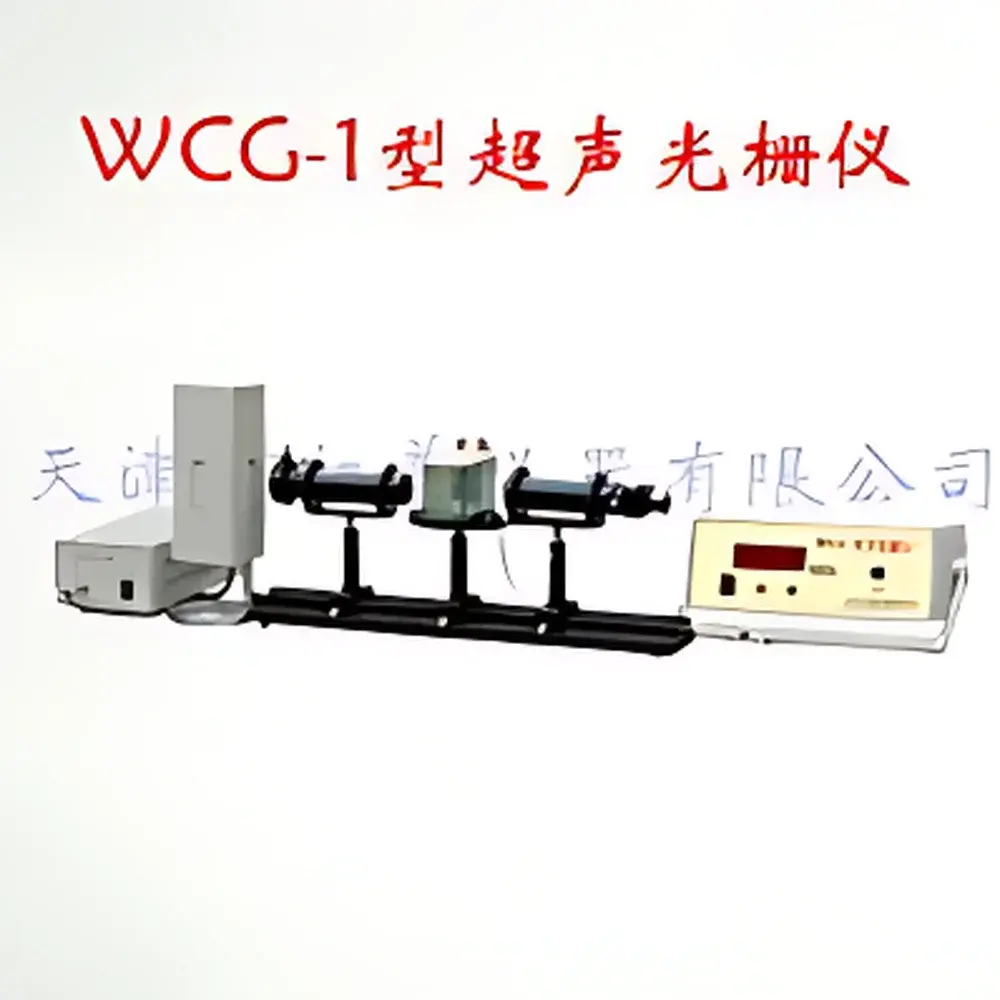
Topo WCG-1 Ultrasonic Grating Apparatus
| Brand | Topo |
|---|---|
| Model | WCG-1 |
| Origin | Tianjin, China |
| Manufacturer | Topo Instruments Co., Ltd. |
| Input Voltage | 220 V AC, 50 Hz |
| Frequency Range | 10 MHz ± 1 MHz |
| Frequency Display | 4-digit LED |
| Diffraction Orders | ≥3 |
| Measuring Range of Micrometer Eyepiece | 8 mm |
| Measurement Accuracy | 0.01 mm |
| Telescope Objective Focal Length | f = 150 mm |
Overview
The Topo WCG-1 Ultrasonic Grating Apparatus is a precision educational and research instrument engineered for the quantitative study of ultrasonic wave propagation in transparent liquids via acousto-optic diffraction. It operates on the principle of dynamic grating formation: when a high-frequency ultrasonic wave (typically 10 MHz) is introduced into a liquid medium—such as water or organic solvents—it induces periodic compression and rarefaction cycles, resulting in spatially periodic variations in refractive index. This transient density modulation functions as a traveling diffraction grating—the “ultrasonic grating”—with a grating constant determined by the acoustic wavelength (λa = vs/f). When a collimated monochromatic light beam (e.g., from a He–Ne laser or sodium lamp) traverses this region, it undergoes Bragg-type diffraction, producing a symmetric set of observable orders. By measuring the angular separation between diffraction maxima using a calibrated telescope and micrometer eyepiece, the speed of sound (vs) in the liquid can be calculated with high reproducibility using the relation vs = f·λa, where λa is derived from optical geometry and the known incident wavelength. The apparatus is designed around a rigid optical bench platform, ensuring mechanical stability, linear alignment fidelity, and compatibility with standard undergraduate physics laboratory infrastructure.
Key Features
- Optical bench-based architecture with high linearity and modular rail system for repeatable component positioning and alignment.
- Integrated 10 MHz ultrasonic transducer with stable frequency output and ±1 MHz tunability, digitally displayed via 4-digit LED readout.
- Dedicated telescope assembly featuring a 150 mm focal length objective lens and fine-adjustment focusing mechanism for precise diffraction angle measurement.
- Micrometer eyepiece with 8 mm travel range and 0.01 mm resolution for accurate determination of fringe spacing on the reticle scale.
- Designed for use with common visible-light sources (e.g., 589.3 nm Na-D line or 632.8 nm He–Ne laser), supporting both qualitative observation and quantitative analysis.
- Robust aluminum-alloy construction and vibration-damped base plate to minimize environmental perturbations during measurement.
Sample Compatibility & Compliance
The WCG-1 supports a wide range of optically transparent, low-absorption liquids—including distilled water, ethanol, glycerol, carbon tetrachloride, and silicone oils—provided they exhibit sufficient acoustic coupling and thermal stability over short experimental durations (typically <5 min per measurement). The cell design accommodates standard rectangular quartz or Pyrex cuvettes (10–20 mm path length). While primarily intended for academic instruction, the apparatus conforms to foundational metrological practices aligned with ISO/IEC 17025 principles for calibration traceability of optical alignment and dimensional measurement subsystems. Its operational methodology is consistent with standard university physics curricula referenced in national syllabi (e.g., China’s “University Physics Experiment Course Standards”) and internationally recognized pedagogical frameworks such as the AAPT ComPADRE digital library modules on acousto-optics.
Software & Data Management
The WCG-1 is a stand-alone, hardware-operated instrument with no embedded microprocessor or digital interface. All measurements are performed manually using analog optical and mechanical components—ensuring full transparency of the underlying physical model and eliminating software-induced uncertainty. Data acquisition relies on direct reading of the micrometer eyepiece and telescope angular scale; results are recorded in laboratory notebooks or exported to spreadsheet tools for statistical analysis (e.g., mean, standard deviation, linear regression of sinθ vs. order number). For institutions requiring audit-ready documentation, the apparatus supports integration into GLP-compliant workflows when paired with controlled environmental logs (temperature, ambient humidity) and standardized reporting templates. No firmware updates, drivers, or proprietary software are required or provided.
Applications
- Determination of sound velocity in liquids as a function of temperature, concentration, or molecular composition.
- Verification of the adiabatic bulk modulus via thermodynamic relations (Ks = ρ·vs2).
- Study of ultrasonic attenuation mechanisms through comparative intensity analysis of diffraction orders.
- Introduction to acousto-optic interaction, Bragg diffraction conditions, and dynamic grating theory in upper-division undergraduate laboratories.
- Calibration reference for validating ultrasonic interferometers or pulse-echo systems in teaching labs.
- Investigation of phase transitions (e.g., liquid–liquid demixing) via real-time monitoring of diffraction pattern stability.
FAQ
What types of liquids are suitable for use with the WCG-1?
Transparent, low-viscosity liquids with minimal optical absorption at visible wavelengths—such as deionized water, methanol, acetone, and cyclohexane—are optimal. Highly viscous or opaque media (e.g., milk, colloidal suspensions) are not compatible.
Is a laser source included with the apparatus?
No. The WCG-1 is source-agnostic and requires an external monochromatic light source. Users commonly employ a 5 mW He–Ne laser (632.8 nm) or low-pressure sodium lamp (589.3 nm); alignment aids and mounting brackets are provided.
Can the WCG-1 be used for quantitative research beyond teaching applications?
Yes—when operated under controlled temperature and pressure conditions with calibrated ancillary instrumentation (e.g., platinum RTD thermometer, barometer), it delivers sound velocity data with ±0.3% relative uncertainty, suitable for material property characterization in applied physics and chemical engineering contexts.
Does the apparatus support automated data capture?
No. It is intentionally designed for manual operation to reinforce fundamental measurement concepts. However, digital camera integration (via optional eyepiece adapter) enables image-based fringe analysis using open-source tools like ImageJ.
What safety precautions apply during operation?
Standard laser safety protocols (ANSI Z136.1) must be observed when using Class II or IIIa lasers. Ultrasonic driver electronics operate at safe extra-low voltage (SELV); no high-voltage hazards are present.



