
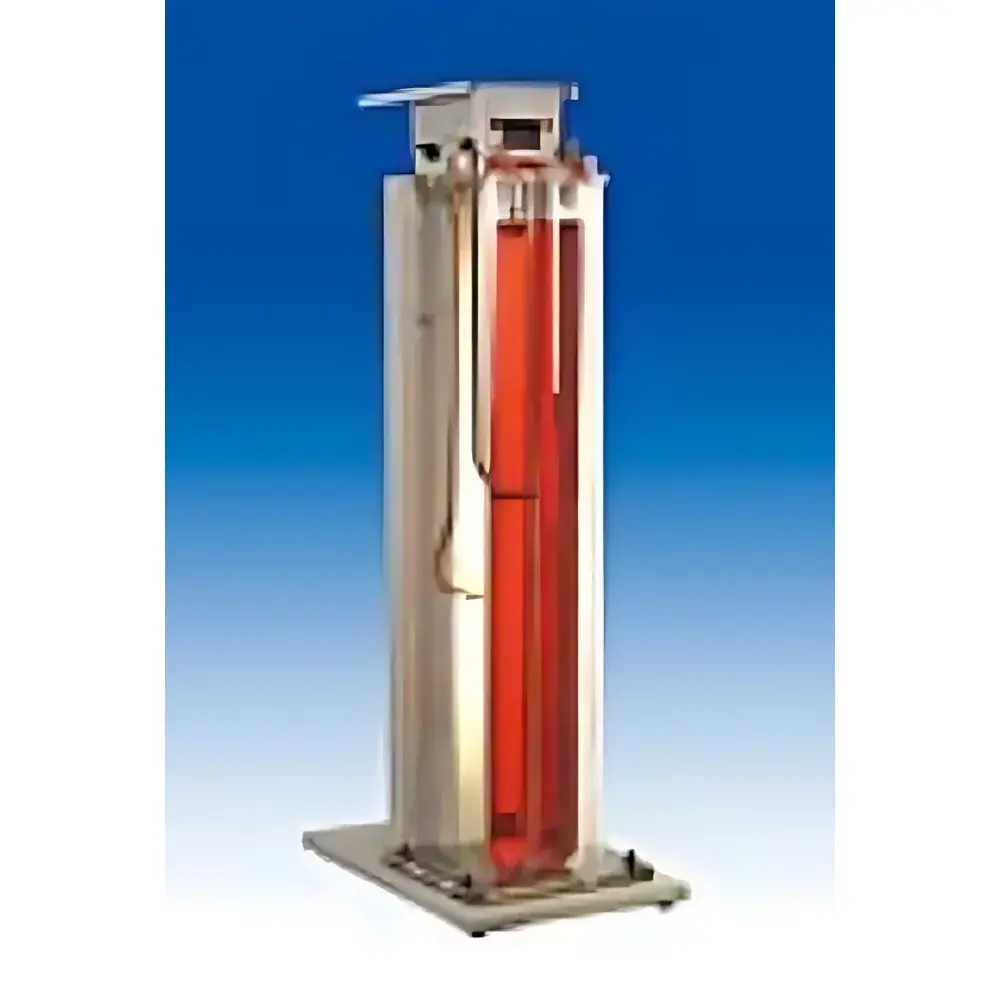
Davenport DC/02 Dual-Column Density Gradient Analyzer
| Brand | Davenport |
|---|---|
| Origin | USA |
| Model | DC/02 |
| Compliance | ASTM D1505-68, ISO 1183, BS 2782 Part 6 Method 620D |
| Operating Temperature | 23 °C ± 0.1 °C |
| Gradient Column | Cylindrical borosilicate glass tube |
| Calibration Reference | Set of 9 precision density marker floats (equally spaced in density) |
| Thermal Control | Integrated heating circuit + passive cooling coil |
| Application Scope | Solid plastics, thermoplastics, elastomers, and rigid polymer specimens |
Overview
The Davenport DC/02 Dual-Column Density Gradient Analyzer is a precision laboratory instrument engineered for the accurate determination of density in solid polymeric materials—primarily thermoplastics, thermosets, and elastomers—using the density gradient column method. It operates on the fundamental principle of buoyancy equilibrium within a stable, linear liquid density gradient, enabling high-reproducibility density measurements without destructive sample preparation. The system complies with internationally recognized standards including ASTM D1505-68 (Standard Test Method for Density of Plastics by the Density-Gradient Technique), ISO 1183-1:2019 (Plastics — Methods for determining the density of non-cellular plastics — Part 1: Immersion method, liquid pyknometer method and titration method), and BS 2782-6:1994 Method 620D. Unlike single-column systems, the DC/02 employs a dual-column architecture to support parallel calibration verification and operational redundancy, enhancing long-term measurement traceability and minimizing downtime during routine maintenance or recalibration.
Key Features
- Dual-column borosilicate glass gradient tubes (each 1.2 m height × 38 mm ID), configured for simultaneous reference float positioning and sample testing
- Active thermal regulation system maintaining column temperature at 23 °C ± 0.1 °C via PID-controlled resistive heater and copper-alloy cooling coil
- Linear density gradient established using calibrated binary solvent mixtures (e.g., ethanol/water or methanol/toluene), validated across a typical range of 0.85–1.40 g/cm³
- Included set of nine NIST-traceable density marker floats, certified to ±0.0002 g/cm³ accuracy and spaced at uniform 0.06 g/cm³ intervals
- Integrated float positioning scale with vernier-assisted reading resolution of 0.1 mm, enabling density interpolation to ±0.0005 g/cm³
- Modular base unit with vibration-damped leveling feet and integrated bubble-level indicator for gravitational alignment
Sample Compatibility & Compliance
The DC/02 accommodates solid specimens up to 10 mm in maximum dimension, provided they are non-porous, chemically inert toward gradient solvents, and free of surface contaminants or trapped air. Commonly tested materials include polyethylene (HDPE, LDPE), polypropylene, PVC, ABS, polycarbonate, and filled composites. All procedures adhere strictly to GLP documentation requirements: each gradient column calibration must be recorded with date, operator ID, ambient lab conditions, float serial numbers, and measured immersion depths. The instrument supports audit-ready compliance with FDA 21 CFR Part 11 when paired with validated electronic lab notebook (ELN) integration—though standalone operation requires manual logbook entries per ISO/IEC 17025 clause 7.7. No modifications to the gradient fluid composition or temperature setpoint are permitted without revalidation per ASTM D1505 Annex A1.
Software & Data Management
The DC/02 is a benchtop analog instrument with no embedded microprocessor or digital interface. Density calculation follows first-principles interpolation: sample density ρs = ρlower + (ds − dlower) × (ρupper − ρlower) / (dupper − dlower), where d denotes immersion depth in millimeters and ρ denotes certified float densities. Users record raw depth measurements manually and compute results using standardized spreadsheets compliant with ISO/IEC 17025 uncertainty budgeting (Type B evaluation of gradient linearity, temperature drift, and reading error). Optional third-party software modules—validated for use with Davenport instruments—support automated data capture via USB-connected digital calipers and generate PDF reports conforming to ASTM E29 and ISO/IEC 17025 clause 7.8.2.
Applications
- Quality control of incoming polymer resin batches against supplier-certified density specifications
- Determination of crystallinity index in semi-crystalline polymers (e.g., PP, PE) via correlation with literature-based density–crystallinity curves
- Identification of polymer blends and detection of unauthorized filler addition in recycled plastics
- Stability assessment of aged or weathered plastic components through longitudinal density tracking
- Supporting ISO 1043-1 material identification coding via density-based classification tiers
- Method transfer validation between laboratories under ISO/IEC 17043 proficiency testing schemes
FAQ
What is the recommended frequency for gradient column recalibration?
Calibration is required before each test series, after any temperature excursion exceeding ±0.3 °C, and at least once per 8-hour shift when operating continuously.
Can the DC/02 be used for porous or fibrous samples?
No—porosity introduces buoyancy artifacts; such specimens require gas pycnometry (ASTM D792) or liquid displacement with vacuum impregnation (ASTM D2734).
Is solvent replacement covered under routine maintenance?
Yes; gradient fluids degrade over time due to evaporation and oxidation. Replacement intervals are determined empirically but typically range from 30 to 90 days depending on ambient humidity and column seal integrity.
Does Davenport provide NIST-traceable float certification?
Yes—each float set ships with a certificate of calibration issued by an ISO/IEC 17025-accredited metrology laboratory, including expanded uncertainty (k=2) and reference temperature.
How is thermal stability verified during operation?
A calibrated platinum resistance thermometer (Pt100, Class A) is inserted into a dedicated port adjacent to the column; readings are logged every 15 minutes and compared against the control setpoint deviation threshold.



