
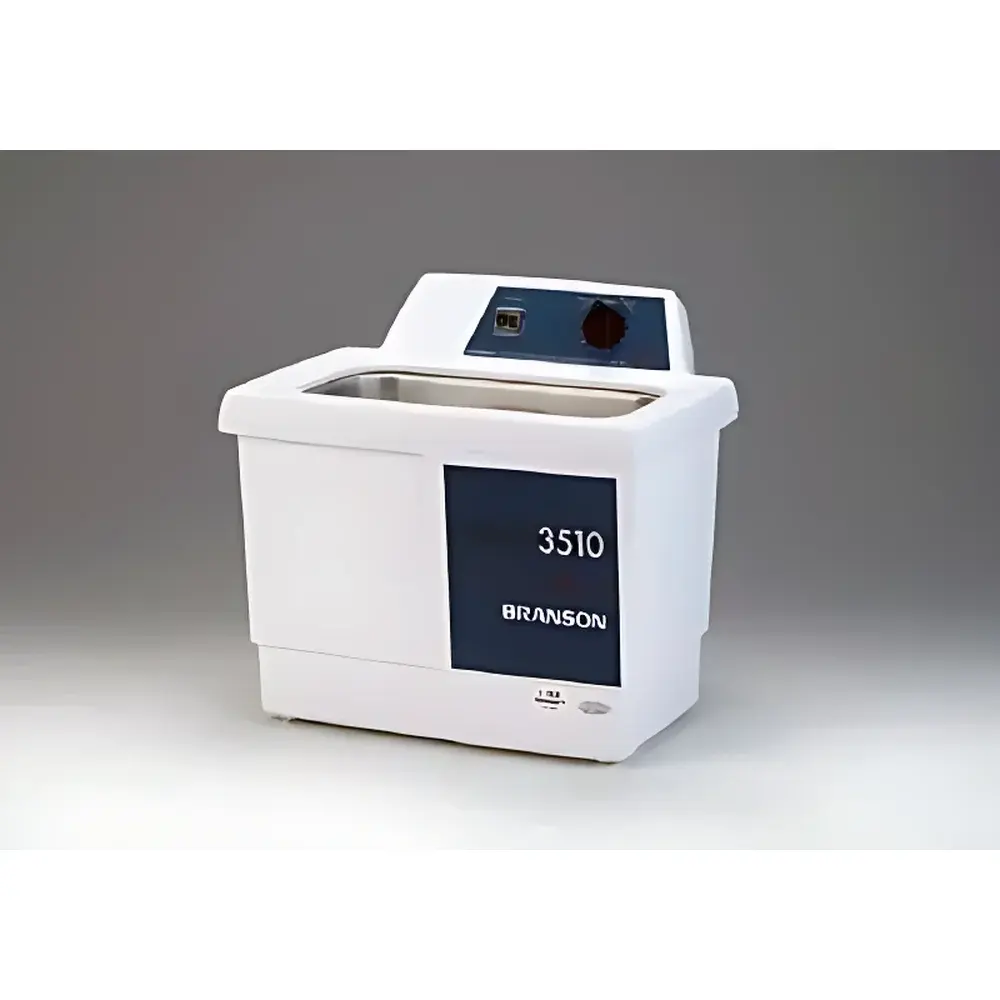
Branson B3510E-MTH Ultrasonic Cleaner
| Brand | Branson |
|---|---|
| Origin | USA |
| Model | B3510E-MTH |
| Tank Volume | 5.7 L |
| Internal Dimensions | 292 × 152 × 152 mm |
| Ultrasonic Frequency | 40 kHz |
| Heating Range | 0–70 °C |
| Timer Range | 0–99 min (digital) |
| Ultrasonic Power Output | 130 W |
| Total Power Consumption | 335 W |
| Input Voltage | 220 V, 50/60 Hz |
| Construction Material | Polypropylene (PP) tank and housing |
| Transducer Type | Langevin-type piezoelectric stack (metal/ceramic) |
| Sweep Frequency Function | Yes |
| Water Level Indicator | Fixed optimal fill line |
| Drain Valve | Integrated |
| Lid Function | Hinged acoustic lid with drip tray mode |
Overview
The Branson B3510E-MTH Ultrasonic Cleaner is a precision-engineered benchtop cleaning system designed for consistent, reproducible removal of particulate, organic, and ionic contaminants from laboratoryware, precision components, optical elements, and medical instruments. Operating on the principle of high-frequency acoustic cavitation—where 40 kHz ultrasonic energy induces controlled microbubble formation and implosion within the cleaning fluid—the unit delivers uniform energy distribution across the entire tank volume. This mechanism enables effective disruption of weak boundary layers and dislodgement of sub-micron residues without mechanical abrasion or surface damage. Developed by Branson, a pioneer in ultrasonic technology since 1946, the B3510E-MTH integrates decades of transducer engineering expertise into a compact, CE-compliant platform optimized for routine QC/QA labs, research facilities, and regulated environments requiring traceable cleaning validation.
Key Features
- Polypropylene (PP) construction throughout the tank and outer housing ensures long-term resistance to acids, alkalis, and common solvents—including diluted nitric acid, ethanol, and aqueous alkaline detergents—reducing corrosion-related maintenance and extending service life.
- Langevin-type piezoelectric transducers—comprising bonded metal mass and high-curie-point ceramic elements—are affixed via industrial-grade epoxy bonding directly to the tank bottom, delivering superior mechanical coupling efficiency and thermal stability over extended duty cycles.
- Continuous frequency sweep modulation eliminates standing wave nodes and hot spots, ensuring spatially homogeneous cavitation intensity across all load configurations—even when processing irregularly shaped or nested items.
- Digital temperature and timer interface displays real-time bath temperature (±0.5 °C accuracy) and remaining cycle time; heating is PID-regulated to maintain setpoint stability within ±1 °C during prolonged operation.
- Vertically oriented internal PCB architecture minimizes condensation ingress risk, while elevated control panel placement above the tank rim prevents liquid splashing and enhances operator ergonomics and IP protection.
- Hinged acoustic lid doubles as a drip tray and incorporates a quick-release drain valve, enabling rapid, spill-free fluid exchange—a critical advantage during multi-solvent cleaning protocols or residue-sensitive applications.
- Fixed optimal fill line ensures repeatable acoustic loading conditions, preserving cavitation efficiency and minimizing power reflection losses at non-design fluid levels.
Sample Compatibility & Compliance
The B3510E-MTH accommodates standard laboratory glassware (e.g., volumetric flasks, pipettes, crucibles), stainless-steel tools, silicon wafers, printed circuit boards, and delicate instrumentation parts up to 292 mm in length. Its PP tank meets USP Class VI biocompatibility requirements for non-leaching contact surfaces. The system complies with IEC 61000-6-3 (EMC emission limits) and IEC 61010-1 (safety for electrical equipment used in laboratory environments). While not inherently validated for sterile processing, it supports GLP/GMP-aligned cleaning SOP development when paired with documented cleaning agents, temperature logs, and post-cycle rinse verification per ASTM F3128–18 (Standard Guide for Validation of Cleaning Processes for Reusable Medical Devices).
Software & Data Management
This analog-digital hybrid model does not include embedded software or network connectivity. All operational parameters—temperature setpoint, timer duration, and on/off state—are configured locally via tactile membrane switches and displayed on a dual-segment LED screen. For auditability in regulated settings, external data loggers (e.g., calibrated thermistors + USB timers) may be employed to record bath temperature profiles and cycle timestamps, satisfying basic 21 CFR Part 11 documentation prerequisites when integrated into broader lab quality management systems.
Applications
- Routine decontamination of HPLC vials, GC syringes, and autosampler components prior to trace-level analysis
- Preparation of substrates for SEM, TEM, and AFM imaging where hydrocarbon or particle carryover must be minimized
- Cleaning of surgical instruments, dental handpieces, and endoscope accessories in ISO 15883-compliant reprocessing workflows
- Removal of photoresist residues and flux contaminants from microelectronics assemblies
- Extraction support for solid-phase microextraction (SPME) fiber conditioning and tissue homogenate clarification
- Validation studies requiring consistent ultrasonic energy delivery across replicate batches (e.g., ASTM D2240 hardness testing sample prep)
FAQ
Is the B3510E-MTH suitable for use with flammable solvents?
No. The unit is rated for aqueous and water-miscible solutions only. Flammable or low-flashpoint solvents require explosion-proof ultrasonic systems certified to ATEX or UL 60079 standards.
Can I operate the heater and ultrasonics independently?
Yes. The control interface allows separate activation of heating and ultrasonic functions, enabling cold cleaning or temperature-controlled sonication without concurrent heating.
What is the recommended cleaning solution concentration for general labware?
For most applications, a 1–2% v/v concentration of a non-ionic, low-foaming detergent (e.g., Alconox® Liquinox® or Micro-90®) in deionized water achieves optimal soil removal while minimizing residue and foaming interference.
Does this model support external timer integration or remote start?
No. It lacks relay outputs or communication ports; all operation is manual and front-panel controlled.
How often should the transducers be inspected for performance drift?
Under normal usage (≤4 hrs/day), annual verification of ultrasonic output power using calorimetric or hydrophone-based methods is recommended per ISO 13073–2:2019 guidelines.
Related Products



