
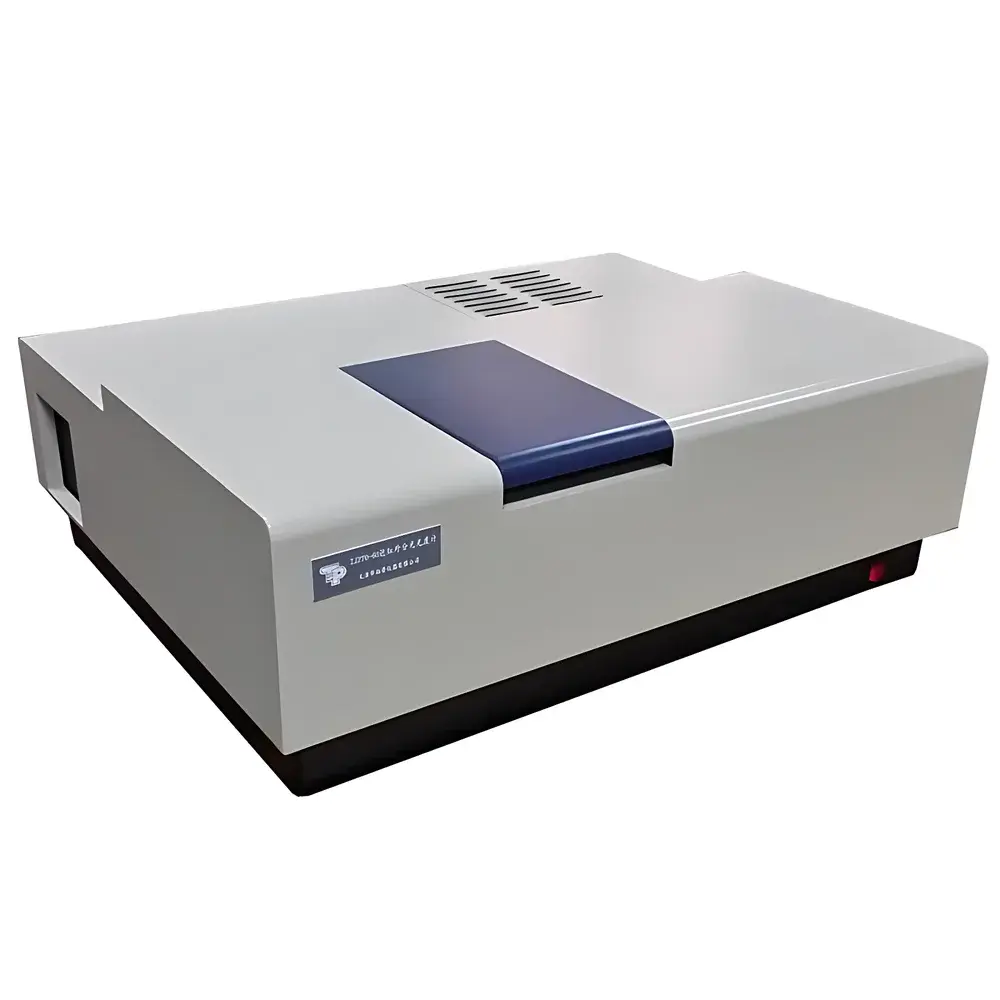
Topo TJ270-60 Dual-Beam Near Infrared Spectrophotometer
| Brand | Topo (TP) |
|---|---|
| Origin | Tianjin, China |
| Manufacturer Type | Direct Manufacturer |
| Instrument Type | Laboratory Benchtop NIR Spectrometer |
| Optical Design | Grating Scanning |
| Wavelength Range | 800–2500 nm |
| Spectral Resolution Options | 0.1–2.0 nm (adjustable scan speed) |
| Scan Speed | Up to 1 scan/s (at 2.0 nm step) |
| Data Acquisition Interval | 1 Hz |
| Measurement Modes | Transmission & Reflectance |
| Detector | PbS (Lead Sulfide) |
| Light Source | Tungsten-Halogen Lamp |
| Grating Density | 300 lines/mm |
| Wavelength Accuracy | ±1.5 nm |
| Wavelength Repeatability | ±1 nm |
| Stray Light | ≤1% T at 1690 nm |
| Spectral Bandwidth Settings | Wide / Normal / Narrow / Very Narrow |
| Scan Modes | Continuous, Repeat, Time-Based |
| X/Y Axis Scaling | Fully Adjustable |
| Dimensions (W×D×H) | 710 × 560 × 240 mm |
| Weight | 45 kg |
| Chemometrics Software | RIMP (Near-Infrared Modeling Platform) |
| Compliance | Designed for GLP-compliant lab environments |
Overview
The Topo TJ270-60 Dual-Beam Near Infrared Spectrophotometer is a benchtop analytical instrument engineered for robust, reproducible spectral acquisition in the 800–2500 nm near-infrared region. It operates on the principle of grating-based scanning spectroscopy, utilizing a high-efficiency blazed diffraction grating (300 lines/mm) to disperse incident light across the detector array. The dual-beam optical architecture—comprising separate sample and reference paths—compensates for source intensity drift and environmental fluctuations in real time, significantly enhancing photometric stability and long-term measurement repeatability. This configuration is particularly advantageous for quantitative analysis where baseline integrity and signal-to-noise ratio are critical. The instrument employs a thermally stabilized tungsten-halogen lamp as its broadband NIR source and a lead sulfide (PbS) photoconductive detector optimized for sensitivity across the entire operational range. Its modular design supports both transmission and reflectance sampling geometries, enabling flexible integration with standard cuvette holders, integrating spheres, or fiber-optic probes.
Key Features
- Dual-beam optical path architecture for real-time background correction and enhanced photometric stability
- High-efficiency 300 L/mm blazed grating delivering low stray light (≤1% T at 1690 nm) and improved spectral fidelity
- Five-step adjustable scan speed (0.1–2.0 nm/step), supporting rapid screening and high-resolution characterization
- Configurable spectral bandwidth (Wide / Normal / Narrow / Very Narrow) to balance resolution and signal throughput
- Fully scalable X- and Y-axis display with real-time zoom, offset, and overlay functions
- Integrated USB interface for direct connection to host PC; no proprietary interface cards required
- Comprehensive pre-processing suite including baseline correction, Savitzky-Golay smoothing, first/second derivative calculation, and spectral normalization
Sample Compatibility & Compliance
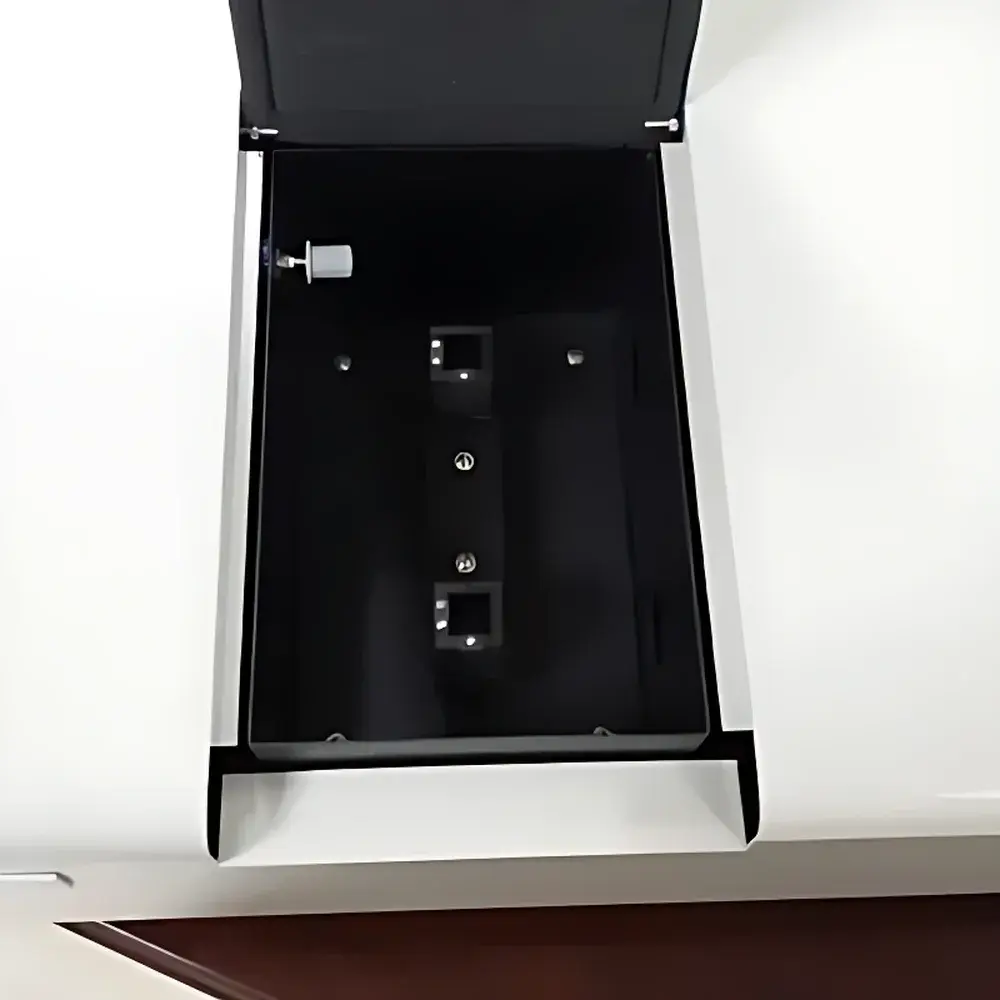
The TJ270-60 accommodates a wide variety of solid, liquid, and semi-solid samples via standardized transmission cells (1–10 mm pathlength) and reflectance accessories—including integrating spheres and contact probes—for non-destructive analysis. It meets fundamental requirements for method validation under ISO/IEC 17025 and ASTM E1655-22 (Standard Practices for Infrared Multivariate Quantitative Analysis). While not certified for regulated GMP production environments, its software architecture supports traceable data handling: all spectra retain embedded timestamps, operator IDs, instrument serial numbers, and acquisition parameters. Raw data files (.spc, .csv) preserve full metadata, facilitating retrospective review during internal audits or regulatory inspections. The system is compatible with laboratory information management systems (LIMS) via standardized file export protocols.
Software & Data Management
Control and analysis are performed using the RIMP (Remote Infrared Modeling Platform) chemometrics software—a Windows-native application developed specifically for NIR spectral modeling and multivariate calibration. RIMP provides full spectral preprocessing, PCA-based outlier detection, PLS and PCR regression model development, cross-validation diagnostics, and prediction reporting with confidence intervals. All processing steps are logged in an immutable audit trail, compliant with ALCOA+ principles (Attributable, Legible, Contemporaneous, Original, Accurate, Complete, Consistent, Enduring, Available). Data exports support CSV, TXT, and JCAMP-DX formats for interoperability with third-party statistical packages (e.g., MATLAB, Unscrambler X, SIMCA). No cloud dependency: all computation and storage occur locally, ensuring data sovereignty and network security.
Applications
The TJ270-60 serves as a foundational tool in academic research laboratories and applied R&D settings across multiple sectors. In agricultural science, it enables rapid quantification of moisture, protein, starch, and oil content in grains and forage. In pharmaceutical development, it supports raw material identification, blend uniformity assessment, and tablet coating thickness monitoring. Petrochemical labs utilize it for hydrocarbon group-type analysis and octane number estimation. Biomedical researchers apply it for non-invasive tissue oxygenation studies and biomarker screening in biofluids. Its versatility extends to polymer characterization (crystallinity, additive concentration), food authenticity verification (adulteration detection), and environmental monitoring (soil organic carbon mapping). Each application benefits from the instrument’s consistent spectral reproducibility and compatibility with established calibration transfer protocols.
FAQ
What is the recommended calibration frequency for routine use?
We recommend wavelength calibration using a NIST-traceable holmium oxide or rare-earth glass standard before each daily session or after any mechanical disturbance.
Can RIMP generate FDA 21 CFR Part 11–compliant electronic records?
RIMP supports user authentication, electronic signatures, and audit trails—but full Part 11 compliance requires additional IT infrastructure (e.g., validated Windows domain, time-stamped logging server, and formal SOP documentation), which falls outside the instrument’s scope.
Is fiber-optic coupling supported out of the box?
Yes—the instrument includes SMA-905 port compatibility; optional fiber bundles (400–2500 nm range) and probe holders can be integrated without hardware modification.
Does the system support external trigger input for synchronized measurements?
No native TTL trigger input is provided; synchronization must be achieved via software-controlled start commands through the USB API.
What maintenance is required for the PbS detector?
The PbS detector is sealed and thermoelectrically cooled; no user-serviceable parts exist. Annual performance verification (noise level, dark current, responsivity) is advised using factory-provided diagnostic routines.






