
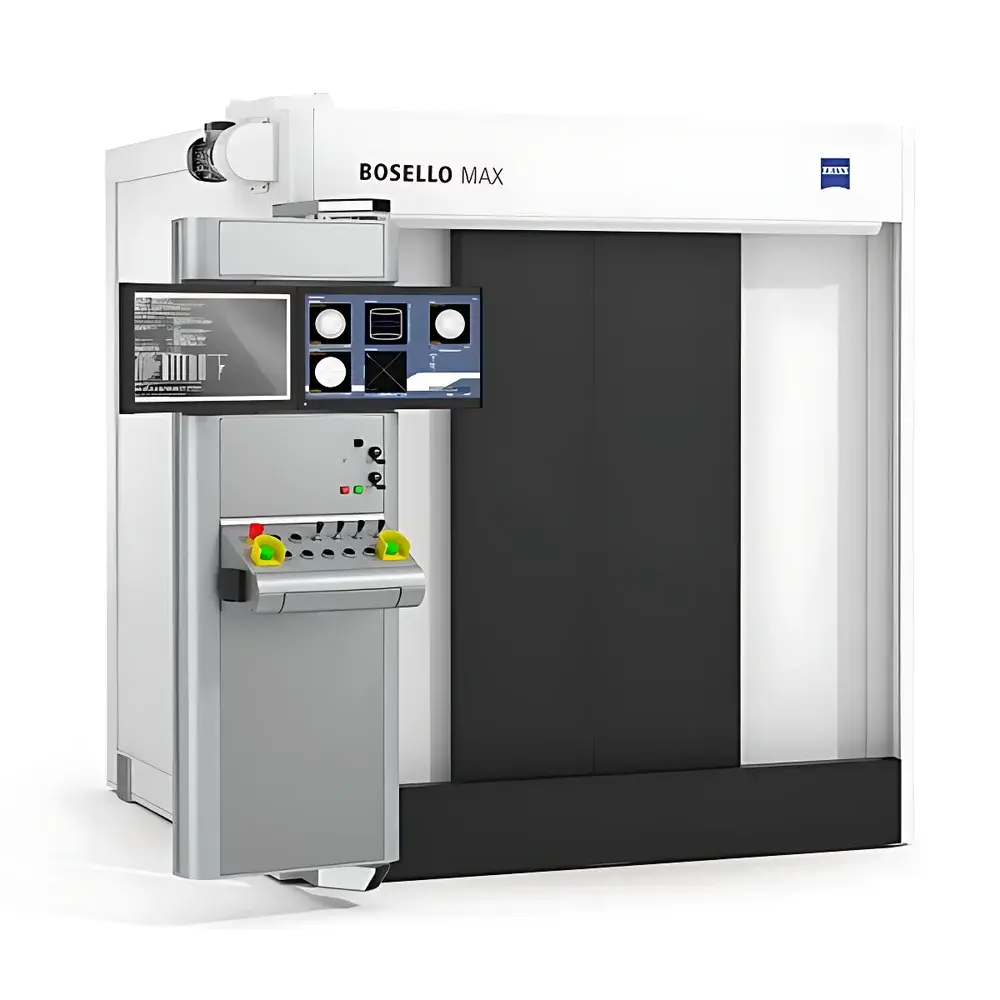
ZEISS BOSELLO MAX Industrial Micro-CT System
| Brand | ZEISS |
|---|---|
| Origin | Shanghai, China |
| Manufacturer Type | Manufacturer |
| Origin Category | Domestic |
| Model | BOSELLO MAX |
| Quotation | Upon Request |
| Detector Type | Flat-Panel Detector (FPD) |
| Scan Mode | Translation-Rotation (TR) |
| Inspection Volume | 1700 × 1700 × 2200 mm to 2600 × 2600 × 2600 mm |
| Sample Weight Capacity | 80 – 250 kg |
Overview
The ZEISS BOSELLO MAX is a high-performance industrial micro-computed tomography (micro-CT) system engineered for non-destructive 3D volumetric inspection in demanding production and quality assurance environments. Operating on the principle of cone-beam X-ray computed tomography, it acquires hundreds of 2D projection images as the sample rotates incrementally through 360°, then reconstructs them into high-fidelity 3D voxel datasets using filtered back-projection or iterative reconstruction algorithms. Designed specifically for in-line and near-line integration, the system delivers metrologically traceable dimensional analysis, internal defect characterization (e.g., porosity, inclusions, cracks), and assembly verification — all without part disassembly or surface preparation. Its mechanical architecture integrates a precision TR (translation-rotation) scanning geometry, enabling stable, repeatable acquisition across large-volume parts while maintaining sub-pixel spatial registration between projections.
Key Features
- Robust TR scanning architecture with motorized translation stage and high-torque rotary table, optimized for geometric stability and long-term reproducibility under factory-floor conditions.
- Modular X-ray source configuration supporting variable kV (up to 450 kV) and focal spot sizes (down to 5 µm), enabling adaptive penetration for low-density aluminum castings and high-density steel or tungsten components.
- Large-format flat-panel detector (FPD) with scintillator-coupled amorphous silicon (a-Si) sensor, offering high dynamic range (>16-bit), low electronic noise, and real-time image correction for beam hardening and scatter compensation.
- Motorized, extendable 360° rotating turntable with dual-sliding cabinet doors and external positioning capability — facilitating ergonomic loading/unloading of parts up to 250 kg without overhead cranes.
- Integrated thermal management and vibration-damping foundation, ensuring consistent imaging performance in ambient temperatures ranging from 15–30°C and typical industrial floor vibrations (ISO 2372 Class A).
- CE-marked, EMC-compliant enclosure with interlocked safety shielding (lead-equivalent ≥ 2.5 mm Pb), meeting IEC 61000-6-2/6-4 and IEC 62464-1 requirements for industrial X-ray systems.
Sample Compatibility & Compliance
The ZEISS BOSELLO MAX accommodates a broad spectrum of industrial components — from small turbine blades (≤100 mm) to full-scale automotive powertrain housings (≥2500 mm). It supports materials with densities spanning 1.2 g/cm³ (polymer composites) to 19.3 g/cm³ (tungsten alloys), with effective resolution down to 50 µm (system-dependent on magnification, source-detector distance, and exposure time). The system complies with ISO 17025:2017 for testing laboratories, supports audit-ready documentation per ISO 9001 and IATF 16949, and provides raw projection data export in DICOM and HDF5 formats for third-party analysis. Optional CT modules enable conformance with ASTM E1441 (Standard Practice for Computed Tomography), ASTM E2737 (Digital Detector Arrays), and VDI/VDE 2630-1.3 (CT-based dimensional metrology).
Software & Data Management
Controlled via ZEISS INSPECT CT software suite, the system delivers integrated workflow management from acquisition planning to quantitative reporting. The software features automated scan parameter optimization based on material composition and geometry, GPU-accelerated FDK and SART reconstruction engines, and built-in GD&T evaluation tools compliant with ASME Y14.5 and ISO 1101. All user actions, parameter changes, and reconstruction logs are timestamped and stored with cryptographic hashing to satisfy FDA 21 CFR Part 11 requirements for electronic records and signatures. Data archiving follows hierarchical storage management (HSM) protocols, with metadata tagging aligned to ASTM E2987 (CT data exchange standards) and optional integration into enterprise PLM/MES platforms via RESTful API.
Applications
The ZEISS BOSELLO MAX serves as a reference-grade inspection platform across regulated manufacturing sectors. In automotive and aerospace casting, it performs wall thickness analysis, core shift quantification, and pore network characterization per ASTM E155 and AMS 2175. For battery module assemblies in new energy vehicles, it validates electrode alignment, separator integrity, and weld joint porosity at sub-100 µm resolution. In oil & gas valve bodies and pipeline fittings, it detects fatigue-induced microcracks and corrosion under insulation (CUI) with volumetric confidence intervals. Additional use cases include additive manufacturing part qualification (per ASTM F3184), turbine blade cooling channel verification, and failure analysis root-cause mapping using volume rendering and cross-sectional slicing.
FAQ
What is the maximum achievable spatial resolution for a given part size?
Resolution is governed by geometric magnification, detector pixel pitch, and focal spot size; typical system MTF-based resolution ranges from 50 µm (at 1× magnification) to <15 µm (with high-magnification optics and optimized geometry).
Does the system support automated defect recognition (ADR) out of the box?
Yes — optional ZEISS ADR module enables supervised machine learning-based classification of voids, inclusions, and shrinkage defects, with configurable sensitivity thresholds and false-positive suppression.
Can the BOSELLO MAX be integrated into an automated production line?
It supports OPC UA and SECS/GEM interfaces for synchronization with PLCs and robotic handling systems, including trigger-based scan initiation and pass/fail result feedback via digital I/O.
Is calibration traceable to national standards?
All dimensional measurements are traceable to PTB (Physikalisch-Technische Bundesanstalt) via ZEISS-certified gauge blocks and sphere artifacts, with annual recalibration services available under ISO/IEC 17025 accreditation.
What are the facility requirements for installation?
Minimum clear floor space: 6 m × 8 m; reinforced concrete floor (≥30 cm depth, load capacity ≥10 t/m²); dedicated 400 V / 3-phase / 63 A supply; HVAC with ±1°C temperature stability and ≤50% RH; no requirement for external radiation shielding beyond the integrated cabinet.
Related Products



