
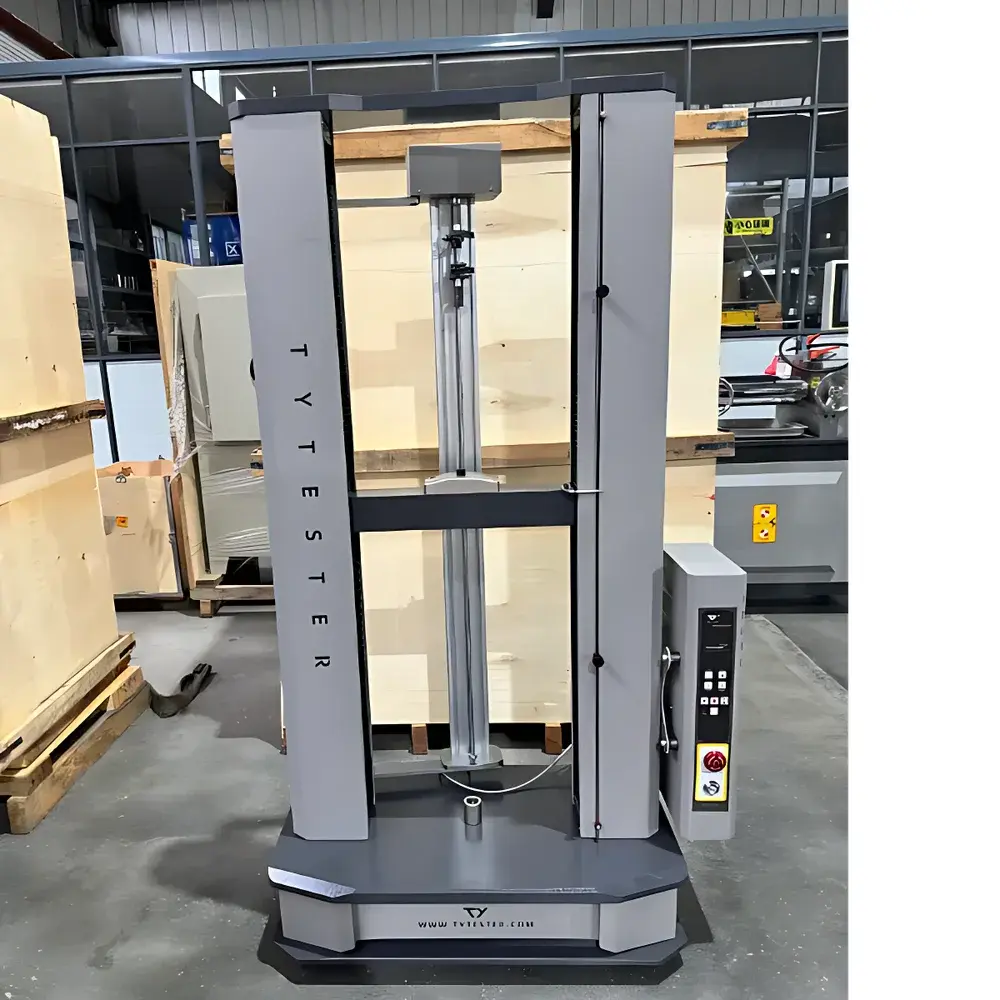
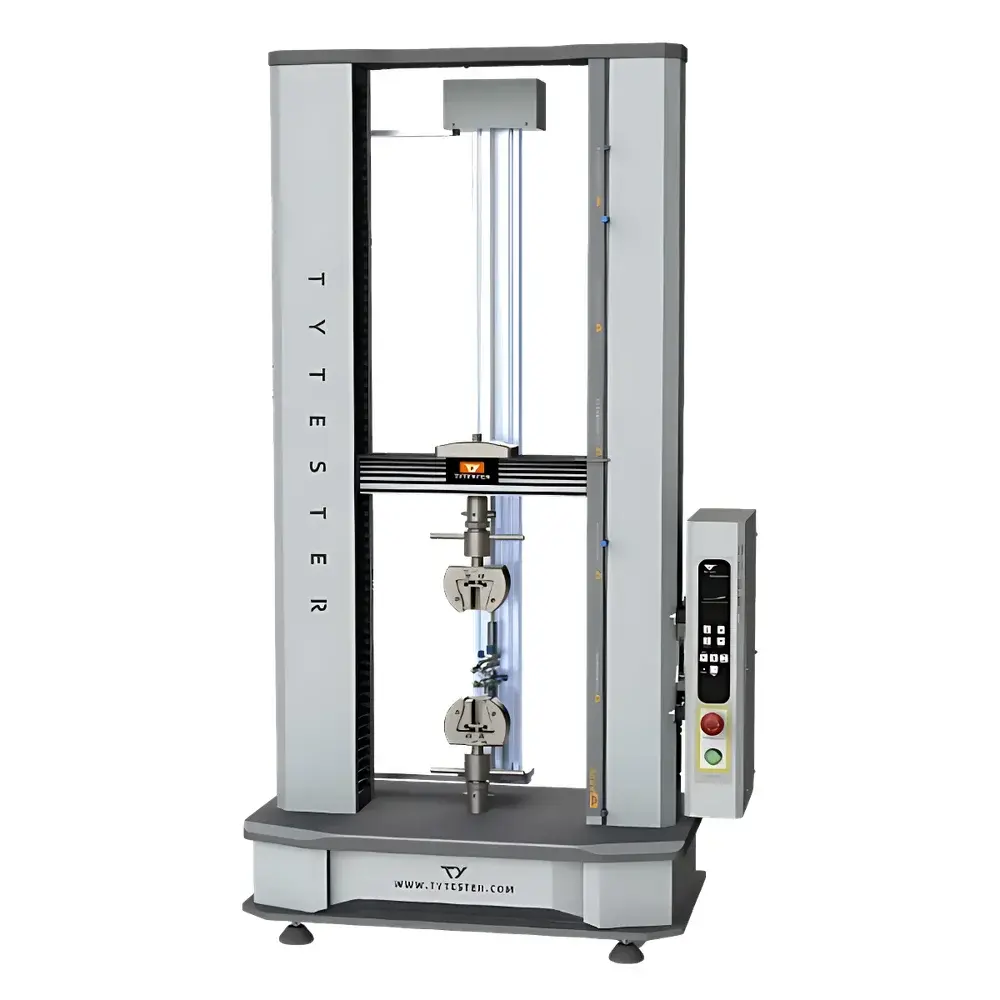
TianYuan TY8000-A5KN Electronic Tensile Testing Machine
| Brand | TianYuan |
|---|---|
| Origin | Jiangsu, China |
| Manufacturer Type | Direct Manufacturer |
| Product Category | Domestic |
| Model | TY8000-A5KN |
| Maximum Test Load | 5 kN |
| Force Measurement Range | 0.4–100% FS |
| Force Accuracy | ≤ ±0.5% |
| Test Stroke | 1000 mm |
| Displacement Resolution | 0.001 mm |
| Control Mode | Servo-Controlled |
| Test Modes | Tensile, Compression, Bending, Shear, Peel, Tear, Puncture |
| Speed Range | 0.001–500 mm/min |
| Speed Accuracy | ≤ ±0.3% |
| Effective Width | 420 mm |
| Dimensions (W×D×H) | 896 × 440 × 1507 mm |
| Weight | 230 kg |
| Power Supply | 380 V AC, 500 W |
| Compliance | GB/T 16491–1996 |
Overview
The TianYuan TY8000-A5KN is a high-precision, servo-controlled electronic tensile testing machine engineered for static mechanical property evaluation of metallic and non-metallic materials under uniaxial loading conditions. Based on closed-loop PID control architecture, it applies controlled force or displacement to specimens while continuously acquiring synchronized load, displacement, and strain data in real time. Its modular load frame—constructed from high-rigidity steel with preloaded ball screws and precision linear guides—ensures minimal deflection and high repeatability across test cycles. Designed for laboratory and quality control environments, the system complies with GB/T 16491–1996 (equivalent in scope to ISO 7500-1 and ASTM E4), supporting standardized determination of tensile strength, yield strength, elongation at break, Young’s modulus, flexural modulus, peel resistance, tear strength, and puncture energy.
Key Features
- Servo-motor-driven crosshead with bidirectional motion control and programmable speed profiles (0.001–500 mm/min), enabling precise execution of constant-rate, constant-load, constant-strain, and cyclic loading protocols.
- High-resolution load cell calibrated to Class 0.5 accuracy (≤ ±0.5% of full scale), with force measurement range spanning 0.4% to 100% FS—optimized for low-force polymer films and high-strength structural alloys alike.
- Sub-micron displacement resolution (0.001 mm) achieved via optical encoder feedback integrated into the drive train, ensuring traceable positional fidelity during creep, relaxation, and low-speed deformation tests.
- 1000 mm vertical stroke accommodates extended elongation testing (e.g., elastomers, textiles) without manual repositioning; effective test width of 420 mm supports standardized specimen grips and environmental chamber integration.
- Robust mechanical architecture—including reinforced base plate, dual-column alignment system, and vibration-damped mounting feet—minimizes parasitic compliance and enhances long-term calibration stability.
Sample Compatibility & Compliance
The TY8000-A5KN accommodates standardized specimens per ISO 527, ASTM D638, ASTM D790, ASTM D1876 (T-peel), ASTM D624 (tear), and GB/T 2567 (composite laminates). Grip options include pneumatic wedge clamps, hydraulic self-tightening jaws, and specialized fixtures for film, wire, foam, and biomedical sutures. All hardware and firmware are designed to support GLP-compliant workflows: audit trails record operator ID, test parameters, calibration history, and raw data timestamps. The system meets mechanical verification requirements of ISO 7500-1 (static calibration) and is suitable for use in environments governed by ISO/IEC 17025 and FDA 21 CFR Part 11 when paired with validated software modules.
Software & Data Management
The bundled PC-based control and analysis software provides intuitive test method configuration via wizard-driven templates aligned with ISO and ASTM standards. Real-time plotting supports simultaneous display of up to six parameter pairs (e.g., Load vs. Displacement, Stress vs. Strain, Load vs. Time). Raw data export is available in CSV, XLSX, and universal ASCII formats; metadata embedding includes test name, operator, date/time, environmental conditions (if external sensors are connected), and instrument serial number. Software features include automatic yield point detection (0.2% offset method), modulus calculation over user-defined strain ranges, energy integration (area under curve), and batch report generation with customizable PDF templates compliant with internal QA documentation requirements.
Applications
This system is routinely deployed in R&D labs for polymer formulation screening, metal alloy qualification, composite interface characterization, and medical device component validation (e.g., suture tensile strength, catheter burst pressure, hydrogel swelling mechanics). In manufacturing QC settings, it verifies incoming raw material specifications (e.g., aluminum sheet tensile properties per ASTM B209), monitors production consistency of extruded profiles, and validates packaging seal integrity (ASTM F88). Additional applications include adhesive bond strength assessment (ASTM D1002), rubber vulcanization optimization, geotextile tensile performance, and additive manufacturing part anisotropy analysis.
FAQ
What standards does the TY8000-A5KN comply with?
It conforms to GB/T 16491–1996 and is mechanically verified per ISO 7500-1. Test methods align with ASTM D638, ISO 527, ASTM D790, and related international material standards.
Can the system perform cyclic loading tests?
Yes—it supports low-frequency load, displacement, and strain cycling (e.g., fatigue pre-conditioning, hysteresis loop acquisition) with programmable upper/lower limits and dwell times.
Is third-party calibration certification available?
Yes—traceable calibration certificates issued by CNAS-accredited laboratories can be provided upon request, covering force, displacement, and speed channels.
Does the software support multi-user access with role-based permissions?
The standard software includes operator-level and administrator-level accounts, supporting password protection, electronic signatures, and configurable audit trail retention periods.
What environmental conditions are recommended for optimal operation?
Ambient temperature: 10–35 °C; relative humidity: ≤ 80% RH (non-condensing); installation on a vibration-isolated concrete floor is strongly advised for sub-0.5% accuracy testing.



