
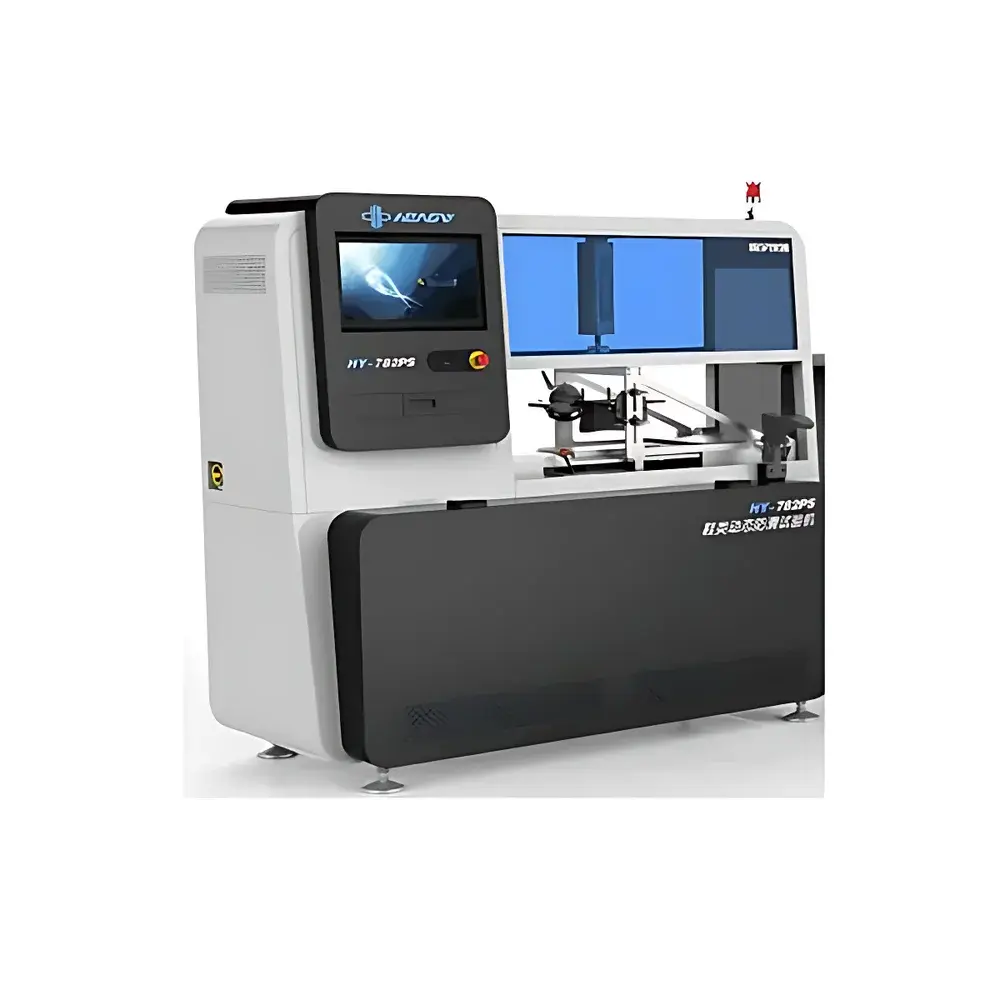
ISO 13287 Slip Resistance Tester for Footwear
| Brand | HENGYU |
|---|---|
| Model | HY-782PS1 |
| Standard Compliance | ASTM F2913-11, ISO 13287:2012, GB/T 3903.6–2017, GB/T 28287–2012, SATRA TM144 |
| Test Surface Options | Stainless Steel, Ceramic Tile, and Customizable Surfaces |
| Dimensions (L×W×H) | 191 × 80 × 175 cm |
| Weight | 300 kg |
| Actuation | Proportional Valve-Controlled Dynamic Loading System |
| Data Acquisition | High-Speed Sampling with Real-Time Force & Displacement Synchronization |
| Software | Integrated Standard-Method Library with One-Click Test Protocol Selection |
| Sample Mounting | Interchangeable Last-Based Fixtures for Secure, Repeatable Footwear Positioning |
| Power Supply | 220 V AC, 50/60 Hz |
Overview
The HENGYU HY-782PS1 Slip Resistance Tester for Footwear is a precision-engineered dynamic tribometer designed to quantify the coefficient of friction (COF) between footwear outsoles and representative walking surfaces under controlled, standardized loading and motion conditions. Operating on the principle of controlled horizontal shear force application during simulated gait motion, the system replicates the biomechanical interface between shoe and substrate as defined in ISO 13287:2012 and ASTM F2913–11. Unlike static slip testers, this instrument captures dynamic COF values across the full sliding cycle—initial contact, transition, and steady-state slip—enabling discrimination between surface-dependent traction performance and material-specific energy dissipation characteristics. Its architecture integrates servo-controlled proportional valve actuation with real-time load-displacement synchronization, ensuring traceable force application profiles compliant with regulatory test protocols used by footwear manufacturers, certification bodies (e.g., SATRA, BSI), and regulatory agencies evaluating slip-related injury risk.
Key Features
- Proportional valve-driven hydraulic/pneumatic actuation system delivering precise, repeatable dynamic loading profiles from 0 to 1,500 N, with response time < 20 ms for transient force fidelity.
- High-speed synchronized data acquisition at ≥10 kHz sampling rate, capturing both normal force and tangential shear force with ≤0.5% full-scale linearity per channel.
- Modular test surface platform accommodating standardized substrates—including polished stainless steel (ISO 13287 Annex A), glazed ceramic tile (ASTM F2913 Annex B), and user-supplied surfaces—mounted via calibrated torque-fastened fixtures to ensure flatness tolerance ≤0.05 mm/m².
- Interchangeable last-based sample holders engineered to replicate anatomical foot geometry; each fixture includes adjustable tension clamps and pressure distribution pads to minimize lateral deformation during testing.
- Embedded control firmware with preloaded test methods: ISO 13287 Mode A (constant velocity), Mode B (accelerated ramp), ASTM F2913 Step-and-Slide, GB/T 3903.6 Wet/Dry Variants, and SATRA TM144 Inclined Plane Correlation Mode.
- Robust structural frame constructed from stress-relieved welded steel with powder-coated corrosion-resistant finish; operational footprint optimized for ISO Class 6 laboratory environments.
Sample Compatibility & Compliance
The HY-782PS1 accommodates footwear sizes EU 35–48 (US Men’s 4–13) using modular last inserts conforming to ISO 8522 anthropometric dimensions. Outsole thickness up to 25 mm and hardness range 40–90 Shore A are fully supported. All mechanical and software functions comply with ISO/IEC 17025:2017 requirements for testing laboratories, including documented calibration traceability to NIST-traceable force and displacement standards. The system supports audit-ready documentation per GLP and GMP frameworks, with electronic records adhering to FDA 21 CFR Part 11 requirements for signature authentication, change tracking, and data integrity preservation.
Software & Data Management
The proprietary HENGYU TestSuite v4.2 software provides intuitive workflow navigation, automated pass/fail evaluation against selected standards, and export of raw time-series datasets in CSV and HDF5 formats. Each test session generates a timestamped report containing operator ID, environmental metadata (temperature/humidity logged via integrated sensors), calibration status flags, and statistical summaries (mean COF, standard deviation, 95% confidence intervals). Audit logs record all user actions—including method edits, parameter overrides, and calibration events—with immutable timestamps and digital signatures. Data archival supports network storage integration (SMB/NFS) and optional cloud backup with AES-256 encryption.
Applications
- Outsole compound development and comparative traction screening across rubber, TPU, EVA, and hybrid formulations.
- Regulatory submission testing for CE marking (PPE Regulation EU 2016/425), ASTM-compliant safety footwear certification, and SATRA-approved occupational footwear.
- Quality assurance in high-volume production lines, supporting SPC-based monitoring of batch-to-batch COF consistency.
- Forensic analysis of slip-and-fall incidents where substrate-specific friction thresholds must be reconstructed under controlled conditions.
- Academic research in biomechanics, polymer tribology, and pedestrian safety engineering requiring reproducible dynamic interface characterization.
FAQ
Does the HY-782PS1 support wet or contaminated surface testing?
Yes—integrated fluid delivery nozzles and drainage channels enable standardized wet testing per ISO 13287 Clause 7.2 and ASTM F2913 Section 8.3 using water, glycerol solutions, or synthetic contaminants.
Can test results be exported directly to LIMS or ERP systems?
Yes—the software includes configurable API endpoints (REST/JSON) and ODBC drivers for direct integration with major laboratory information management systems and enterprise resource planning platforms.
Is on-site installation and IQ/OQ validation included?
HENGYU provides factory-verified Installation Qualification (IQ) documentation; Operational Qualification (OQ) protocols are supplied for customer-executed validation under ISO 13485 or ISO/IEC 17025 guidelines.
What maintenance intervals are recommended for long-term measurement stability?
Preventive maintenance is scheduled every 12 months or after 5,000 test cycles, including load cell recalibration, proportional valve cleaning, and surface flatness verification using certified optical interferometry.



