
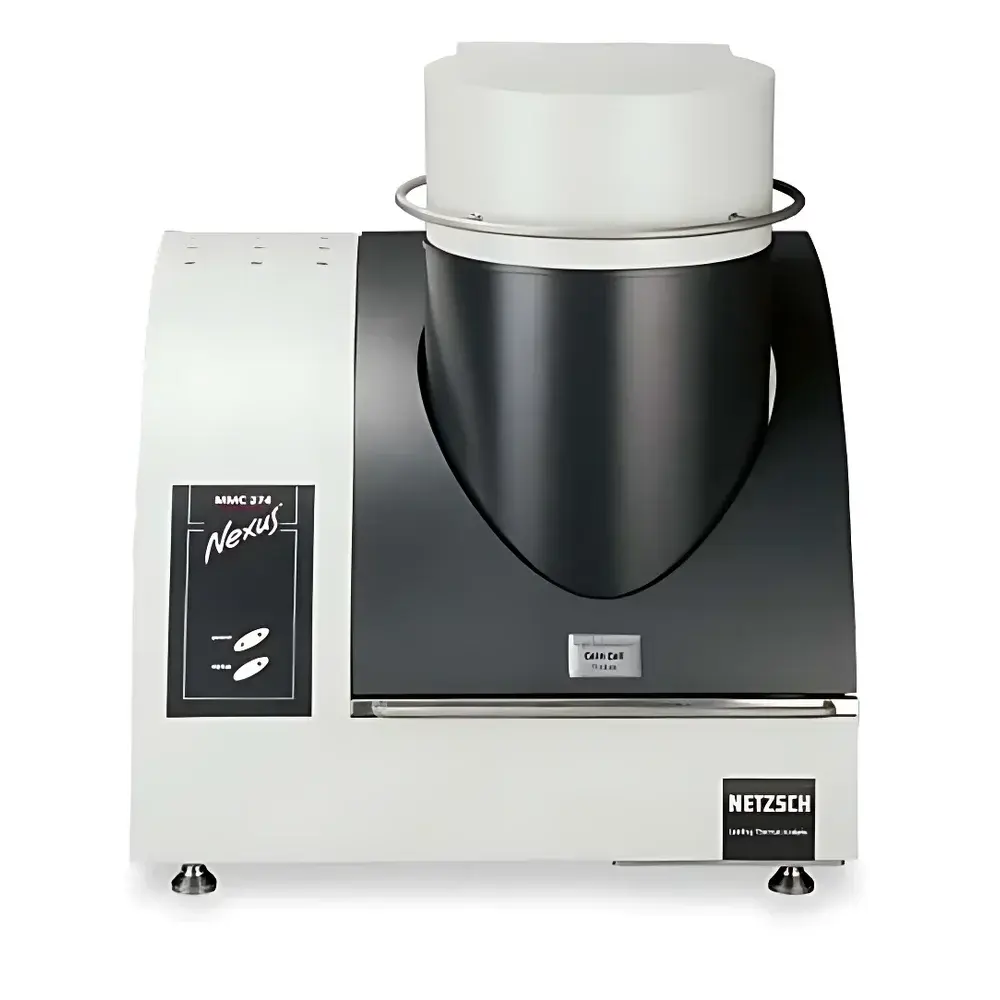
Netzsch MMC 274 Nexus Multimode Calorimeter
| Brand | Netzsch |
|---|---|
| Origin | Germany |
| Model | MMC 274 Nexus |
| Temperature Range | Up to 500 °C |
| Pressure Range | Up to 100 bar (10 MPa) |
| Modular Design | ARC, Scanning, and Button Cell Modules |
| Software | Proteus® Thermal Analysis Suite |
| Compliance | ASTM E1981, ISO 22513, IEC 60079-10-1 (for hazardous area applications), GLP/GMP-ready data audit trail |
Overview
The Netzsch MMC 274 Nexus is a high-precision, benchtop multimode calorimeter engineered for rigorous thermal hazard assessment, reaction kinetics characterization, and electrochemical thermal performance evaluation. Unlike conventional single-mode instruments, the MMC 274 Nexus employs a modular architecture comprising a central electronics and control unit paired with interchangeable calorimetric modules—each optimized for distinct thermodynamic measurement principles. Its core operation leverages adiabatic, scanning, and isothermal heat-flow methodologies grounded in fundamental calorimetric theory: adiabatic tracking via heat-wait-search (HWS) and isothermal adiabatic modes; dynamic scanning based on controlled power input or linear temperature ramping; and differential temperature monitoring under constant ΔT or multi-step protocols. Designed and manufactured in Selb, Germany, the system meets stringent engineering tolerances for thermal stability, pressure integrity, and signal reproducibility—making it suitable for R&D laboratories, process safety departments, and battery development centers operating under regulatory frameworks including OSHA 29 CFR 1910.119, EU REACH Annex XVII, and UN GHS classification guidelines.
Key Features
- Modular platform supporting three dedicated calorimetry modules: Adiabatic Reaction Calorimetry (ARC®-compatible), Scanning Calorimetry (DSC-analogous), and Button Cell Electrothermal Module—enabling method-specific configuration without hardware duplication.
- Extended operational envelope: temperature control from −80 °C to 500 °C (with optional cryo-cooling and high-temp furnace kits); pressure capability up to 100 bar (10 MPa) with leak-tight, rupture-disc-protected sample chambers.
- High-fidelity thermal isolation: active adiabatic control with real-time thermal inertia compensation and <0.01 K/min baseline drift in isothermal mode.
- Multi-sensor architecture: simultaneous acquisition of temperature, pressure, voltage, current, and heat flow signals at 10 Hz sampling rate, synchronized via internal master clock.
- Interchangeable sample containment systems: stainless steel, Hastelloy®, gold-plated, and quartz vessels (0.1–20 mL volume range), validated for corrosive, reactive, and volatile chemistries per ASTM E2550.
Sample Compatibility & Compliance
The MMC 274 Nexus accommodates heterogeneous sample types—including organic/inorganic solids, slurries, liquid-phase reactions, energetic materials, and commercial-grade coin cells (CR2032, CR2025, etc.). Vessel selection follows compatibility matrices aligned with ISO 11357-1 (plastics), ASTM D3895 (oxidative induction time), and IEC 62660-2 (lithium-ion cell safety testing). All modules comply with GLP and GMP documentation requirements: full electronic audit trail (21 CFR Part 11 compliant), user-access controls, and immutable raw data storage. Calibration traceability is maintained to NIST SRM 3471 (indium) and BAM reference materials. Pressure-rated modules are certified to PED 2014/68/EU and ASME BPVC Section VIII Div. 1.
Software & Data Management
Proteus® Thermal Analysis Software serves as the unified interface for instrument control, real-time visualization, and post-experiment analysis. It supports automated method sequencing, peak deconvolution (e.g., onset, peak maxima, enthalpy integration), kinetic modeling (e.g., AKTS Thermokinetics integration), and comparative overlay of MMC data with concurrent TGA, DSC, or TMA results. Data export conforms to ASTM E1447 (thermal analysis data exchange format) and is compatible with LIMS environments via OPC UA and CSV/Excel interfaces. Raw binary files (.prw) retain full metadata—including firmware version, calibration history, sensor IDs, and environmental logs—for forensic traceability during regulatory audits.
Applications
- Process safety screening: runaway reaction onset detection, adiabatic temperature rise (ΔTad), time-to-maximum-rate (TMRad) calculations per CCPS Guidelines.
- Reaction mechanism studies: determination of activation energy (Ea), pre-exponential factor (A), and reaction order using isoconversional methods (Friedman, Ozawa-Flynn-Wall).
- Battery thermal management: exothermic onset mapping during charge/discharge cycling, SEI layer formation enthalpy quantification, and thermal runaway propagation analysis under variable SOC and C-rate conditions.
- Material stability assessment: decomposition kinetics of pharmaceuticals, polymers, and propellants under accelerated aging profiles.
- Hazard classification: UN Test Series H.2, H.3, and H.4 compliance verification for transport safety evaluation.
FAQ
Can the MMC 274 Nexus perform both ARC and DSC-type measurements on the same sample without reconfiguration?
No—module swapping is required between ARC and Scanning modes. However, identical sample preparation protocols (e.g., hermetic crimping, mass loading) ensure cross-module comparability.
Is third-party kinetic software integration supported?
Yes—Proteus® exports ASCII-compatible data files and provides API hooks for AKTS, Kinetics Neo, and Thermo-Calc interoperability.
What is the typical calibration frequency for pressure and temperature sensors?
Annual calibration is recommended; factory-certified recalibration services include NIST-traceable verification against primary standards.
Does the纽扣电池 module support galvanostatic cycling with simultaneous heat flow measurement?
Yes—the button cell module integrates programmable potentiostat/galvanostat functionality (±5 A, 0.1 mV resolution) with synchronous microcalorimetric readout at 100 ms intervals.
Are custom vessel geometries available for proprietary sample formats?
Yes—Netzsch offers OEM vessel design and qualification services, including finite element thermal modeling and mechanical stress validation per EN 13445.






