
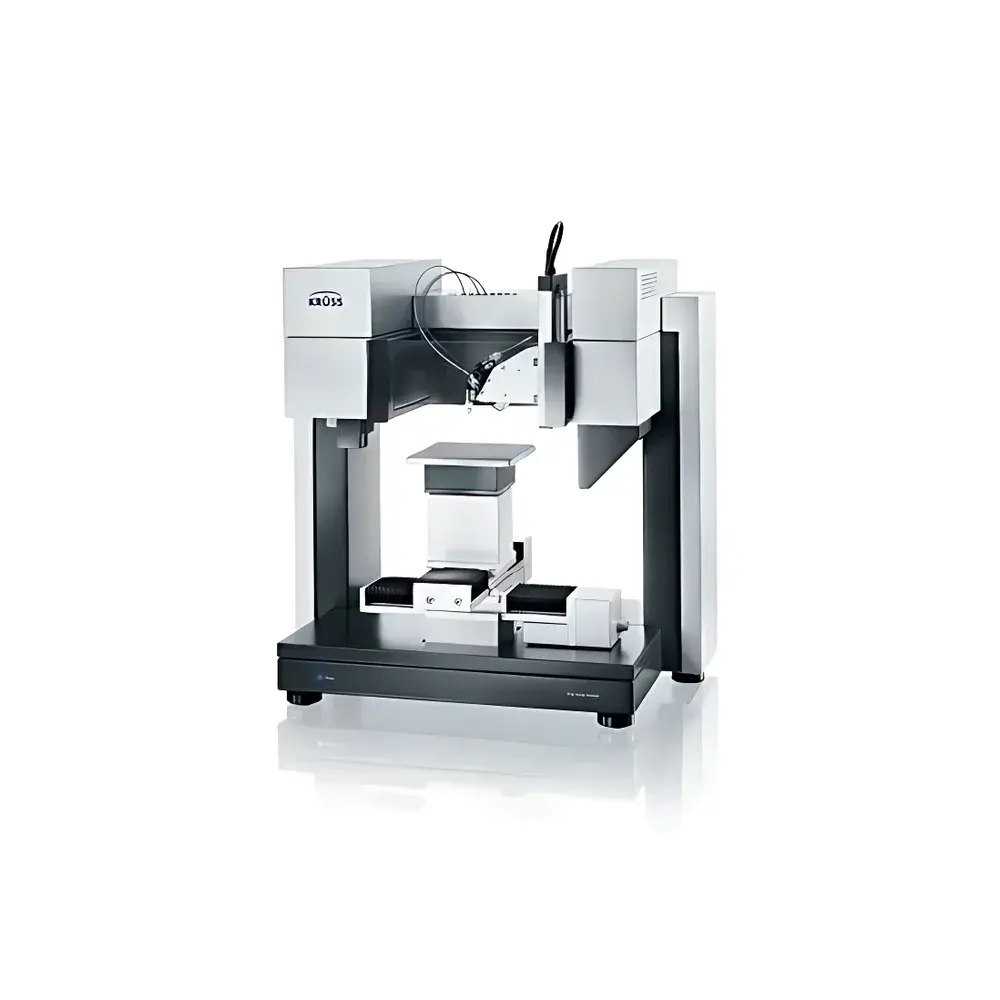
Krüss DSA100E Advanced Drop Shape Analyzer
| Origin | Germany |
|---|---|
| Manufacturer Type | Authorized Distributor |
| Origin Category | Imported |
| Model | DSA100E |
| Pricing | Available Upon Request |
Overview
The Krüss DSA100E Advanced Drop Shape Analyzer is a high-precision, fully automated optical tensiometer engineered for quantitative characterization of interfacial phenomena at solid–liquid and liquid–liquid boundaries. Based on the pendant and sessile drop method—combined with advanced image analysis of droplet contour geometry—the instrument determines static, advancing, and receding contact angles, surface free energy (SFE), surface tension (SFT), interfacial tension (IFT), adhesion work, spreading coefficient, and contact angle hysteresis. Its modular architecture integrates thermal control, multi-liquid dispensing, motorized sample positioning, and high-resolution imaging to support both routine QC workflows and rigorous R&D investigations in materials science, surface engineering, and formulation development.
Key Features
- Triple-axis motorized sample stage with software-controlled positioning for repeatable, location-resolved measurements across heterogeneous surfaces (e.g., coated vs. uncoated zones, plasma-treated vs. untreated regions)
- Automated 8-channel liquid dispensing system enabling sequential or comparative SFE determination using up to eight reference liquids without manual intervention
- High-resolution industrial camera with telecentric zoom lens and adjustable backlighting, optimized for sub-pixel edge detection of droplets from 0.5 µL to >10 µL
- Integrated tilting stage for dynamic contact angle and roll-off angle measurement—critical for evaluating superhydrophobicity, self-cleaning behavior, and anti-fouling performance
- Thermostatically regulated sample environment (optional humidity control available) supporting wetting analysis under defined temperature (e.g., 5–80 °C) and ambient conditions
- Rugged optomechanical housing with vibration-damped base and fixed optical axis design—ensures consistent image framing regardless of viewing angle adjustment, eliminating re-focusing during multi-angle acquisition
- ADVANCE software platform with ISO/IEC 17025-aligned audit trail, user-level access control, and FDA 21 CFR Part 11-compliant electronic signatures (when configured)
Sample Compatibility & Compliance
The DSA100E accommodates substrates ranging from standard microscope slides to large-format panels (up to 300 × 300 mm with optional extended stage). Compatible materials include polymers (PP, PET, PE), metals (Al, stainless steel), ceramics, glass, paper, wood, and functionalized thin films. Surface roughness up to Ra ≈ 5 µm is accommodated via advanced baseline correction algorithms. The system supports compliance with ASTM D7334 (surface energy of polymer films), ISO 19403-2/-4 (contact angle and SFE), and USP (assessment of container closure integrity via wettability). All measurement protocols are traceable to NIST-certified reference liquids (e.g., water, diiodomethane, ethylene glycol).
Software & Data Management
ADVANCE software provides full workflow automation—from droplet deposition and image capture to contour fitting, Young–Laplace equation solving, and Owens–Wendt/Fowkes/Schenkel SFE model selection. Batch processing enables statistical evaluation of spatial heterogeneity (e.g., 50+ positions per sample). Raw images, processed contours, and metadata are stored in vendor-neutral TIFF and CSV formats. Optional modules include GLP/GMP reporting templates, SFT temperature-dependence modeling, and interfacial rheology add-ons for viscoelastic interface characterization. Data export supports LIMS integration via ODBC and REST API interfaces.
Applications
- Quality assurance of plasma, corona, or flame surface activation prior to printing, coating, or adhesive bonding
- Quantitative assessment of hydrophobic/hydrophilic coatings (e.g., anti-fog, anti-reflective, oleophobic layers)
- Evaluation of long-term coating stability under thermal cycling or UV exposure
- Characterization of self-cleaning surfaces (e.g., lotus-effect coatings) via roll-off angle and contact angle hysteresis
- Surface cleanliness verification for semiconductor wafers, medical devices, and aerospace components
- Formulation optimization of inks, adhesives, and dispersions through interfacial tension profiling
- High-temperature surface tension measurement of molten polymers and hot-melt adhesives (with optional heated stage)
FAQ
What is the minimum droplet volume resolvable by the DSA100E?
The system reliably analyzes sessile droplets as small as 0.5 µL using precision syringe pumps and high-magnification optics.
Can the DSA100E measure contact angles on curved or textured surfaces?
Yes—advanced baseline algorithms compensate for local topography; however, surface roughness exceeding Ra = 5 µm may require complementary profilometry validation.
Is temperature-controlled measurement possible out-of-the-box?
Standard configuration includes ambient operation; temperature control (5–80 °C) requires the optional Peltier-based sample stage or external thermostatic chamber.
How does the DSA100E ensure measurement reproducibility across operators?
Through standardized ADVANCE method files, automated stage positioning, and built-in calibration routines for pixel-to-length conversion and lens distortion correction.
Does the system support regulatory compliance for pharmaceutical manufacturing?
When equipped with 21 CFR Part 11 options and validated IQ/OQ protocols, the DSA100E meets GMP requirements for surface characterization in drug product and packaging development.



