
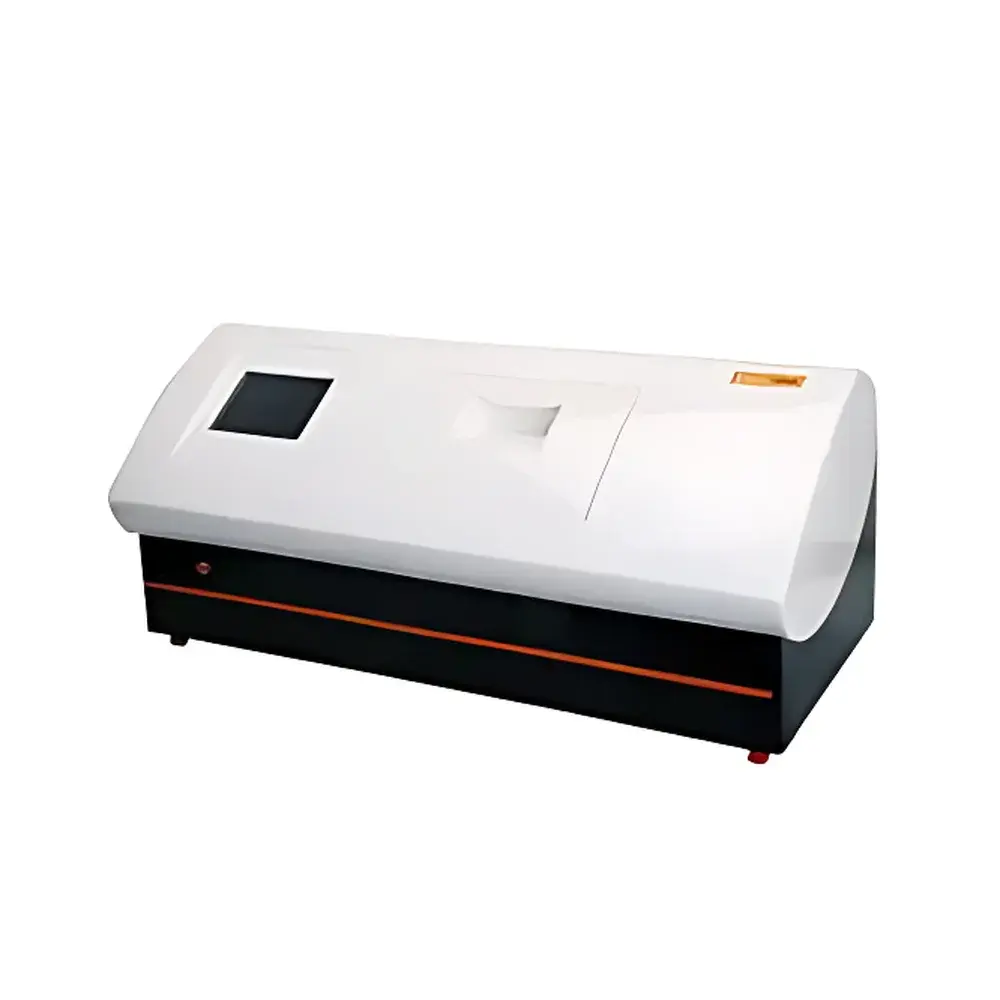
Hanon P850 Fully Automatic Polarimeter
| Brand | Hanon |
|---|---|
| Model | P850 |
| Measurement Range | ±89.99° |
| Accuracy | ±0.01° (within ±45°), ±0.02° (full range) |
| Resolution | 0.001° |
| Temperature Control | Peltier-based, 15–30 °C, ±0.3 °C accuracy |
| Light Source | LED (589.3 nm) |
| Minimum Transmittance | 1% |
| Repeatability (SD) | 0.002° |
| Data Storage | 1000 measurements |
| Display | 5.6″ TFT touch screen |
| Interface | USB, RS232 |
| Power | 220 V AC ±10%, 50 Hz, 250 W |
| Net Weight | 26 kg |
Overview
The Hanon P850 Fully Automatic Polarimeter is an advanced optical measurement instrument engineered for high-precision determination of optical rotation in chiral substances. Based on the fundamental principle of polarimetry—measuring the angular rotation of plane-polarized light as it passes through optically active media—the P850 delivers traceable, temperature-stabilized quantification of specific rotation ([α]), concentration, and purity across pharmaceutical, food, chemical, and academic laboratories. Unlike conventional manual or semi-automatic systems, the P850 integrates closed-loop Peltier thermoregulation, real-time photodetector feedback, and automated zero-point calibration to eliminate operator-dependent variability. Its core optical path employs a stable 589.3 nm LED source—matching the sodium D-line wavelength required by pharmacopoeial standards (e.g., USP , EP 2.2.7, and ChP IV)—ensuring metrological consistency without lamp aging drift or warm-up delays.
Key Features
- Integrated Peltier Temperature Control: Built-in thermoelectric module maintains sample cell temperature from 15 °C to 30 °C with ±0.3 °C accuracy and 0.1 °C resolution—critical for compliance with temperature-sensitive assays (e.g., sucrose or glucose determinations per ISO 5725 or AOAC 955.03).
- Automated Calibration System: Optional factory-installed auto-calibration routine, supported by certified quartz calibration standards traceable to NIM (National Institute of Metrology, China), enables in-situ verification across ±45° range—reducing downtime and supporting GLP audit readiness.
- Extended Angular Range & High Resolution: Measures optical rotation from –89.99° to +89.99° with 0.001° digital resolution and repeatability of ≤0.002° (standard deviation), accommodating highly concentrated or strongly rotating samples (e.g., essential oils, amino acid solutions, or synthetic chiral intermediates).
- Long-Life LED Illumination: Cold-white LED source operating at 589.3 nm provides >100,000 hours of stable output—eliminating mercury-vapor lamp replacement cycles and ensuring consistent spectral output throughout instrument lifetime.
- Intuitive Human-Machine Interface: 5.6-inch capacitive TFT touchscreen with context-aware menus supports multi-language operation, step-by-step method setup, and real-time graphical display of rotation trends during measurement.
- Data Integrity Architecture: Internal non-volatile memory stores up to 1000 complete measurement records—including timestamp, temperature, rotation value, mode (α/ [α]/ %w/w / °Z), and operator ID—exportable via USB or RS232 for LIMS integration.
Sample Compatibility & Compliance
The P850 accommodates standard sample cells up to 200 mm path length (including 100 mm, 200 mm quartz cells and disposable cuvettes), with minimum transmittance tolerance of 1%. It meets key international regulatory expectations for analytical instrumentation: design conformity with IEC 61010-1 (safety), electromagnetic compatibility per EN 61326-1, and alignment with data integrity principles referenced in FDA 21 CFR Part 11 (when paired with compliant lab software). The instrument’s documented traceability chain—including factory calibration against NIM-certified standards—and its built-in performance verification protocol support validation under GMP, ISO/IEC 17025, and pharmacopoeial monographs requiring polarimetric assay (e.g., USP-NF entries for dextrose, levodopa, or camphor).
Software & Data Management
No proprietary PC software is required for basic operation; all functions—including method creation, temperature ramping, multi-point averaging, and result export—are executed directly on the embedded system. For centralized laboratory management, raw ASCII-formatted data files (CSV) are generated upon USB transfer, containing full metadata (date/time, cell ID, temperature, raw signal, calculated value, unit, and user tag). Audit trail functionality—including record of calibration events, parameter changes, and user logins—is maintained internally and exportable for review during internal audits or regulatory inspections. Instrument firmware supports over-the-air updates via USB, ensuring continued alignment with evolving analytical requirements.
Applications
- Pharmaceutical QC: Quantitative assay of enantiomeric purity in APIs (e.g., ibuprofen, naproxen) per USP and EP 2.2.7.
- Sugar Industry: Direct Brix and polarization degree (°Z) calculation for cane and beet sugar solutions in accordance with ICUMSA methods.
- Food & Flavor Analysis: Determination of natural vs. synthetic vanillin, menthol, or limonene content based on specific rotation deviations.
- Academic Research: Kinetic studies of enzymatic hydrolysis (e.g., invertase activity via sucrose → glucose+fructose rotation shift) under controlled thermal conditions.
- Chemical Synthesis: In-process monitoring of asymmetric catalysis reactions where optical rotation serves as a rapid proxy for enantiomeric excess (ee).
FAQ
Does the P850 comply with pharmacopoeial wavelength requirements?
Yes—the 589.3 nm LED source is spectrally aligned with the sodium D-line specified in USP, EP, JP, and ChP monographs for polarimetric assays.
Can the instrument perform temperature-ramped measurements?
No—it maintains a single user-defined setpoint (15–30 °C) per measurement; ramping requires external thermostatic control of the cell holder.
Is the calibration certificate NIST-traceable?
Certificates are issued with NIM (China National Institute of Metrology) traceability; NIST-traceable equivalents are available upon request with third-party accreditation.
What sample cell formats are supported?
Standard 100 mm and 200 mm quartz cells (with matching cell holders), plus optional 10 mm and 50 mm micro-cells for limited-volume samples.
How is data security handled for regulated environments?
While the P850 itself does not implement electronic signatures or role-based access control, its immutable local storage, time-stamped logs, and CSV export format enable integration into validated LIMS or ELN platforms meeting 21 CFR Part 11 requirements.



