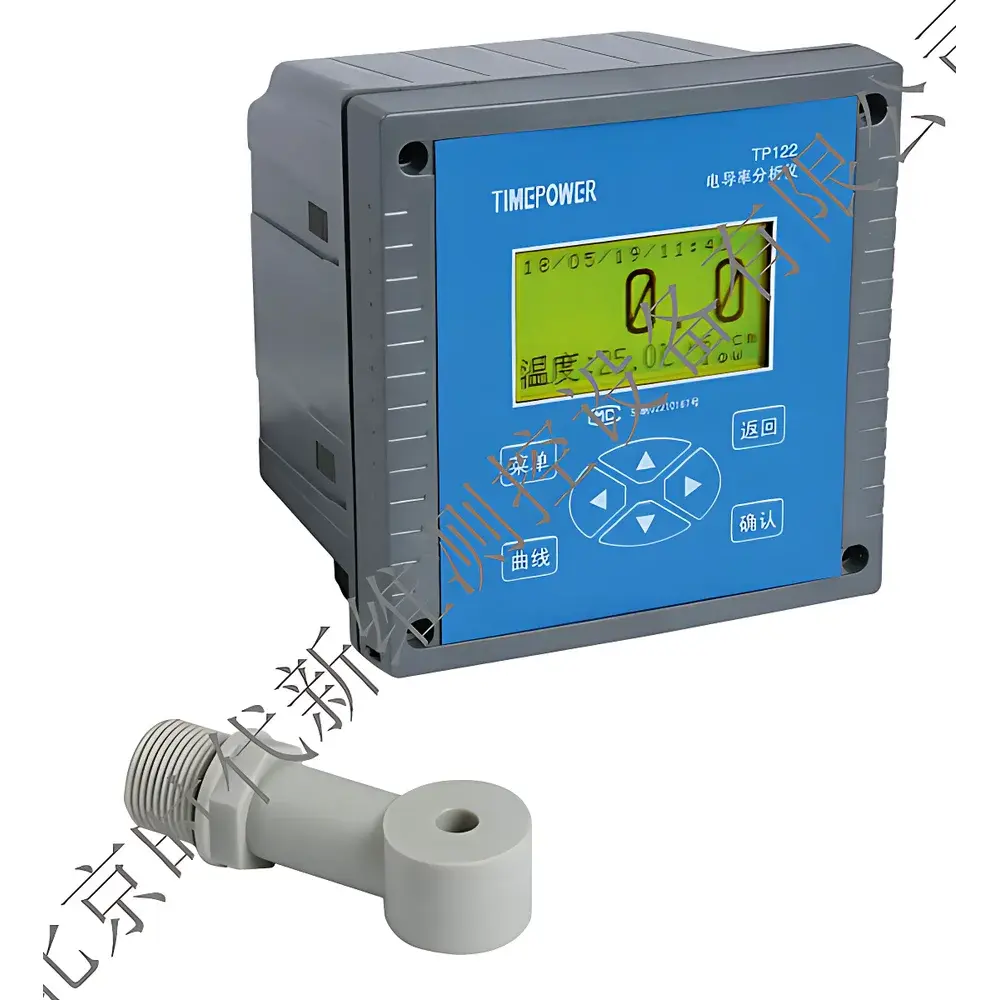
Timepower TP122 Inductive Online Conductivity Analyzer
| Brand | Timepower |
|---|---|
| Origin | Beijing, China |
| Manufacturer Type | Manufacturer |
| Model | TP122 |
| Measurement Principle | Non-contact inductive (toroidal) conductivity sensing |
| Display | 128×64 dot-matrix LCD, Chinese interface |
| Measurement Range | 0–1000 mS/cm |
| Accuracy | ±2.5% FS |
| Resolution | 0.1 mS/cm |
| Repeatability | 1% FS |
| Temperature Compensation | Pt1000 sensor, 0–60 °C |
| Sample Temp. Range | 5–50 °C |
| Ambient Temp. Range | 5–45 °C |
| Temp. Resolution | 0.1 °C |
| Temp. Error | ±0.5 °C |
| Humidity Limit | ≤90% RH (non-condensing) |
| Storage Temp. | −25–55 °C |
| Isolated Current Output | 0–10 mA / 0–20 mA / 4–20 mA (load <300 Ω) |
| Output Accuracy | ±1% FS |
| Relay Outputs | 2 SPST (AC 220 V / 3 A or DC 30 V / 3 A), user-configurable |
| Power Supply | AC 85–265 V, 45–65 Hz |
| Power Consumption | ≤15 W |
| Enclosure Rating | IP65 |
| Dimensions (H×W×D) | 145×120×150 mm |
| Panel Cutout | 138×138 mm |
| Weight | 0.64 kg |
Overview
The Timepower TP122 Inductive Online Conductivity Analyzer is an industrial-grade, microprocessor-based conductivity monitoring system engineered for continuous, non-invasive measurement of aqueous electrolyte solutions in demanding process environments. Unlike contact-type conductivity sensors—whose electrodes are susceptible to fouling, corrosion, and polarization—the TP122 employs a toroidal (inductive) measurement principle. This design features two isolated, epoxy-encapsulated alloy ring coils housed within a chemically inert PPS or PVDF body: one coil acts as the excitation transmitter, generating an alternating magnetic field; the second serves as the induction receiver. When the magnetic field penetrates the conductive medium, eddy currents are induced in the solution, with magnitude directly proportional to its electrical conductivity. The receiver coil detects this induced current, enabling precise, drift-free conductivity calculation without physical electrode–solution contact. This architecture eliminates electrode passivation, scaling, and calibration drift commonly observed in traditional 2-/4-electrode cells—making the TP122 especially suitable for high-solids, viscous, abrasive, or highly corrosive streams encountered in power generation, chemical processing, wastewater treatment, and pharmaceutical water systems.
Key Features
- Non-contact toroidal sensing technology ensures long-term stability and zero electrode maintenance in aggressive media
- High-resolution 128×64 Chinese-language LCD display with intuitive menu navigation and real-time multi-parameter view (conductivity, temperature, timestamp, system status)
- 24-bit A/D conversion circuitry delivers high signal fidelity and low-noise data acquisition
- Integrated Pt1000 temperature sensor with automatic linear/non-linear compensation across 0–60 °C
- Optically isolated analog outputs (0–10 mA, 0–20 mA, or 4–20 mA) with load capability up to 300 Ω and output accuracy of ±1% FS
- Dual programmable relay outputs (SPST, AC/DC rated) for alarm, control interlock, or pump activation
- Robust IP65-rated NEMA 4X enclosure for reliable operation in outdoor, washdown, or high-humidity industrial settings
- Low-power consumption (≤15 W) and wide-input universal AC supply (85–265 V, 45–65 Hz) ensure compatibility with global plant power infrastructure
- Cyclic data storage with auto-overflow management enables local trend review without external logging hardware
Sample Compatibility & Compliance
The TP122 is designed for continuous monitoring of low-to-high conductivity aqueous solutions—including boiler feedwater, condensate, cooling tower blowdown, desalination brine, acid/base solutions, and purified water (PW) and water-for-injection (WFI) loops per USP and EP 2.2.38. Its non-contact sensor eliminates contamination risk and complies with hygienic requirements for pharmaceutical and food-grade applications. While not intrinsically safe, the analyzer meets IEC 61326-1 (EMC for industrial environments) and IEC 61000-4 series immunity standards. Its analog output and relay logic support integration into DCS, PLC, or SCADA systems compliant with ISA-88 and ISA-95 frameworks. For regulated environments, the device supports audit-ready operation when paired with time-stamped data logging and user-access-controlled configuration changes—aligning with foundational expectations of FDA 21 CFR Part 11 (when used with validated software infrastructure) and GLP/GMP documentation practices.
Software & Data Management
The TP122 operates as a standalone, embedded instrument with no external PC dependency. All configuration—including measurement range selection, temperature compensation mode (linear or material-specific), relay setpoints, output scaling, and unit display preferences—is performed locally via the front-panel keypad and LCD. Parameter changes are saved to non-volatile memory with write-protection options. The built-in data buffer stores up to 30 days of hourly conductivity and temperature snapshots (configurable interval), accessible via scroll navigation. While the analyzer does not feature Ethernet, USB, or Modbus RTU out-of-the-box, optional communication modules (sold separately) enable RS-485 Modbus RTU connectivity for centralized data aggregation and remote diagnostics. Exported logs adhere to CSV-compatible formatting for import into LIMS, MES, or historian platforms such as OSIsoft PI or Emerson DeltaV.
Applications
- Real-time monitoring of steam-cycle purity in fossil and nuclear power plants per ASTM D4582 and IAPWS guidelines
- Conductivity control in chemical dosing systems for pH adjustment, coagulation, and chlorine residual management
- Leak detection in heat exchangers and condensers via sudden conductivity spikes in closed-loop cooling water
- Monitoring of reverse osmosis (RO) and electrodeionization (EDI) product water quality in semiconductor and biopharma facilities
- Effluent compliance tracking in municipal and industrial wastewater treatment plants under EPA NPDES permit limits
- Batch concentration verification in fertilizer production and electroplating rinse baths
- Sanitary process water validation in dairy, beverage, and API manufacturing lines
FAQ
What makes inductive (toroidal) conductivity measurement more reliable than electrode-based methods?
Inductive sensors eliminate direct electrochemical interaction between the transducer and process fluid—removing sources of polarization error, coating-induced drift, and electrode corrosion. This yields superior long-term reproducibility in high-conductivity, high-fouling, or oxidizing environments where electrode sensors require frequent cleaning or replacement.
Can the TP122 be used for ultrapure water (UPW) applications below 1 µS/cm?
No. The TP122’s lower detection limit is optimized for 0–1000 mS/cm, making it unsuitable for sub-µS/cm UPW monitoring. For those applications, a high-sensitivity contacting cell with temperature-controlled flow cell and air-tight shielding is required.
Is temperature compensation mandatory—and how is it implemented?
Yes. Conductivity is inherently temperature-dependent. The TP122 uses a built-in Pt1000 sensor and applies either linear (default) or configurable non-linear compensation algorithms per ISO 7888 or DIN EN 27888, referenced to 25 °C.
What mounting options are available for the sensor and transmitter?
The transmitter supports panel-mount (138×138 mm cutout), wall-mount, or rack-mount installation. Sensor variants include inline flow-through bodies, submersible probes, flanged insertion assemblies, and custom-engineered housings for pressurized or sanitary piping.
Does the device support HART or other digital communication protocols natively?
Not by default. The base TP122 provides analog and relay I/O only. HART or Modbus RTU functionality requires an optional communication module installed at time of order or as a field retrofit.
Related Products