
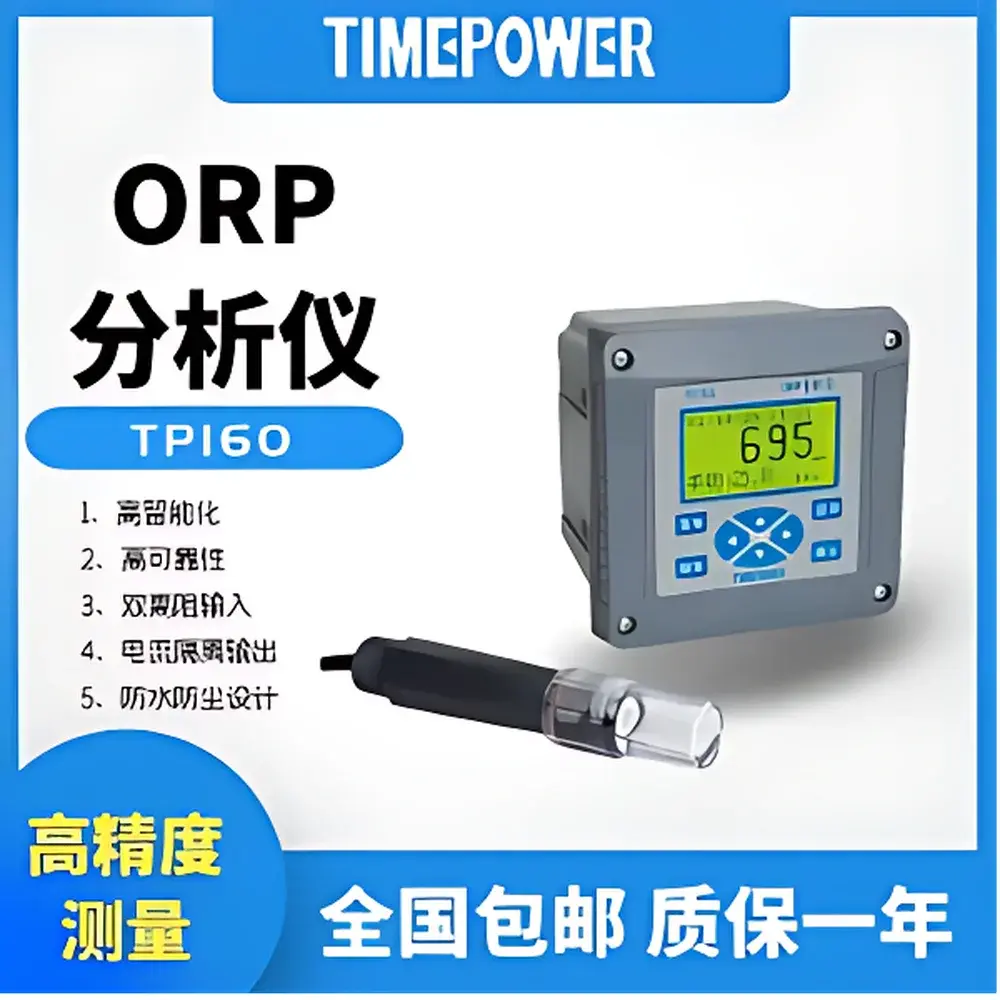
TimePower TP160 Industrial Online ORP Analyzer
| Brand | TimePower |
|---|---|
| Origin | Beijing, China |
| Manufacturer Type | Manufacturer |
| Product Category | Domestic |
| Model | TP160 |
| Instrument Type | Industrial Online ORP Meter |
| Display | 128×64 Dot-Matrix LCD (Chinese Interface) |
| ORP Measurement Range | ±2000 mV |
| Electrical Indication Error | ±1 mV |
| Resolution | 1 mV |
| Temperature Compensation Range | 0–60 °C |
| Sample Temperature Range | 5–60 °C |
| Sample Pressure Rating | <0.6 MPa |
| Ambient Temperature Range | 5–45 °C |
| Ambient Humidity | ≤85% RH (non-condensing) |
| Storage & Transport Temperature | −25–55 °C |
| Isolated Current Output | 0–10 mA / 0–20 mA / 4–20 mA (user-selectable, load ≤750 Ω) |
| Relay Outputs | 2 SPST NO contacts (configurable, AC220 V/3 A or DC30 V/3 A) |
| Power Supply | AC 85–265 V, 45–65 Hz |
| Enclosure Rating | IP65 |
| Power Consumption | ≤15 W |
| Data Retention on Power Loss | >10 years |
Overview
The TimePower TP160 Industrial Online ORP Analyzer is an electrochemical process instrument engineered for continuous, real-time monitoring of oxidation-reduction potential (ORP) in aqueous industrial streams. It operates on the principle of potentiometric measurement using a platinum reference-sensing electrode pair immersed directly in the sample medium. The measured potential reflects the thermodynamic tendency of the solution to accept or donate electrons — a fundamental indicator of redox activity critical for water quality control, disinfection efficacy validation, and chemical process stability. Unlike pH, which measures hydrogen ion activity, ORP provides a composite, non-specific index of all oxidizing and reducing species present (e.g., free chlorine, ozone, permanganate, ferrous/ferric ions). The TP160 employs high-input-impedance millivolt measurement circuitry (>1012 Ω) to minimize polarization errors and ensure stable, drift-free readings under variable conductivity conditions typical in power plant condensate, wastewater effluent, pharmaceutical rinse water, and food-grade CIP solutions.
Key Features
- True industrial-grade design with IP65-rated NEMA 4X enclosure, suitable for wall-mount or pipe-mount installation in harsh chemical environments.
- Integrated Pt-based ORP sensor interface with automatic temperature compensation (ATC) via built-in Pt100 RTD or external probe input (0–60 °C range).
- High-accuracy analog output (±1 mV error, 1 mV resolution) with selectable 0–10 mA, 0–20 mA, or 4–20 mA isolated current loop — fully compatible with DCS, PLC, and SCADA systems.
- Dual programmable relay outputs support fail-safe alarm logic for out-of-spec ORP excursions (e.g., low disinfectant residual, breakthrough of reducing agents).
- Non-volatile memory retains calibration data, configuration settings, and operational history for >10 years without battery backup — compliant with long-term audit requirements under GLP and ISO 17025 frameworks.
- Menu-driven Chinese-language interface with intuitive navigation, eliminating language barriers for on-site operators while maintaining technical precision.
Sample Compatibility & Compliance
The TP160 is validated for continuous operation in low-to-moderate conductivity water matrices (20 µS/cm to 2000 µS/cm), including demineralized water, cooling tower blowdown, activated sludge effluent, clean-in-place (CIP) rinse water, and pharmaceutical purified water (PW) and water-for-injection (WFI) distribution loops. It meets mechanical and electrical safety requirements per IEC 61000-6-2 (EMC immunity) and IEC 61010-1 (measurement category II, pollution degree 2). While not certified to UL or ATEX standards, its IP65 rating and 0.6 MPa pressure tolerance align with ANSI/ISA-12.12.01 for non-hazardous area instrumentation. For regulated industries, the device supports traceable calibration logs and user-accessible configuration audit trails — facilitating alignment with FDA 21 CFR Part 11 expectations when deployed with appropriate procedural controls.
Software & Data Management
The TP160 operates as a standalone field transmitter with no embedded operating system or remote connectivity. All configuration, calibration, and alarm thresholds are set locally via front-panel keypad and LCD. However, its 4–20 mA output enables seamless integration into centralized historian platforms (e.g., OSIsoft PI, Emerson DeltaV, Siemens Desigo CC) for trend analysis, SPC charting, and automated reporting. Calibration records—including date, operator ID (manually entered), buffer values, slope, and offset—can be logged externally via DCS timestamps. The absence of cloud dependency ensures deterministic response time (<500 ms loop update) and eliminates cybersecurity exposure vectors common in IoT-enabled analyzers — a key consideration for critical infrastructure applications governed by NIST SP 800-82 or IEC 62443.
Applications
- Power Generation: Monitoring ORP in condensate polishing systems to detect early-stage copper/iron corrosion products and verify amine treatment effectiveness.
- Environmental Engineering: Tracking redox shifts in biological nutrient removal (BNR) basins and membrane bioreactors (MBR) to optimize denitrification and prevent sulfide formation.
- Pharmaceutical Manufacturing: Ensuring oxidative sanitization integrity during steam-in-place (SIP) cycles and verifying residual peracetic acid levels in sterile barrier systems.
- Food & Beverage: Validating chlorine dioxide or ozone residuals in final rinse water to meet FDA Food Code 3-801.12 and HACCP prerequisite program requirements.
- Chemical Process Control: Supervising redox-controlled reactions such as chromium(VI) reduction, cyanide destruction, and electroplating bath stability.
FAQ
What electrode types are compatible with the TP160?
The analyzer is designed for use with standard Pt/ORP combination electrodes featuring ceramic junctions and refillable KCl electrolyte — no proprietary sensor interface is required.
Does the TP160 support automatic calibration?
No. Calibration is manual and performed using certified ORP standard buffers (e.g., +225 mV Zobell’s solution, +470 mV quinhydrone); slope verification is recommended every 30 days in critical applications.
Can the unit operate in deionized water with conductivity below 5 µS/cm?
Measurement stability may degrade due to high source impedance; a grounded reference electrode or flow cell with conductive grounding ring is advised for ultrapure water applications.
Is firmware upgrade capability available?
Firmware is factory-programmed and not field-upgradable; functional updates require hardware revision per TimePower’s engineering release cycle.
How is temperature compensation applied?
The TP160 applies Nernstian temperature correction (−0.198 mV/°C per 100 mV ORP change at 25 °C) based on either internal RTD or user-supplied external temperature signal.





