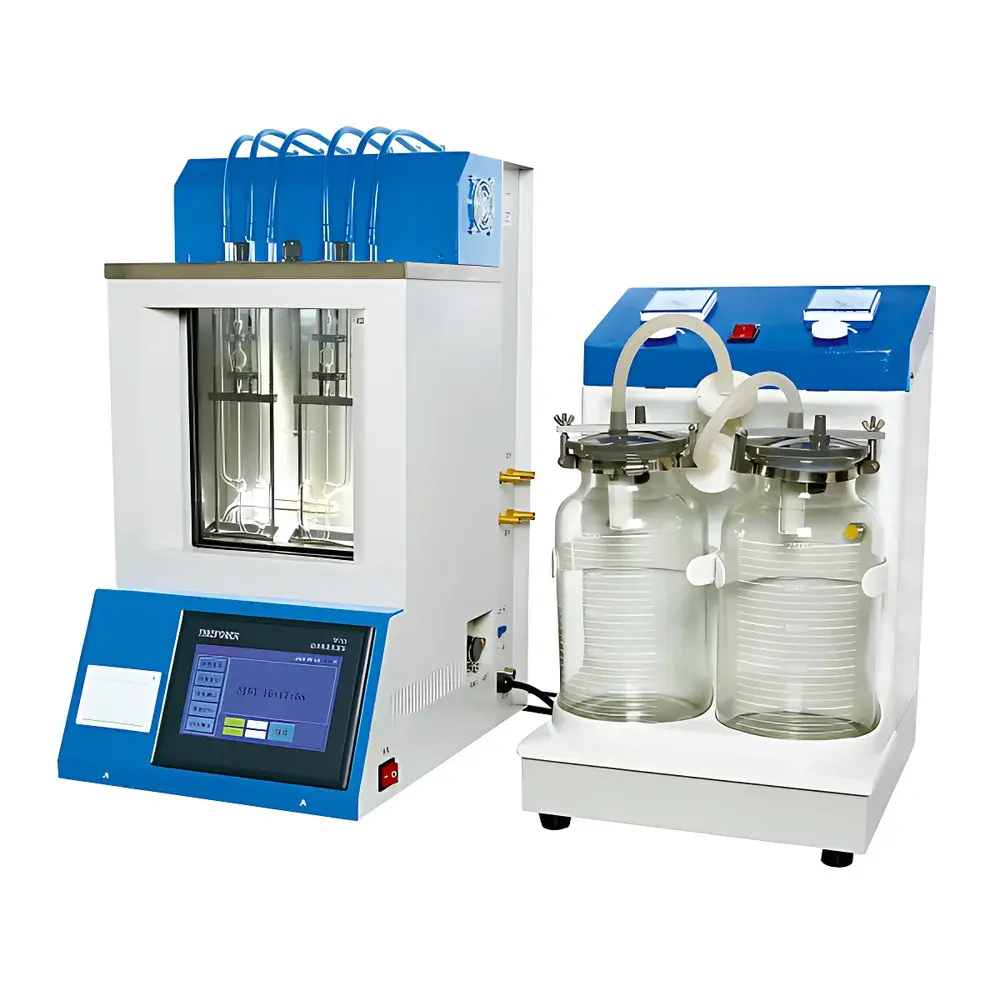
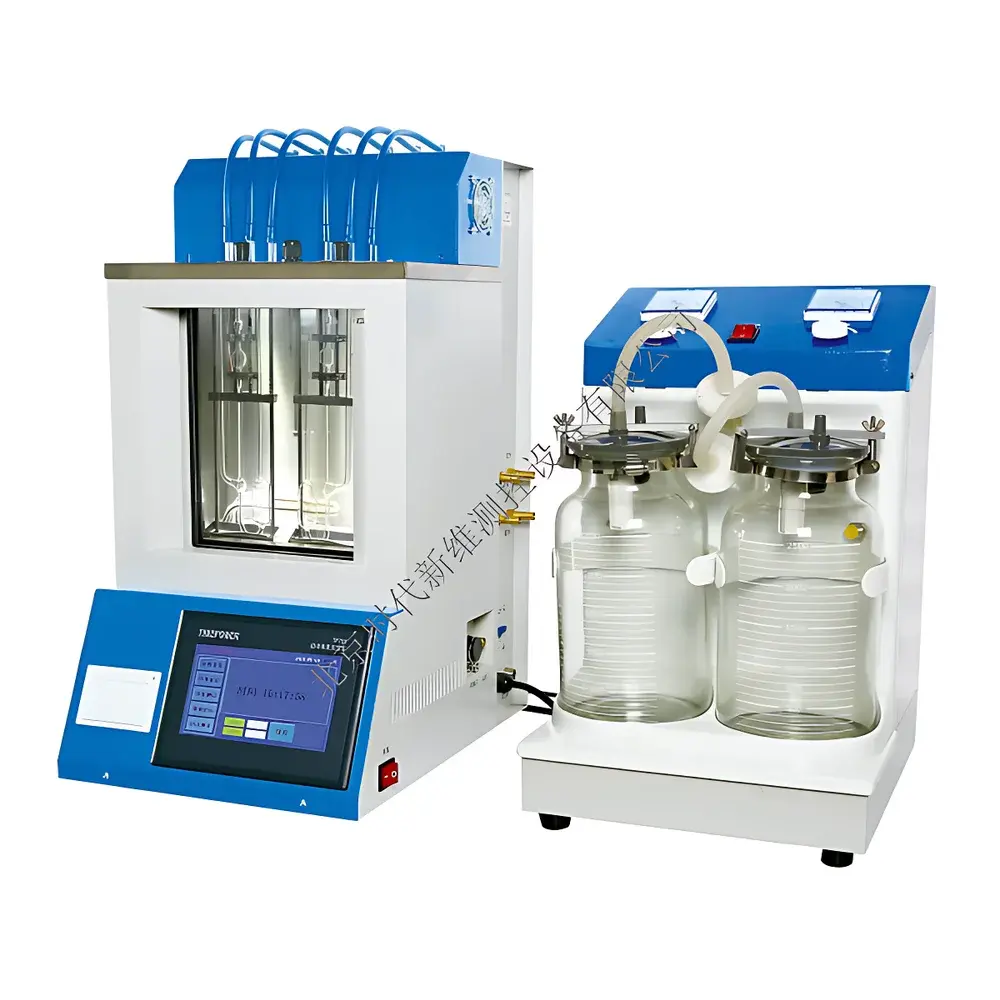
TimePower TP725 Fully Automated Kinematic Viscosity Tester
| Brand | TimePower |
|---|---|
| Origin | Beijing, China |
| Manufacturer Type | Manufacturer |
| Origin Category | Domestic (China) |
| Model | TP725 |
| Pricing | Upon Request |
| Control Temperature Range | Ambient to 100 °C |
| Temperature Stability | ±0.01 °C |
| Temperature Resolution | 0.01 °C |
| Kinematic Viscosity Resolution | 0.00001 mm²/s |
| Sample Capacity | Dual independent test positions |
| Power Supply | AC 220 V ±10%, 50 Hz ±10% |
| Power Consumption | ≤1500 W |
| Dimensions (W×D×H) | 370 mm × 300 mm × 650 mm |
| Weight | ~28 kg |
| Operating Environment | 5–40 °C, RH ≤85% |
| Detection Method | Infrared liquid-level sensing with immunity to ambient light interference |
| Cleaning & Drying | Fully automated capillary tube rinse and thermal drying cycle |
| Compliance | Designed per GB/T 265–1988 (equivalent to ASTM D445 and ISO 3104) |
Overview
The TimePower TP725 Fully Automated Kinematic Viscosity Tester is an engineered solution for precise, repeatable measurement of kinematic viscosity in petroleum-based liquids—including lubricating oils, transformer oils, jet fuels, diesel, and crude fractions—under strictly controlled thermal conditions. It operates on the capillary flow principle defined in GB/T 265–1988, which aligns with internationally recognized standards such as ASTM D445 and ISO 3104. The instrument employs a Ubbelohde-type viscometer immersed in a thermally stabilized bath, where kinematic viscosity (ν) is calculated from the efflux time (t) and the calibrated viscometer constant (C), using the fundamental relation ν = C × t. Unlike manual or semi-automated systems, the TP725 integrates dual independent test channels, enabling asynchronous analysis of two samples at identical or differing setpoints—critical for comparative QC workflows in refinery labs or third-party testing facilities.
Key Features
- Dual-channel architecture with independent temperature control and timing logic per capillary, supporting parallel or staggered testing without cross-contamination risk.
- High-stability temperature regulation system with ±0.01 °C accuracy over the full 20–100 °C operational range; utilizes PID-controlled immersion heating and optional refrigeration module for sub-ambient capability.
- Non-contact infrared liquid-level detection system—immune to ambient lighting variations—ensures reliable meniscus tracking during efflux, eliminating false triggers caused by surface reflections or dust.
- Fully automated post-test sequence: solvent rinse (with programmable volume and dwell time), air purge, and thermal drying of the capillary tube—preventing carryover and ensuring baseline reproducibility across >500 consecutive runs.
- Embedded dual-CPU architecture with real-time fault diagnostics, self-calibration prompts, and hardware-level error logging accessible via service mode.
- Integrated oil drain port with quick-release valve enables safe, spill-free bath fluid exchange—essential for maintaining thermal homogeneity and avoiding oxidation-related drift.
- Backlit LCD interface with proximity-sensing membrane keys reduces mechanical wear and improves usability in gloved-lab environments.
Sample Compatibility & Compliance
The TP725 accommodates standard Ubbelohde capillaries (e.g., Cannon-Fenske Routine, BS/IP/ASTM types) with nominal viscometer constants ranging from 0.001 to 1.0 mm²/s². It supports transparent and mildly colored petroleum products meeting ISO 3104 requirements for clarity and absence of suspended particulates. For opaque or high-wax-content samples (e.g., heavy fuel oils), pre-filtration or solvent dilution per ASTM D1298 is recommended prior to loading. The system’s firmware implements audit-trail logging compliant with GLP principles, recording operator ID, timestamp, bath temperature profile, efflux time, calculated viscosity, and cleaning cycle status for each run. While not inherently 21 CFR Part 11–certified, its data export structure (CSV/Excel-compatible) facilitates integration into validated LIMS environments requiring electronic record integrity.
Software & Data Management
Data acquisition and calculation are handled onboard by deterministic real-time firmware—no external PC dependency required for routine operation. Results display includes kinematic viscosity (mm²/s), efflux time (s), bath temperature (°C), and pass/fail flag against user-defined specification limits. All measurements are time-stamped with persistent RTC (battery-backed clock maintaining date/time during power loss). Raw and processed data export via USB 2.0 to removable flash storage in comma-delimited format, preserving column headers, units, and metadata. Optional PC software (available separately) provides trend analysis, statistical process control (SPC) charts (X̄-R, Cpk), and batch report generation aligned with ISO/IEC 17025 documentation requirements.
Applications
- Quality control of insulating oils in power generation and transmission facilities—monitoring oxidation-induced viscosity increase per IEC 60296.
- Refinery process stream verification: naphtha, kerosene, and lube base stock viscosity grading per ASTM D2500 and D445.
- Research evaluation of polymer-modified fuels and bio-blends where shear-thinning behavior must be decoupled from kinematic assessment.
- Third-party certification labs performing accredited testing to CNAS-CL01 (equivalent to ISO/IEC 17025) for export documentation.
- Regulatory compliance testing for marine bunker fuels under ISO 8217 Annex A (kinematic viscosity at 50 °C and 100 °C).
FAQ
Does the TP725 support calibration verification with NIST-traceable reference oils?
Yes—calibration verification mode accepts certified reference materials (CRMs) with stated uncertainty (e.g., Cannon Standard Oils); the system calculates bias and repeatability against certified values and logs deviation metrics.
Can the instrument operate unattended overnight?
Yes—equipped with thermal cut-off protection, low-oil-level detection, and automatic shutdown after final drying cycle; recommended for scheduled batches up to 12 hours.
Is capillary selection user-configurable within the interface?
Yes—operators assign viscometer constants and geometry codes (e.g., “Cannon 100cSt”) to each channel during setup; constants are stored with sample ID for traceability.
What maintenance intervals are recommended for long-term reliability?
Bath oil replacement every 6 months (or 500 runs), infrared sensor cleaning weekly with lint-free swab, and annual verification of temperature sensor linearity per ISO 17025 procedures.
How is data integrity ensured during power interruption?
All critical parameters—including ongoing efflux timestamps and temperature history—are written to non-volatile memory every 2 seconds; recovery resumes from last valid state without data loss.