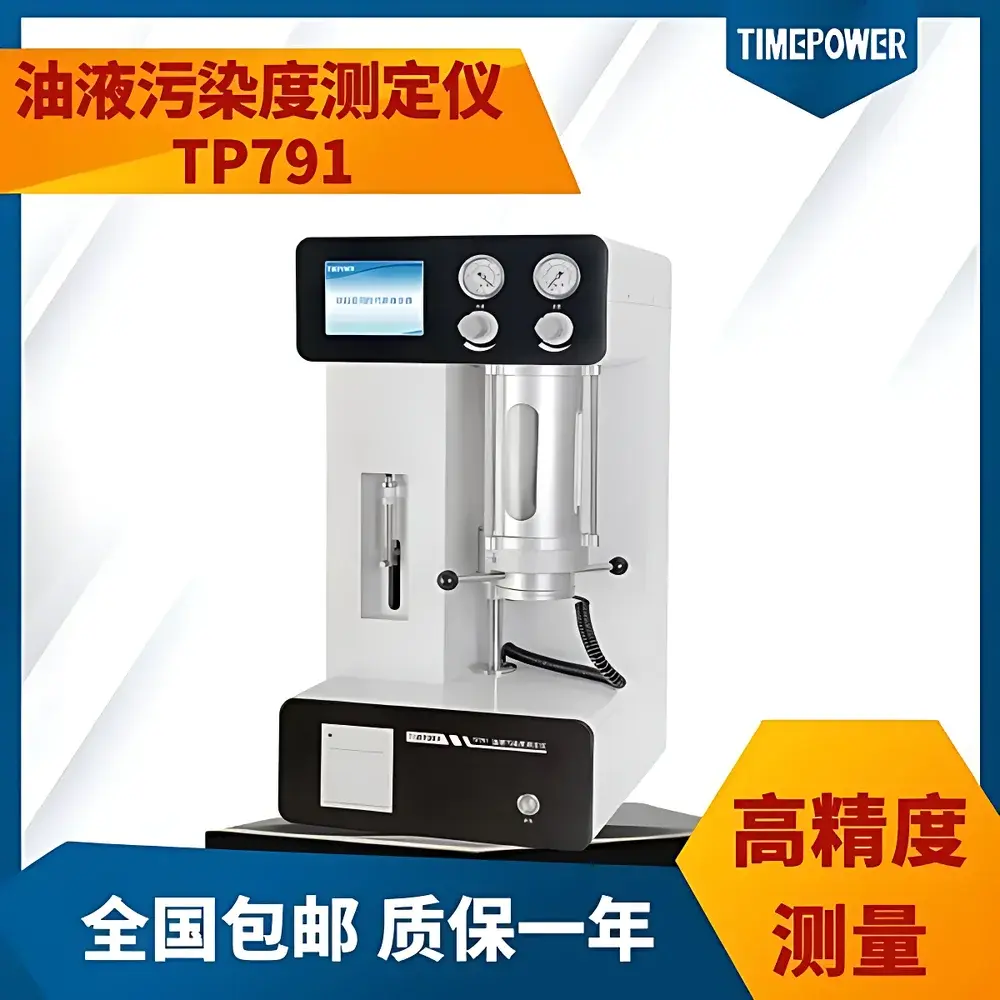
Oil Particle Contamination Analyzer TP791 by TimePower
| Brand | TimePower |
|---|---|
| Origin | Beijing, China |
| Manufacturer Type | Direct Manufacturer |
| Country of Origin | China |
| Model | TP791 |
| Pricing | Available Upon Request |
| Measurement Principle | Light Obscuration (LO) per ISO 11171 & ISO 4406 |
| Detection Range | 0.8 µm to 600 µm (sensor-dependent) |
| Accuracy | ±0.5% |
| Repeatability (RSD) | <2% |
| Resolution | <10% |
| Operating Temperature | 0–60 °C |
| Light Source | Semiconductor Laser |
| Number of Measurement Channels | 16 (user-configurable size thresholds within calibrated range) |
| Sample Flow Rate | 5–80 mL/min |
| Coincidence Limit | 12,000–24,000 particles/mL (sensor-dependent) |
| Power Supply | AC 220 V ±10%, 50 Hz ±10% |
| Power Consumption | ≤200 W |
| Dimensions (Main Unit) | 360 × 370 × 700 mm |
| Dimensions (Air Pump) | 330 × 266 × 255 mm |
| Weight (Main Unit) | 30 kg |
| Weight (Air Pump) | 10 kg |
Overview
The TimePower TP791 Oil Particle Contamination Analyzer is a precision laboratory and field-deployable instrument engineered for quantitative assessment of solid particulate contamination in liquid media—primarily lubricants, hydraulic fluids, insulating oils, and turbine oils. It operates on the internationally standardized light obscuration (LO) principle defined in ISO 11171 (calibration standards) and ISO 4406 (coding of contamination levels), providing traceable, repeatable particle count data essential for predictive maintenance, fluid lifecycle management, and regulatory conformance. The system employs a high-stability semiconductor laser source and a precisely aligned optical detection zone where particles suspended in the flowing sample cause transient reductions in transmitted light intensity. These pulse amplitudes are directly proportional to particle cross-sectional area, enabling simultaneous sizing and counting across 16 user-defined channels spanning 0.8 µm to 600 µm—subject to sensor configuration and calibration traceability. Designed for integration into quality control laboratories, condition monitoring centers, and OEM service facilities, the TP791 delivers metrologically sound data under ambient conditions ranging from 0 °C to 60 °C.
Key Features
- High-sensitivity laser-based optical detection with low-noise signal processing architecture for enhanced resolution and minimal baseline drift
- 16-channel configurable particle sizing matrix, supporting flexible threshold selection within the calibrated size range (e.g., ISO 4406 reporting at ≥4 µm(c), ≥6 µm(c), ≥14 µm(c))
- Adjustable sample flow rate (5–80 mL/min) optimized for viscosity-matched fluid handling without cavitation or shear-induced particle disruption
- Dual-unit modular design: main analyzer chassis and dedicated air pump module for controlled pressurized sampling—reducing entrained air artifacts and improving measurement reproducibility
- Compliance-ready firmware architecture supporting audit trails, user access levels, and electronic signature capability in alignment with GLP and FDA 21 CFR Part 11 requirements (when deployed with validated software configuration)
- Rugged mechanical construction (30 kg main unit; aluminum alloy chassis with EMI-shielded electronics enclosure) suitable for industrial lab environments and mobile testing platforms
Sample Compatibility & Compliance
The TP791 is validated for use with mineral- and synthetic-based hydraulic oils (e.g., ISO VG 32–100), turbine oils (ASTM D4378), transformer insulating oils (IEC 60296, ASTM D877/D1816), engine oils (SAE J183), gear oils, aviation fuels (Jet A-1, JP-8), water-glycol and phosphate ester hydraulic fluids, and polymer solutions where non-volatile insoluble particulates require quantification. It adheres to core international standards including ISO 4402 (obsolete but referenced for legacy correlation), ISO 11171 (for sensor calibration using NIST-traceable PSL standards), ISO 4406:2017 (for reporting contamination codes), and ASTM D6786 (standard test method for automatic particle counters in lubricants). Optional calibration verification kits and certified reference materials (CRM) are available to support internal validation protocols required under ISO/IEC 17025-accredited laboratories.
Software & Data Management
The instrument interfaces via USB 2.0 or RS-232 with TimePower’s proprietary ParticleView™ software (Windows 10/11 compatible), which provides real-time histogram visualization, cumulative/differential distribution plots, trend analysis over time-series sampling, and automated ISO 4406 code generation. Data export supports CSV, PDF, and XML formats compliant with LIMS integration frameworks. Software features include configurable pass/fail limits per channel, multi-sample batch reporting, instrument calibration log archiving, and timestamped operator identification. For regulated environments, optional 21 CFR Part 11-compliant mode enables electronic records with role-based permissions, audit trail logging, and digital signature workflows—fully documented in the system validation package (IQ/OQ/PQ templates provided).
Applications
- Condition-based oil analysis in power generation plants (turbine lube oil cleanliness verification per IEC 60300-3-3)
- Hydraulic system health monitoring in aerospace ground support equipment and flight-line maintenance depots
- Transformer oil acceptance testing and in-service degradation tracking in utility substations
- Quality release testing of new lubricants and hydraulic fluids per OEM specifications (e.g., Boeing D6-17487, GEK 32568)
- Root-cause analysis of component wear in gearboxes, servo valves, and fuel injection systems through particle morphology correlation (when paired with microscopy)
- Validation of filtration efficiency in offline kidney-loop systems and portable filtration units
FAQ
What particle size standards are used to calibrate the TP791 sensor?
The sensor is calibrated using NIST-traceable polystyrene latex (PSL) spheres per ISO 11171, with size assignment verified via differential mobility analysis (DMA) or electron microscopy.
Can the TP791 measure particles in water-based coolants or glycol solutions?
Yes—provided the fluid is optically transparent at the laser wavelength (typically 780 nm) and viscosity permits stable laminar flow through the sensing zone; optional wetted-material kits (e.g., sapphire flow cell) are available for aggressive chemistries.
Is the instrument suitable for on-site use in field maintenance trucks?
The modular design, wide operating temperature range (0–60 °C), and robust shock-mounted optics make it appropriate for mobile deployment; battery-powered inverters and vibration-dampened mounting kits are recommended accessories.
How is coincidence error managed during high-concentration measurements?
The system applies dynamic dilution algorithms and offers programmable sample dilution modules; maximum coincidence limit (12,000–24,000 particles/mL) is sensor-specific and documented in the calibration certificate.
Does TimePower provide ISO/IEC 17025-compliant calibration services?
Yes—certified calibration and verification services are offered through TimePower’s CNAS-accredited metrology lab (Certificate No. CNAS LXXXXX), including uncertainty budgets per ISO/IEC 17025:2017 Annex A.3.
Related Products