
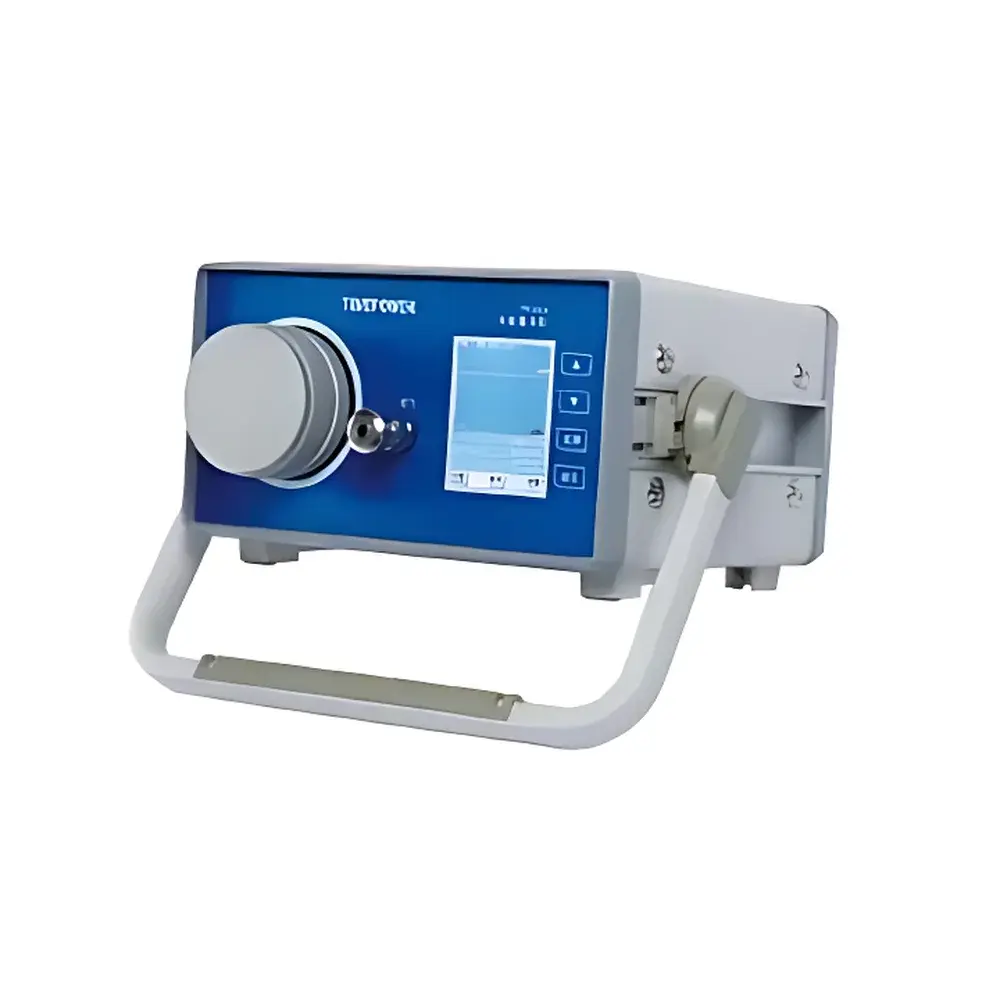
TimePower TP208 Precision Chilled-Mirror Hygrometer
| Brand | TimePower |
|---|---|
| Origin | Beijing, China |
| Manufacturer | TimePower Instruments Co., Ltd. |
| Model | TP208 |
| Measurement Range | –60 °C to 0 °C (at 10 °C ambient) |
| Resolution | 0.01 °C |
| Accuracy | ±0.2 °C |
| Repeatability | ±0.1 °C |
| Cooling Method | Four-stage Peltier thermoelectric cooling |
| Minimum Mirror Temperature | –60 °C |
| Gas Flow Rate | 15–60 L/h |
| Operating Pressure Range | 1 kPa to 1 MPa (10 mbar to 10 bar) |
| Display | Color LCD with real-time dew point, ppmv (µL/L), equilibrium curve, and flow rate |
| Equilibration Time | 3–5 minutes |
| Power Supply | AC 220 V ±10%, 50 Hz ±10% |
| Power Consumption | ≤70 W |
| Dimensions | 320 × 300 × 190 mm |
| Weight | 6.6 kg |
| Operating Ambient | –20 °C to +50 °C, ≤90% RH (non-condensing) |
| Corrosion-Resistant Flow Path | Yes |
| Control Algorithm | Digital fuzzy logic temperature regulation |
| Diagnostic Functions | Flow deviation alert, low optical energy warning, non-equilibrium detection |
Overview
The TimePower TP208 Precision Chilled-Mirror Hygrometer is a primary-standard moisture analyzer engineered for trace-level water vapor measurement in industrial and laboratory gas streams. It operates on the fundamental physical principle of dew point thermometry: when a gas sample is cooled isobarically across a polished, temperature-controlled mirror surface, water vapor condenses at the thermodynamic dew point—the temperature at which the partial pressure of water equals its saturation vapor pressure. The TP208 detects this phase transition optically using high-sensitivity photodetection, enabling direct, calibration-free determination of dew point temperature with metrological traceability. Unlike absorption-based or capacitive sensors, chilled-mirror technology provides absolute, first-principle measurement without drift-related recalibration—making it the reference method specified in ISO 8503-1, ASTM D2875, and IEC 62271-4 for critical applications such as SF6 insulation gas monitoring in high-voltage switchgear and ultra-dry nitrogen validation in semiconductor tool purging.
Key Features
- Four-stage Peltier cooling architecture achieves stable mirror temperatures down to –60 °C, supporting measurement in demanding dry-gas applications including electronics-grade N2, SF6, and argon blanketing gases.
- Digital fuzzy logic temperature control minimizes thermal overshoot and accelerates equilibration—typical stabilization time is 3–5 minutes per sample, significantly reducing throughput latency versus conventional analog PID systems.
- Corrosion-resistant wetted path constructed from electropolished stainless steel and fluoropolymer-sealed optics, rated for continuous exposure to aggressive process gases including HCl, Cl2, and HF-containing streams (with optional chemically resistant mirror coating).
- Real-time color LCD interface displays dew point temperature (°C), volumetric moisture concentration (ppmv or µL/L), dynamic equilibrium curve, instantaneous gas flow rate (L/h), and system diagnostic status—all simultaneously and without menu navigation.
- Integrated self-diagnostic suite monitors optical signal integrity (target range: 99–100% reflectance), flow compliance (15–60 L/h), pressure stability (1 kPa–1 MPa), and thermodynamic convergence—triggering audible/visual alerts for out-of-spec conditions prior to result acceptance.
- Compact benchtop form factor (320 × 300 × 190 mm, 6.6 kg) with passive air-cooled heat dissipation eliminates need for external chillers or water recirculation, enhancing field deployability in substations, cleanrooms, and mobile calibration labs.
Sample Compatibility & Compliance
The TP208 is validated for use with non-condensable, non-reactive gases—including nitrogen, argon, helium, SF6, CO2, and compressed air—within its specified pressure (1 kPa–1 MPa) and flow (15–60 L/h) windows. Its inert flow path enables reliable operation with mildly corrosive gases; for highly reactive or particulate-laden streams, inline filtration (0.1 µm sintered metal) and pressure regulation are recommended upstream. The instrument conforms to electromagnetic compatibility requirements per IEC 61326-1 and meets safety standards IEC 61010-1 for measurement equipment used in industrial environments. While not inherently 21 CFR Part 11 compliant, audit-ready data export (CSV via USB) and configurable user access levels support integration into GLP/GMP workflows when paired with validated LIMS or ELN platforms.
Software & Data Management
Data acquisition and reporting are handled locally via the embedded color display; no proprietary PC software is required for routine operation. All measurements—including timestamp, dew point, ppmv equivalent, flow rate, mirror temperature history, and diagnostic flags—are stored internally (≥10,000 records) and exportable via USB flash drive in comma-separated values (CSV) format. Exported files include column headers compatible with Excel, MATLAB, and statistical process control (SPC) tools. For automated integration, the RS-232 serial port supports Modbus RTU protocol, enabling programmable readout by PLCs or SCADA systems. Firmware updates are performed via USB, with version rollback capability and SHA-256 checksum verification to ensure integrity.
Applications
- Power Transmission: Continuous monitoring of SF6 dew point in GIS circuit breakers and transformers per IEEE C37.122.1 to prevent dielectric failure and hydrolysis-induced corrosion.
- Semiconductor Manufacturing: Verification of <1 ppmv moisture in bulk nitrogen supply lines feeding CVD, ALD, and etch tools—critical for preventing oxide layer defects and wafer contamination.
- Pharmaceutical Processing: Validation of compressed air and purge gas dryness during lyophilization, tablet coating, and aseptic filling per USP and Annex 1 requirements.
- Aerospace Testing: Certification of cryogenic propellant handling systems (e.g., LOX, LH2) where ice formation risks component blockage and sensor malfunction.
- Calibration Laboratories: Use as a transfer standard for verifying capacitance hygrometers, tunable diode laser analyzers (TDLAS), and aluminum oxide sensors under ISO/IEC 17025-accredited procedures.
FAQ
What pre-conditioning is required before measurement?
Prior to analysis, flush the sample line and optical chamber with high-purity nitrogen (≥99.999%) at 30 L/h for ≥15 minutes to remove residual moisture and contaminants. Verify optical energy remains within 99–100% on the “Settings” screen before initiating measurement.
Can the TP208 measure gases at elevated pressures?
Yes—the instrument supports static and flowing gas pressures from 1 kPa to 1 MPa (10 mbar to 10 bar). For pressures >100 kPa, ensure inlet pressure regulation and avoid rapid pressure transients that may disturb mirror condensation dynamics.
Is mirror cleaning required between samples?
No routine cleaning is needed under normal operation. The optical surface is self-cleaning during each dew cycle. If contamination is suspected (e.g., persistent low reflectance), follow the manufacturer’s procedure using spectroscopic-grade methanol and lint-free wipes—never abrasive solvents or cloths.
How does ambient temperature affect accuracy?
The stated accuracy (±0.2 °C) applies at ambient temperatures between 10 °C and 30 °C. At extremes (–20 °C or +50 °C), mirror cooling efficiency decreases slightly; however, internal thermal compensation algorithms maintain repeatability within ±0.1 °C across the full operating range.
Does the TP208 support automated data logging?
Yes—internal memory stores up to 10,000 complete measurement records with timestamps and diagnostics. Scheduled exports via USB or periodic polling via RS-232 enable unattended long-term trending without host PC dependency.





