
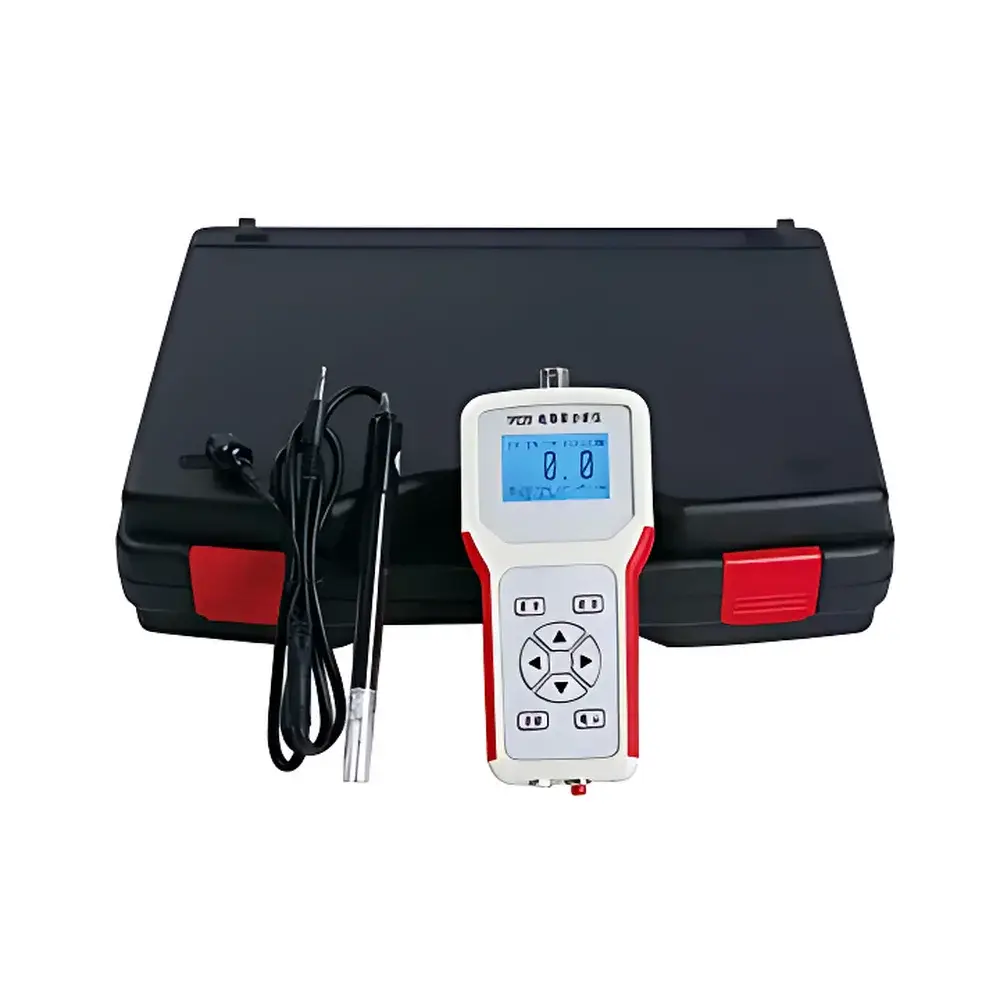
Timepower TP220 Portable Conductivity Analyzer
| Brand | Timepower |
|---|---|
| Origin | Beijing, China |
| Manufacturer Type | Manufacturer |
| Product Category | Domestic |
| Model | TP220 |
| Detection Parameters | Multi-parameter |
| Portability | Portable |
| Conductivity Range | 0–200 mS/cm |
| TDS Range | 0–100 g/L |
| Resistivity Range | 0–100 MΩ·cm |
| Salinity Range | 0–100 ppt |
| Temperature Range | 0–60 °C |
| Accuracy | ±2.5% F.S. |
| Minimum Resolution | 0.001 µS/cm |
| Repeatability | ≤1% |
| Temperature Sensor | Pt1000 |
| Temp. Compensation Range | 0–60 °C |
| Sample Temp. | 5–60 °C |
| Ambient Temp. | 5–45 °C |
| Ambient Humidity | ≤90% RH (non-condensing) |
| Power Supply | AC 85–265 V, 45–65 Hz |
| Power Consumption | ≤1 W |
| Dimensions | 80 × 30 × 175 mm |
| Weight | 0.26 kg |
| Display | 128 × 64 dot-matrix LCD, Chinese interface |
| Electrode Constants Supported | K = 0.01, 0.1, 1.0, 10.0 cm⁻¹ |
Overview
The Timepower TP220 Portable Conductivity Analyzer is a field-deployable, multi-parameter electrochemical instrument engineered for precise and reliable measurement of conductivity, total dissolved solids (TDS), resistivity, salinity, and temperature in aqueous solutions. It operates on the principle of two-electrode (or four-electrode) conductometric measurement: a stable, low-distortion sinusoidal excitation voltage (1–3 kHz) is applied across a pair of parallel or cylindrical electrodes with a fixed geometric cell constant (K), and the resulting current is measured to compute solution conductance. The instrument automatically compensates for temperature-induced variations using a built-in Pt1000 sensor and applies standardized algorithms per ISO 7888 and ASTM D1125 to convert raw conductance into standardized conductivity values at 25 °C. Designed for rugged field use and routine laboratory spot-checking, the TP220 meets functional requirements for process monitoring, environmental sampling, and quality control in regulated environments where portability, battery endurance, and data integrity are critical.
Key Features
- True portable architecture: Compact housing (80 × 30 × 175 mm), lightweight (0.26 kg), and integrated rechargeable battery supporting up to 8 hours of continuous operation.
- Multi-range auto-ranging capability: Supports electrode constants K = 0.01, 0.1, 1.0, and 10.0 cm⁻¹ — enabling accurate measurements from ultra-pure water (0.000–3.000 µS/cm) to high-conductivity industrial brines (up to 200 mS/cm).
- High-fidelity signal acquisition: 24-bit analog-to-digital conversion ensures resolution down to 0.001 µS/cm and repeatability ≤1% F.S., minimizing drift and quantization error.
- Intuitive Chinese-language interface: 128 × 64 dot-matrix LCD with adjustable backlight; simultaneous display of conductivity, temperature, timestamp, and operational status.
- Robust embedded firmware: Single-chip microcontroller platform optimized for low power consumption (≤1 W) and thermal stability across 5–45 °C ambient conditions.
- Data persistence: Non-volatile memory retains calibration records and measurement logs for ≥10 years after power loss; cyclic storage with overflow overwrite simplifies long-term field deployment.
Sample Compatibility & Compliance
The TP220 is validated for use with potable water, wastewater, boiler feedwater, cooling tower fluids, pharmaceutical rinse solutions, and food-grade process streams. Its electrode selection guidance aligns with IEC 60746-3 and USP recommendations: K = 0.01 cm⁻¹ electrodes are specified for ultrapure water (100 µS/cm to mitigate polarization effects. While the device itself does not carry CE, UKCA, or FDA 510(k) certification, its measurement methodology conforms to foundational principles referenced in ISO/IEC 17025-accredited laboratories. When operated with documented calibration procedures (using NIST-traceable KCl standards), the analyzer supports GLP-compliant data generation for internal QC and pre-audit verification.
Software & Data Management
The TP220 operates as a standalone instrument with no proprietary PC software dependency. All calibration, configuration, and measurement functions are executed via on-device menu navigation. Calibration points are stored in non-volatile memory with timestamp and operator ID fields (user-assigned). Though it lacks USB or Bluetooth connectivity, the unit supports manual transcription of logged data for integration into LIMS or Excel-based trending workflows. For regulated users, the instrument’s deterministic behavior, fixed firmware versioning, and absence of cloud synchronization reduce validation burden under FDA 21 CFR Part 11 Annex 11 requirements — provided that procedural controls govern calibration frequency, electrode maintenance, and data review.
Applications
- Power generation: Monitoring condensate purity and demineralizer effluent conductivity in thermal and nuclear plants per EPRI guidelines.
- Environmental fieldwork: Rapid assessment of surface water, groundwater, and effluent discharge compliance with EPA Method 120.1 and ISO 7888.
- Pharmaceutical manufacturing: Verification of Water for Injection (WFI) and Purified Water (PW) conductivity per USP , including temperature-compensated limits at 25 °C.
- Food & beverage QA: In-line checks of CIP rinse water, syrup dilutions, and brine concentrations prior to filling.
- Academic teaching labs: Demonstrating fundamental electrochemical concepts including cell constant derivation, Kohlrausch’s law, and temperature compensation models.
FAQ
What electrode constant should I select for measuring deionized water?
For conductivity below 3 µS/cm, use a K = 0.01 cm⁻¹ or K = 0.1 cm⁻¹ electrode. A sealed flow-through cell is strongly advised to prevent CO₂ absorption, which artificially elevates readings.
Does the TP220 support automatic temperature compensation (ATC)?
Yes — it employs a built-in Pt1000 sensor and applies linear or nonlinear (optionally selectable) compensation per ISO 7888, referencing conductivity to 25 °C.
How often must the instrument be calibrated?
Calibration frequency depends on usage intensity and regulatory context; daily verification with a single standard is typical for QC labs, while weekly two-point calibration (low- and mid-range) is recommended for field surveys.
Can the TP220 store calibration history?
Yes — each calibration event is timestamped and archived alongside electrode ID and standard concentration used, accessible via the “Cal History” menu.
Is the device suitable for hazardous area use?
No — it is not intrinsically safe or ATEX-certified. Use only in general-purpose, non-explosive environments per IEC 60079-0.





