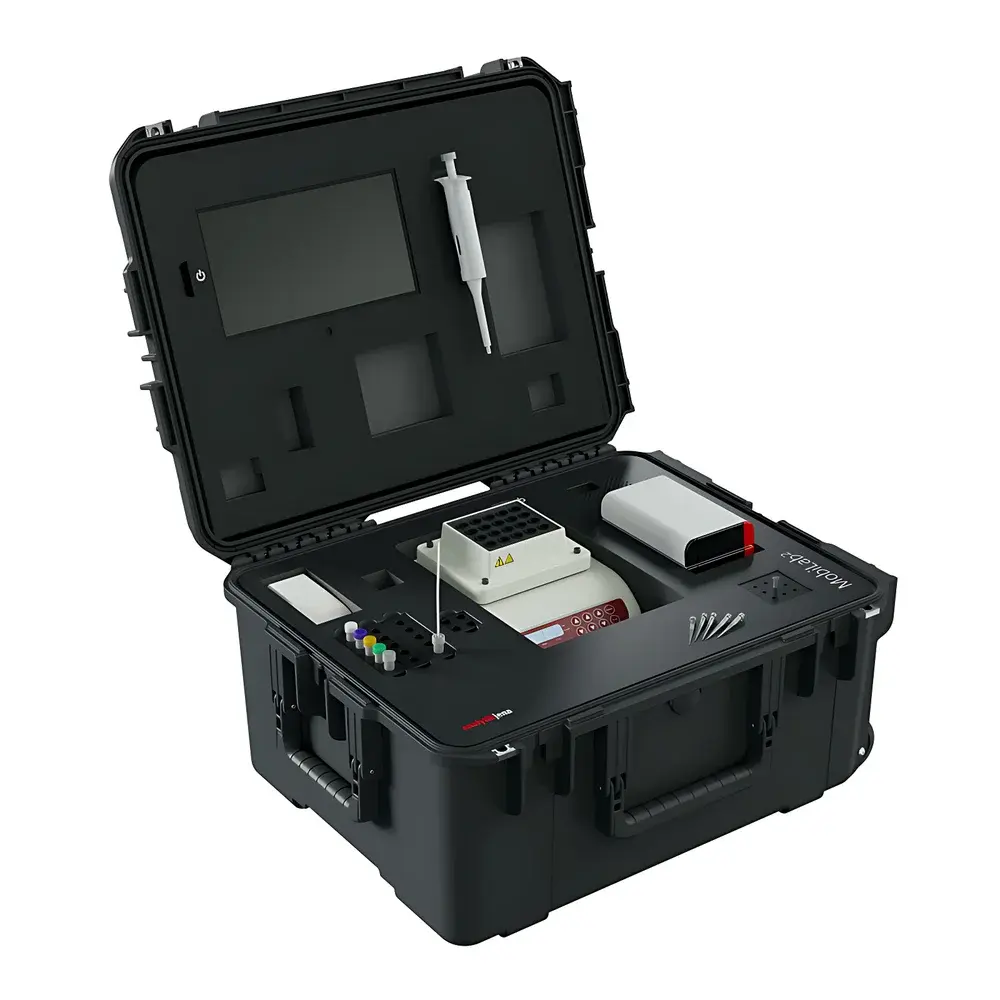
Analytik Jena MobiLab2 Field-Deployable Pathogen Detection System
| Brand | Analytik Jena |
|---|---|
| Origin | Germany |
| Manufacturer | Analytik Jena AG |
| Country of Origin | Imported |
| Model | MobiLab2 |
| Price | Upon Request |
| Dimensions | 560 × 220 × 350 mm (W × H × D) |
| Weight | 25 kg |
| Power Supply | AC adapter or integrated high-capacity rechargeable battery |
| Sample Throughput | 9 samples or 9 assays simultaneously |
| Thermal Block Temperature Range | 4 °C – 105 °C |
| PCR Module Temperature Uniformity | ±0.3 °C |
| PCR Module Temperature Accuracy | ±0.2 °C |
| Heating/Cooling Module | High-efficiency, long-life Peltier elements |
| Incubation & Shaking | 25–100 °C, up to 1400 rpm |
| Detection Method | RAH (Rapid Amplification and Hybridization) coupled with lateral flow immunoassay (LFIA) |
| Readout Format | Visual interpretation of dual-line lateral flow strips (control + test bands) in sealed reaction chambers |
Overview
The Analytik Jena MobiLab2 Field-Deployable Pathogen Detection System is an integrated, self-contained molecular diagnostics platform engineered for real-time, on-site detection of bacterial pathogens without reliance on centralized laboratory infrastructure. Built upon the RAH (Rapid Amplification and Hybridization) principle—a streamlined isothermal or rapid-cycling nucleic acid amplification strategy combined with sequence-specific hybridization—the system bypasses conventional enrichment culture steps, enabling detection directly from raw environmental or food surface swabs. Unlike traditional qPCR workflows requiring thermal cyclers, separate extraction modules, and electrophoresis or fluorescence readers, the MobiLab2 consolidates sample lysis, nucleic acid purification, target amplification, probe hybridization, and visual result interpretation into a single, closed-tube, hands-free process. Its architecture adheres to ISO/IEC 17025-aligned design principles for field-deployable analytical systems and supports compliance with food safety standards including ISO 16140-2 (validation of alternative methods), EN ISO 11290-1 (Listeria monocytogenes), and ISO 6579-1 (Salmonella spp.).
Key Features
- Integrated end-to-end workflow: From swab-based sample collection to definitive yes/no result in under 90 minutes—no external centrifuges, pipettes, or reagent prep required.
- Sealed, single-use cartridge-based assay format: Minimizes cross-contamination risk and eliminates aerosol generation; all reactions occur within hermetically sealed reaction chambers.
- Intelligent thermal management: Precision Peltier-controlled heating/cooling block with ±0.2 °C accuracy and ±0.3 °C uniformity across all 9 positions ensures reproducible amplification kinetics critical for RAH fidelity.
- Ruggedized field-grade enclosure: IP54-rated housing, shock-absorbing chassis, and ergonomic carry handle enable reliable operation in warehouses, farms, ports, or disaster response zones.
- Embedded color touchscreen interface: Preloaded step-by-step video guidance, multilingual UI support (English, Spanish, French, Chinese), and context-sensitive prompts reduce operator dependency and support GLP-aligned documentation.
- Dual-power architecture: Operates continuously for ≥4 hours on internal lithium-ion battery (tested at 37 °C ambient), or seamlessly switches to 100–240 V AC input—ideal for off-grid or mobile command centers.
Sample Compatibility & Compliance
The MobiLab2 accepts direct swab eluates from environmental surfaces, food contact zones, or clinical specimens (e.g., nasopharyngeal or rectal swabs). It has been validated per AOAC PTM and MicroVal guidelines for detection of Salmonella enterica, Listeria monocytogenes, Escherichia coli O157:H7 and O104:H4, Shigella spp., Staphylococcus aureus, Campylobacter jejuni, Yersinia enterocolitica, and Clostridium perfringens. Each assay kit includes lyophilized reagents, magnetic-bead-based extraction buffers, RAH master mix, and pre-calibrated lateral flow strips—all qualified per ISO 13485 manufacturing controls. The system meets IEC 61000-6-2/6-3 EMC requirements and carries CE marking under Directive 2017/746 (IVDR) for in vitro diagnostic use in professional settings.
Software & Data Management
Firmware v3.2+ supports audit-trail-enabled operation logs (user ID, timestamp, assay ID, thermal profile, result image capture) compliant with FDA 21 CFR Part 11 Annex 11 requirements when paired with optional networked printer or USB export. All result images are stored in DICOM-compliant TIFF format with embedded metadata (temperature trace, cycle count, strip batch ID). No cloud upload occurs by default; data residency remains local unless explicitly configured via encrypted Ethernet/Wi-Fi connection to on-premise LIMS.
Applications
- Routine environmental monitoring in ready-to-eat (RTE) food production lines (e.g., deli meats, dairy, produce packing facilities).
- Emergency outbreak investigation at point-of-origin—enabling same-day confirmation of pathogen presence during recalls or public health alerts.
- Border inspection and port-of-entry screening for imported agricultural commodities.
- Field surveillance in low-resource settings where cold-chain transport of samples is impractical or prohibited.
- Research applications requiring rapid strain differentiation using custom-designed RAH probes (available via Analytik Jena’s Custom Assay Development Service).
FAQ
Does the MobiLab2 require laboratory certification to operate?
No—its design fulfills the criteria for “operator-independent” instrumentation under ISO/IEC 17025 Clause 6.2.3; however, users must maintain records of calibration verification (performed annually using NIST-traceable thermal reference standards) and kit lot traceability.
Can the system detect viable vs. non-viable cells?
RAH detects intact target DNA/RNA sequences but does not distinguish viability; for viability assessment, optional propidium monoazide (PMA) pretreatment kits are available as add-ons.
Is method validation support provided?
Yes—Analytik Jena supplies full validation packages (including precision, LOD/LOQ, ruggedness, and inclusivity/exclusivity data) aligned with ISO 16140-2 and applicable national regulatory expectations.
What maintenance is required?
Annual Peltier module performance verification and touchscreen calibration; no consumable parts beyond assay kits and swabs.
How is contamination control ensured between runs?
Each assay uses disposable, single-use cartridges; the instrument features UV-C irradiation (254 nm, 15-min cycle) for internal chamber decontamination—validated per ISO 15883-1.