Timepower TP651 Petroleum and Synthetic Fluid Demulsibility Tester
| Brand | Timepower |
|---|---|
| Model | TP651 |
| Origin | Beijing, China |
| Manufacturer | Timepower Instrument Co., Ltd. |
| Type | Benchtop Automated Demulsibility Testing System |
| Temperature Range | Ambient to 100 °C |
| Temperature Accuracy | ±2 °C |
| Temperature Resolution | 0.1 °C |
| Repeatability | ≤4 °C |
| Stirring Duration | 5 min (programmable) |
| Stirrer Positioning Precision | ±0.5 mm (6 mm above cylinder bottom) |
| Bath Temperature Control | 54 °C ±1 °C (or 82 °C ±1 °C for high-viscosity oils) |
| Power Supply | AC 220 V ±10%, 50 Hz ±10% |
| Max. Power Consumption | 1600 W |
| Dimensions (W×D×H) | 510 × 360 × 580 mm |
| Net Weight | 23.5 kg |
| Environmental Operating Conditions | 5–40 °C, RH ≤85% |
| Sample Vessel | Standard 100 mL graduated cylinder (ASTM D1401 / GB/T 7305 compliant) |
Overview
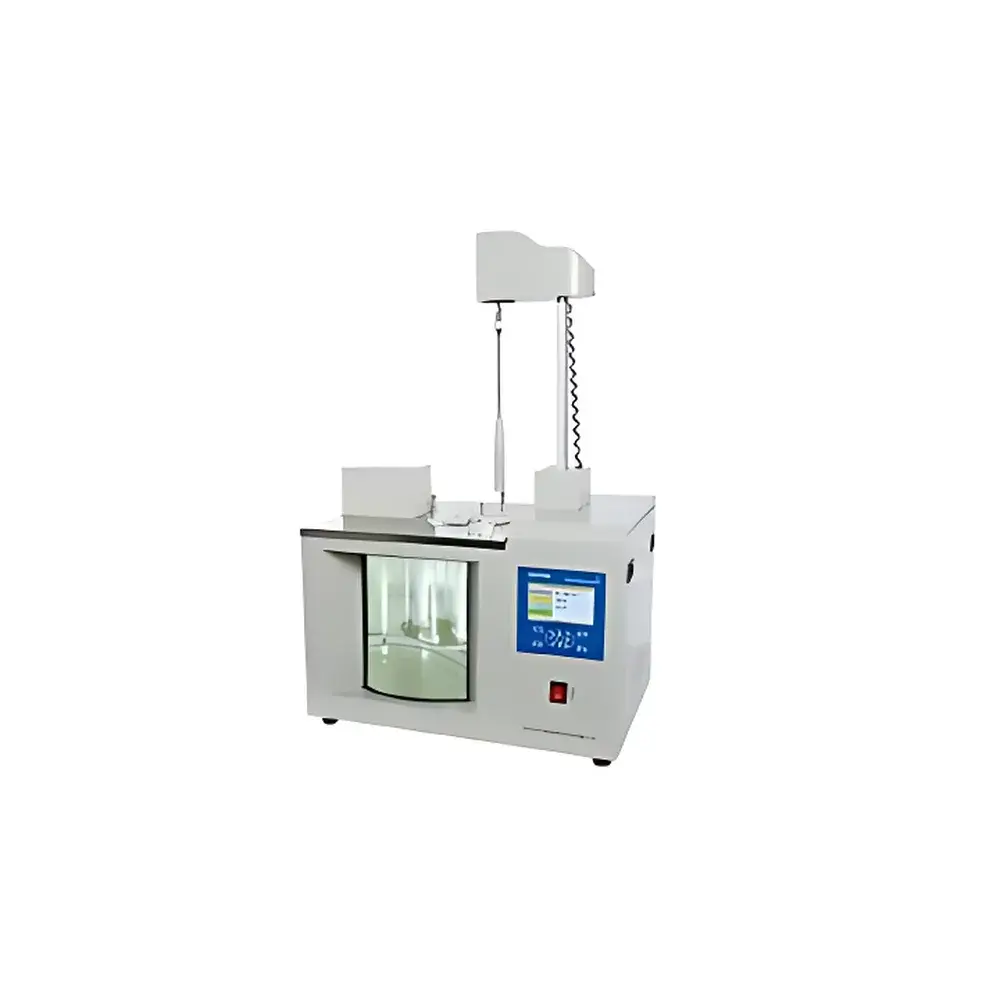
The Timepower TP651 Petroleum and Synthetic Fluid Demulsibility Tester is an automated benchtop instrument engineered to quantify the demulsification behavior of lubricating oils, turbine oils, hydraulic fluids, and synthetic base stocks under standardized thermal and mechanical agitation conditions. It operates in strict accordance with ASTM D1401 and GB/T 7305—two internationally recognized test methods that define the time required for oil–water emulsions to separate into distinct layers following controlled stirring and subsequent quiescent settling. The instrument employs a precision water bath system maintained at either 54 °C ±1 °C (standard condition) or 82 °C ±1 °C (for highly viscous samples), ensuring thermally stable test environments. A microprocessor-controlled electromechanical actuator precisely positions the stainless-steel stirrer 6 mm above the bottom of the calibrated 100 mL glass cylinder, initiating a 5-minute stirring cycle at fixed rotational speed. Upon cessation, the stirrer retracts automatically, and the integrated digital timer begins measuring separation time—defined as the elapsed duration until three clearly defined phases (oil, emulsion, water) are visually discernible and stable. This measurement directly correlates to the fluid’s resistance to emulsion formation and its capacity to release entrained water—a critical performance parameter for turbine oils in power generation and circulating systems in petrochemical processing.
Key Features
- Fully automated test sequence: temperature stabilization → stirrer descent → 5-minute agitation → stirrer retraction → separation timing initiation
- High-precision electric linear actuator ensures repeatable stirrer positioning (±0.5 mm tolerance) and smooth vertical motion without mechanical backlash
- Microcontroller-based architecture with real-time PID temperature regulation and digital feedback control for bath stability within ±1 °C
- 480 × 272-pixel color LCD interface with intuitive Chinese-language menu navigation and context-sensitive prompts
- Integrated safety logic: automatic power cutoff during cylinder insertion/removal; over-temperature and dry-run protection circuits
- Modular design facilitates routine maintenance—stirrer assembly, cylinder holder, and bath cover are tool-free removable
Sample Compatibility & Compliance
The TP651 is validated for use with mineral-based turbine oils, rust-inhibited oils, fire-resistant phosphate ester and polyol ester synthetics, and hydroprocessed base stocks. It accommodates samples meeting ISO 3104 viscosity limits (up to ~300 cSt at 40 °C) when tested at elevated temperature (82 °C). All operational parameters—including bath temperature setpoints, stirrer immersion depth, agitation duration, and visual phase discrimination criteria—are aligned with ASTM D1401-22 and GB/T 7305-2003. The instrument supports GLP-compliant documentation workflows when paired with external lab information management systems (LIMS); audit trails for temperature logs, start/stop timestamps, and operator ID entry can be exported via RS232 or USB interfaces. While not inherently 21 CFR Part 11 compliant, its deterministic control firmware and non-volatile event logging enable validation per internal QA protocols in regulated environments.
Software & Data Management
The embedded firmware provides full test lifecycle control without requiring external PC software. All critical parameters—including bath temperature profile, stirrer position timeline, and separation time—are stored in non-volatile memory with timestamping. Up to 100 test records can be retained onboard and reviewed directly on the LCD screen. Data export is supported via standard serial communication (RS232) using ASCII-delimited format compatible with Excel, LabArchives, or custom LIMS ingestion modules. Optional firmware updates—distributed via encrypted USB key—include enhanced calibration traceability features and expanded language support. No cloud connectivity or remote access capabilities are implemented, preserving data sovereignty and network security in air-gapped laboratory settings.
Applications
- Quality assurance of new turbine oils prior to commissioning in steam and gas turbine systems (IEC 60296 compliance support)
- Condition monitoring of in-service lubricants in power plants to detect hydrolytic degradation or surfactant contamination
- R&D evaluation of demulsifier additive packages in formulation laboratories
- Third-party certification testing for ISO 8573-2 compressed air system lubricants
- Contract testing services in independent petroleum analysis labs accredited to ISO/IEC 17025
- Academic research on interfacial tension dynamics and coalescence kinetics in oil–water dispersions
FAQ
What standards does the TP651 comply with?
It fully implements ASTM D1401 and GB/T 7305 test procedures, including specified temperatures, stirrer geometry, cylinder dimensions, and phase separation criteria.
Can the instrument test oils with viscosity above 100 cSt?
Yes—by selecting the 82 °C ±1 °C test mode, high-viscosity oils (e.g., certain hydraulic or gear oils) achieve sufficient fluidity for reliable phase separation assessment.
Is the 100 mL cylinder included with the system?
Yes, one ASTM-certified borosilicate glass cylinder (100 mL, Class A) is supplied as standard equipment; additional cylinders are available as consumable spares.
How is temperature calibration verified?
The unit includes a dedicated calibration port for inserting a traceable NIST-certified reference thermometer; procedure details are documented in the user manual’s metrology section.
Does the system require periodic recalibration of the stirrer position?
No—the electromechanical actuator uses absolute position encoding; physical verification with gauge blocks is recommended only after impact events or major service interventions.